What Do PF, PT, ESI, LOP and CTC Recovery Mean on Your Payslip? A Line-by-Line Decoder
9 min read | By Tazk Team
Table Of Contents
Social Media


Your offer letter said ₹6 lakh a year. You did the maths: ₹50,000 a month. Then the first salary landed, and it was a lot less. The payslip had a dozen short codes: PF, PT, ESI, LOP, TDS, and one line that just said "CTC recovery". Nobody explained any of it.
You are not alone. Payslips are written for accountants, not for people. This guide reads one with you, line by line, in plain words.
It is useful for three kinds of readers:
- Employees who want to know where their money goes.
- First-time managers who get asked "why is my salary less?"
- Small-business owners who want payslips their staff can actually understand.
Why trust this guide?
This guide is written by the payroll team at Tazk. We build payroll software that generates payslips for Indian businesses every month, so we see which lines confuse people most. Rules here are linked to official sources.
What do PF, PT, ESI, LOP and CTC recovery mean on a payslip?
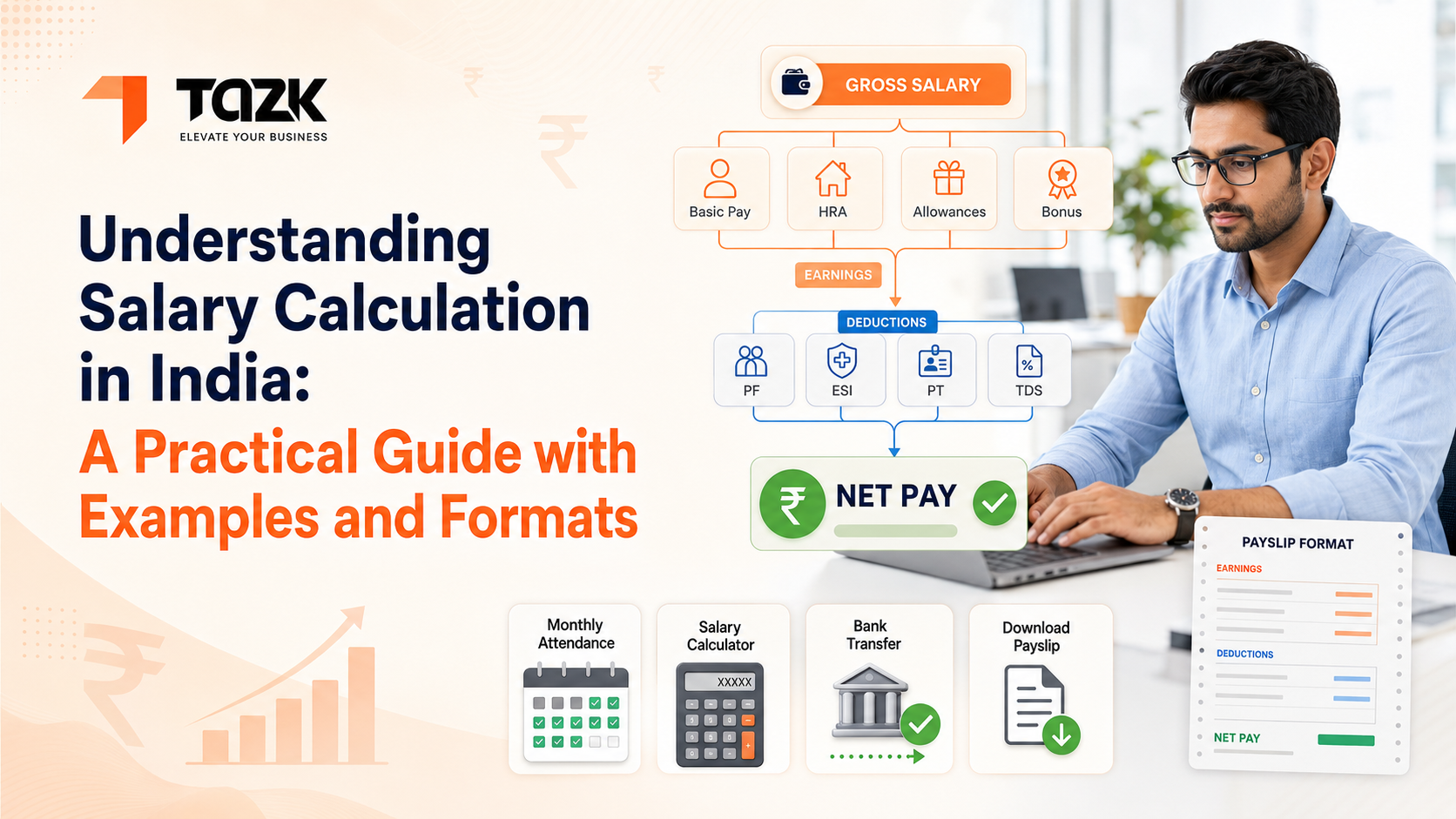
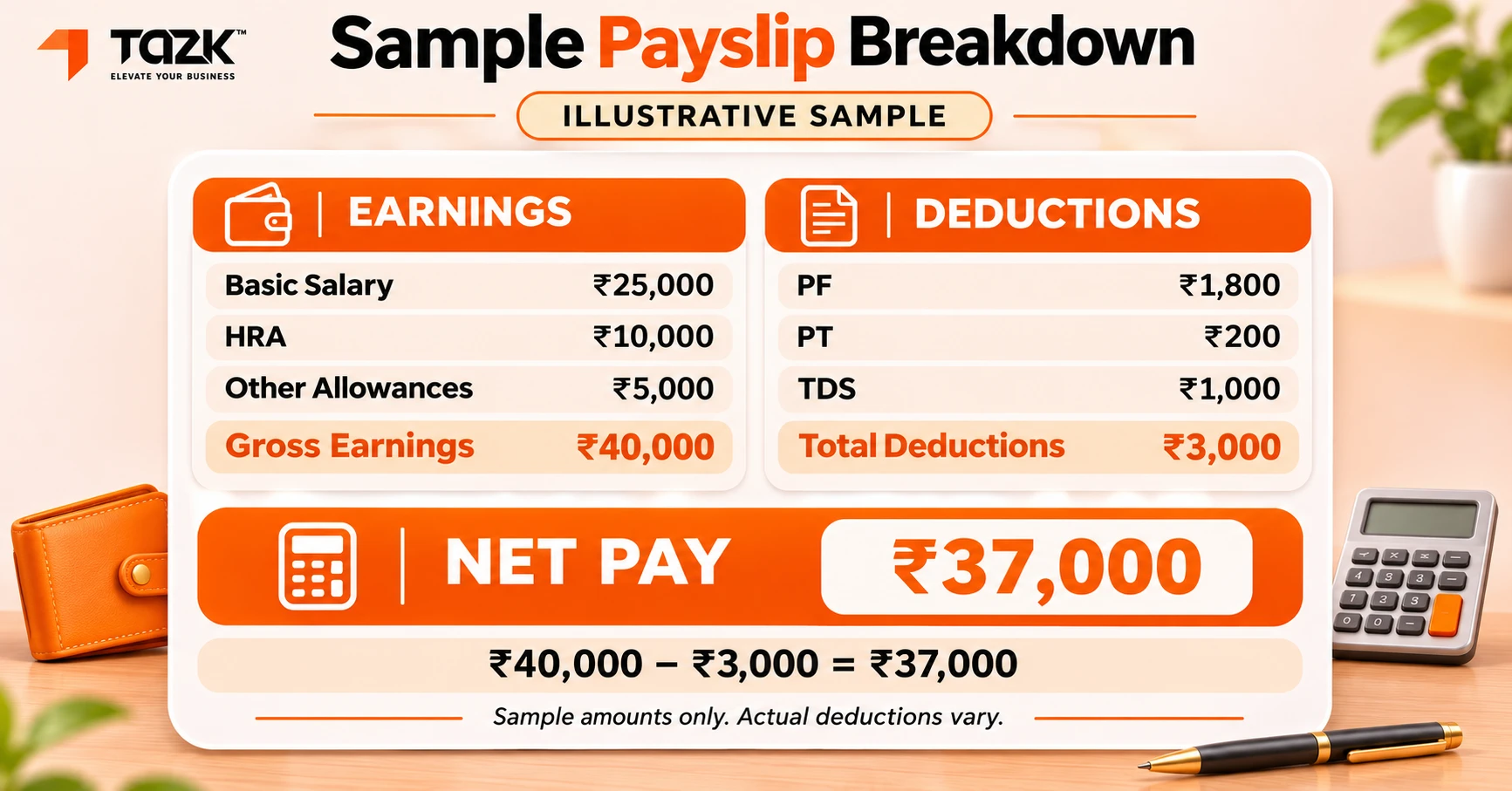
Every payslip has three parts: earnings, deductions and net pay. Here is a simple sample for one month.
| Earnings | Amount (₹) | Deductions | Amount (₹) |
|---|---|---|---|
| Basic salary | 20,000 | Employee PF (12% of basic) | 2,400 |
| HRA | 10,000 | Professional tax (PT) | 200 |
| Special allowance | 8,000 | TDS (income tax) | 1,000 |
| Conveyance allowance | 2,000 | Loss of pay (1 day) | 1,333 |
| Gross salary | 40,000 | Total deductions | 4,933 |
| Net pay (take-home) | 35,067 |
This is an example only. Your amounts, PT and TDS depend on your salary, state and tax choices. ESI does not appear here because this employee's gross pay is above the ESI limit.
Now, what do the short codes mean?
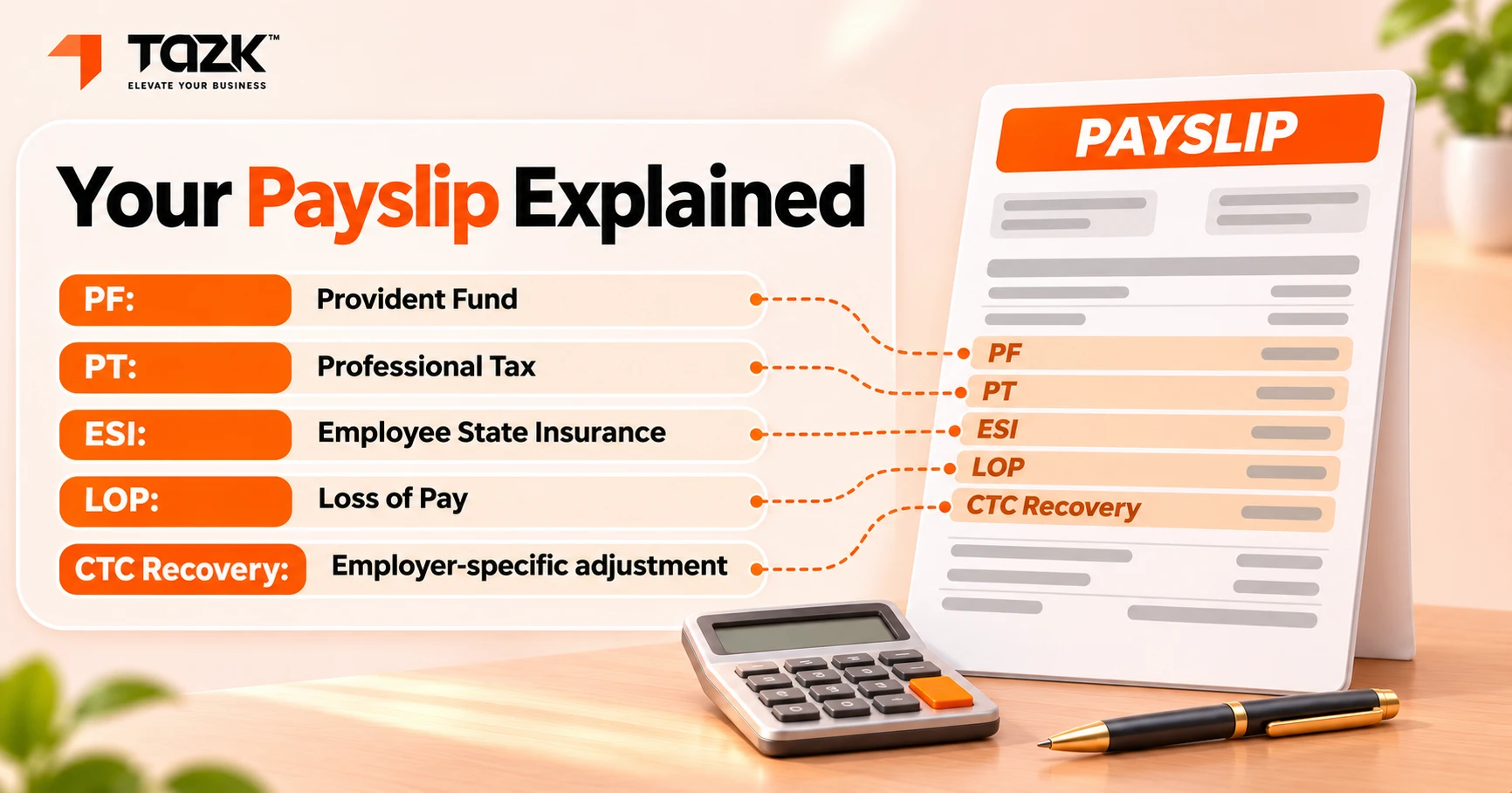
| Code | Full name | What it is, simply |
|---|---|---|
| Basic | Basic salary | The fixed core of your pay. Many other lines are worked out from it. |
| HRA | House rent allowance | Money to help pay rent. Part of it may be tax-free if you pay rent and use the old tax regime. |
| PF | Provident Fund | Retirement savings. 12% of your basic (plus DA) goes from your salary into your PF account, and your employer adds a matching share. Run by EPFO. |
| ESI | Employees' State Insurance | Health insurance for lower-paid employees. Applies only if your gross pay is at or below the ESI limit. Run by ESIC. |
| PT | Professional tax | A small tax charged by some state governments on salaried people. |
| TDS | Tax deducted at source | Income tax your employer cuts every month and pays to the government for you |
| LOP | Loss of pay | Salary cut for days you were absent without paid leave |
| CTC recovery | Cost-to-company recovery | Parts of your CTC that are shown on the payslip but not paid to you in cash, such as the employer's PF share. |
Gross salary is everything you earned before deductions. Net pay is what actually reaches your bank account.
What is Professional Tax and who deducts it?
Professional tax (PT) is a tax that some state governments charge on people who earn a salary or run a profession. Your employer deducts it from your salary and pays it to the state.
Key points:
- It depends on your state. Some states charge PT and some do not. The amount and the salary slabs are different in each state.
- It has a yearly cap. The Constitution limits professional tax to ₹2,500 per person per year.
- It is often a small, fixed amount. In many states it is around ₹200 a month for higher salary slabs, with some states charging a different amount in one month of the year. Check your own state's slab.
- Your employer deducts it. If you work in a PT state, your employer must deduct it and file it on time.
- It reduces your taxable income. PT paid is allowed as a deduction from salary income when working out income tax.
If you see "PT" on your payslip, that is what it means. If you moved states and the amount changed, it is because the new state has a different slab.
For owners: PT filing dates and registration rules also differ by state. Our India payroll compliance guide for PF, ESI, PT and TDS covers the monthly calendar. To see how PT rates are kept current in the software, see Tazk's salary and payroll help page .
What is Form 12BB, and do I have to submit it?
Form 12BB is a declaration you give your employer listing things that can lower your income tax. Your employer uses it to work out how much TDS to cut each month.
It usually covers:
- Rent paid, to claim HRA exemption (with landlord's PAN if rent is above the set limit)
- Leave travel claims (LTA)
- Home loan interest
- Tax-saving investments and payments, such as PF, life insurance, PPF, ELSS or medical insurance
Do you have to submit it? It is not a punishment if you do not. But if you skip it, your employer cannot count your tax-saving items, so more TDS may be cut. You can still claim eligible items when you file your income tax return.
Old regime vs new regime: Most of these deductions apply only under the old tax regime. If you choose the new regime, you may have little or nothing to declare beyond a few items. Ask your HR team which regime you have chosen for this year
Important update: The new Income-tax Act, 2025, applies from tax year 2026-27, and many form numbers are changing. For example, Form 16 is being replaced by Form 130. The declaration you know as Form 12BB may carry a new number, but its purpose is the same. Check the Income Tax Department website or ask your employer for the current form.
In Tazk, TDS is worked out from your annual income, your declarations and your chosen regime. You can read how on Tazk's salary and payroll help page.
How is basic salary calculated from CTC?
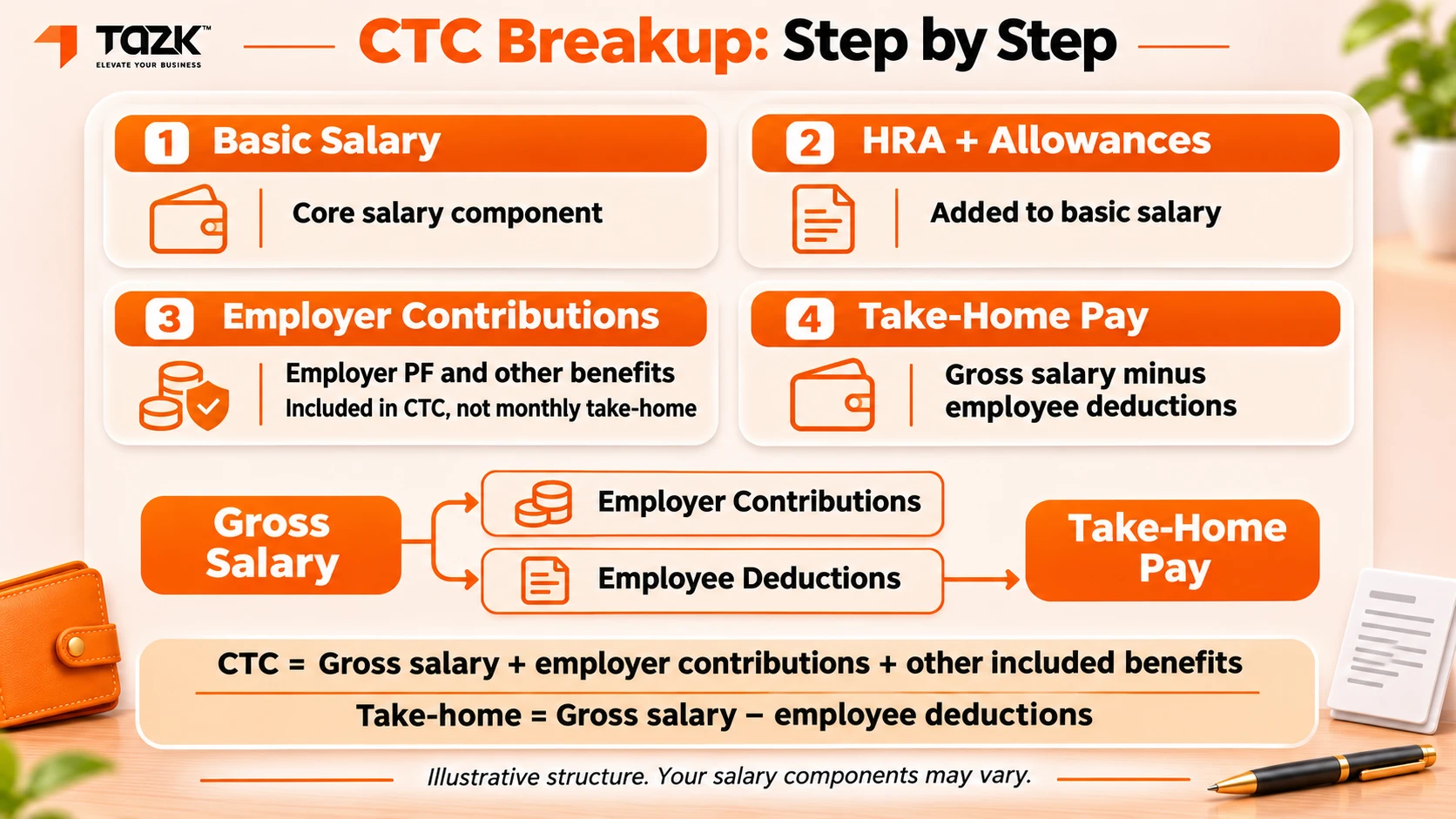
CTC (cost to company) is the total amount your employer spends on you in a year. It includes your gross salary and things you do not get in cash, such as the employer's PF share and sometimes gratuity or insurance.
Basic salary is usually set as a percentage of CTC or gross pay. Many companies keep basic at around 40% to 50% of CTC, but there is no single fixed rule. It depends on the company's salary policy and the law.
Why basic matters:
- Your PF is 12% of basic (plus DA).
- Gratuity is worked out on basic (plus DA).
- HRA is often a percentage of basic.
Labour code note: Under the new labour codes, if allowances make up more than half of your total pay, part of them is counted as "wages" for things like PF and gratuity. So companies are reviewing very low basic salaries.
Simple example:
- CTC: ₹6,00,000 a year
- Basic at 40% of CTC: ₹2,40,000 a year, or ₹20,000 a month
We keep the full CTC-to-in-hand calculation in one place. For the step-by-step method, read our step-by-step salary calculation guide.
Why is my take-home lower than the gross salary?
Because deductions come out of gross pay before it reaches you. And your CTC is higher still, because it includes amounts that never become cash in hand.
Think of it as three levels:
- CTC: everything the company spends on you.
- Gross salary: CTC minus employer-only costs (like employer PF and gratuity).
- Net pay: gross salary minus your deductions (employee PF, ESI, PT, TDS, LOP and any loan EMI).
Common reasons your take-home is lower than you expected:
- Employee PF is 12% of basic. On a ₹20,000 basic, that is ₹2,400 a month.
- TDS may be higher if you have not submitted your tax declarations
- LOP days reduce pay if you took leave without balance.
- Loan or advance EMIs are deducted if you took one from your employer.
- Mid-month joining means you are paid only for the days you worked.
Good news: Your PF is still your money. It goes into your PF account and earns interest. It is savings, not a loss.
What is LOP, and how is it calculated?
LOP (loss of pay) is the salary cut for days you were absent without approved paid leave. It is also called "leave without pay".
How it is calculated:
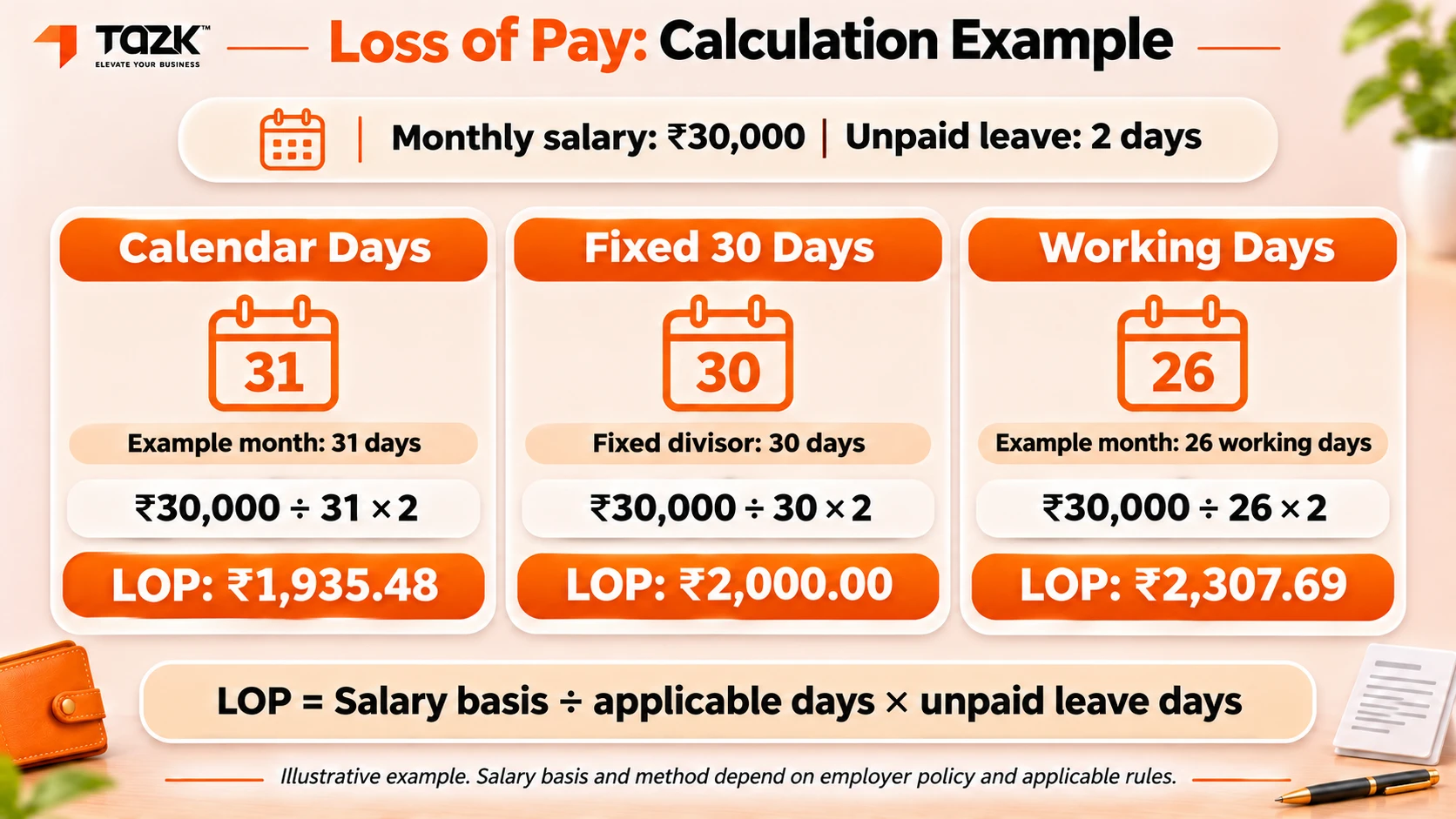
LOP amount = (Monthly salary ÷ number of days used by your company) × LOP days
The "number of days" depends on company policy. Common methods:
| Method | Divide by | Example: ₹40,000 gross, 1 LOP day |
|---|---|---|
| Calendar days | Days in the month (28 to 31) | ₹40,000 ÷ 30 = ₹1,333 (in a 30-day month) |
| Fixed 30 days | Always 30 | ₹40,000 ÷ 30 = ₹1,333 |
| Working days | Working days in the month (for example 26) | ₹40,000 ÷ 26 = ₹1,538 |
Some companies apply LOP only to certain parts of pay, so check your salary policy.
Why LOP surprises people: Usually because an absence was not approved in time, or because a leave balance ran out. If you think LOP is wrong, check your attendance record first, then talk to HR before the next payroll run.
For owners, LOP mistakes usually come from attendance that does not flow cleanly into payroll. Payroll software that generates payslips straight from attendance cuts these errors.
Which payslip lines does the employer pay, and which does the employee pay?
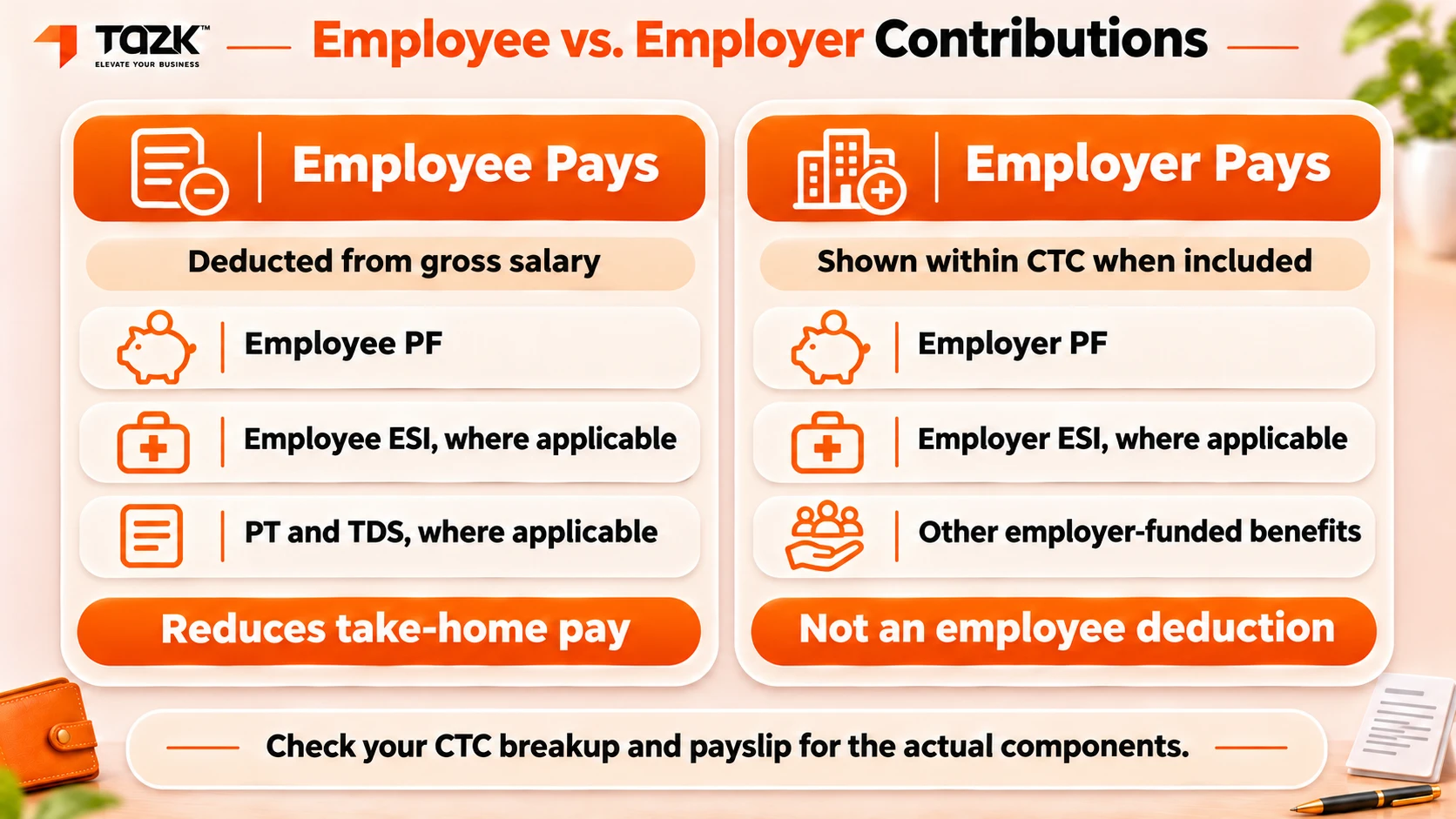
This is where CTC recovery comes in. Some lines on your payslip are paid by you, from your salary. Others are paid by your employer on top of your salary, but they still count in your CTC.
| Item | Who pays | Shown in your take-home? |
|---|---|---|
| Employee PF (12% of basic) | You | Deducted from your pay |
| Employer PF (matching share, part goes to pension) | Employer | No, but it is in your CTC |
| Employee ESI | You | Deducted from your pay, if ESI applies |
| Employer ESI | Employer | No, but it is in your CTC |
| Professional tax | You | Deducted from your pay |
| TDS | You | Deducted from your pay |
| Gratuity provision | Employer | No, paid later when you leave after eligibility |
| Group health insurance | Usually employer | No, but often in your CTC |
So what is "CTC recovery"? Some companies show the employer's share of PF, ESI, insurance or similar costs as a line called "CTC recovery" (or "employer contribution"). It shows that part of your CTC has gone into those benefits instead of your bank account. It does not mean you were fined or charged extra. In some companies, the same label is also used to recover amounts such as notice-pay shortfalls or advances, so check the note on your payslip or ask HR.
For worked numbers on how employer contributions change your in-hand pay, read our post with take-home pay examples after the ₹25,000 PF ceiling.
For owners: Clear labels prevent most payslip questions. With Tazk Payroll , you define salary components once (Basic, HRA, allowances, PF, ESI, PT and TDS), and payslips go to employees on WhatsApp and email
Try a sample payslip in Tazk Payroll (14-day free trial). Start your 14-day free trial