Payroll & Attendance for Multi-Location Restaurant and Retail Chains: What Actually Breaks at Outlet
13 min read | By Lokesh A
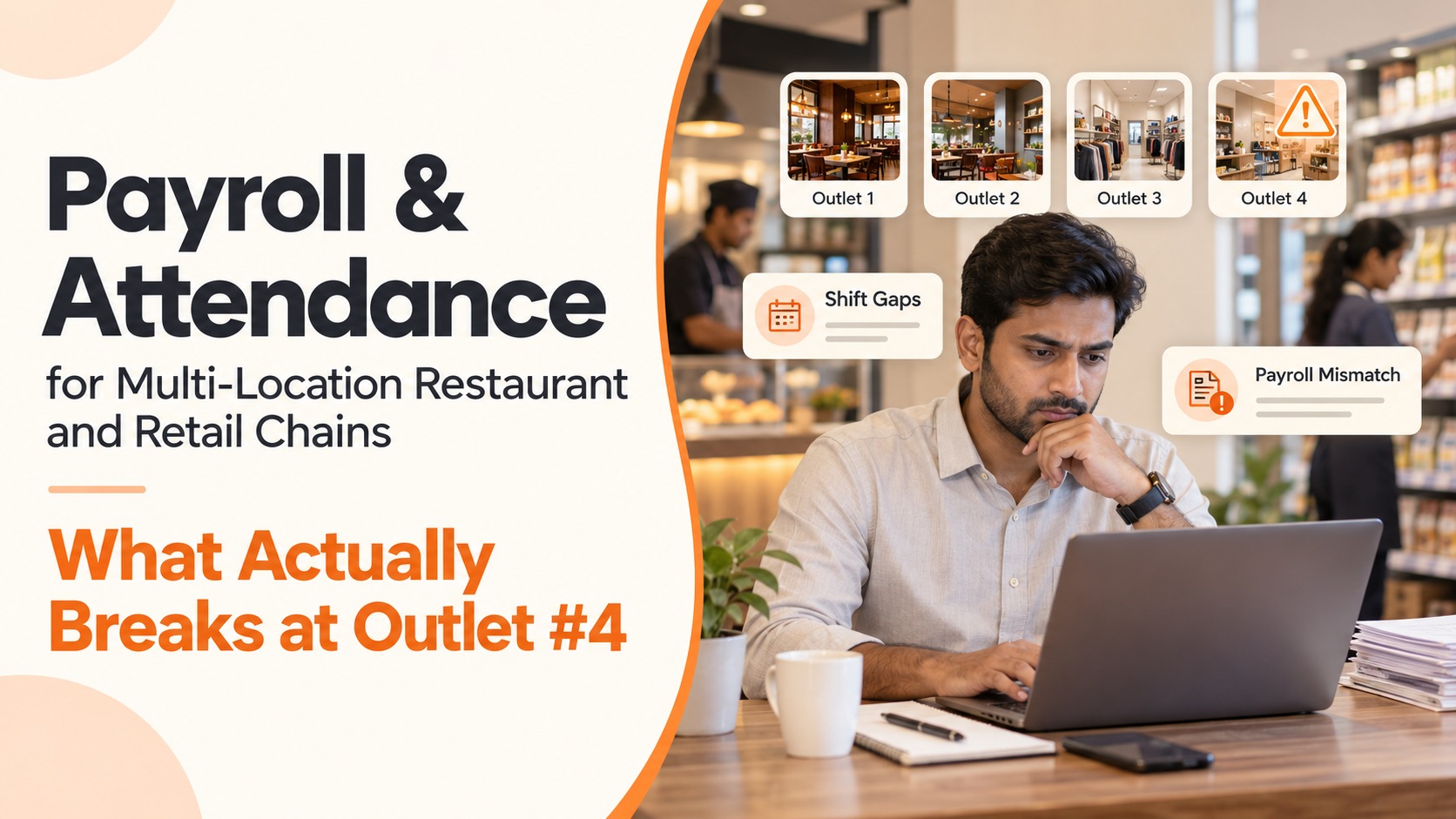
Table Of Contents
Social Media




The outlet that breaks everything
Here's a pattern we see again and again with growing Indian retail and restaurant chains.
Outlet one runs fine. Outlet two, still fine — it's basically a copy of outlet one. Outlet three, mostly fine, with a few small manual fixes each month.
Then outlet four opens. And suddenly, the payroll spreadsheet that worked for three locations starts producing wrong numbers. Nobody changed anything on purpose. What changed is simpler, and much bigger, than that: outlet four is in a different state.
Different state means different tax rules, different filing dates, and sometimes completely different forms. This article explains exactly what breaks when a restaurant or retail chain crosses a state line. It also covers the payroll structure that keeps working, no matter how many outlets you add.
Why One Login Doesn't Automatically Mean One Set of Rules
A lot of business owners assume that once they're using one payroll system across all locations, compliance is basically solved. The software handles it, right?
Not quite. The software can only apply rules it knows about. And in India, some of the most important payroll rules aren't national — they're set state by state. If your system, or your payroll team, is still treating every outlet the same way, that's a problem. You can end up compliant in the city where you started, and quietly wrong everywhere else.
The clearest example of this is professional tax. Let's look at exactly how different it really gets.
The Professional Tax Maze
Professional tax (PT) is a small tax that state governments charge on salaries. It's capped at ₹2,500 per person per year by the Constitution, so on its own, it sounds simple. In practice, it's one of the most fragmented rules in Indian payroll.
Here's what changes state to state, using real 2026 figures:
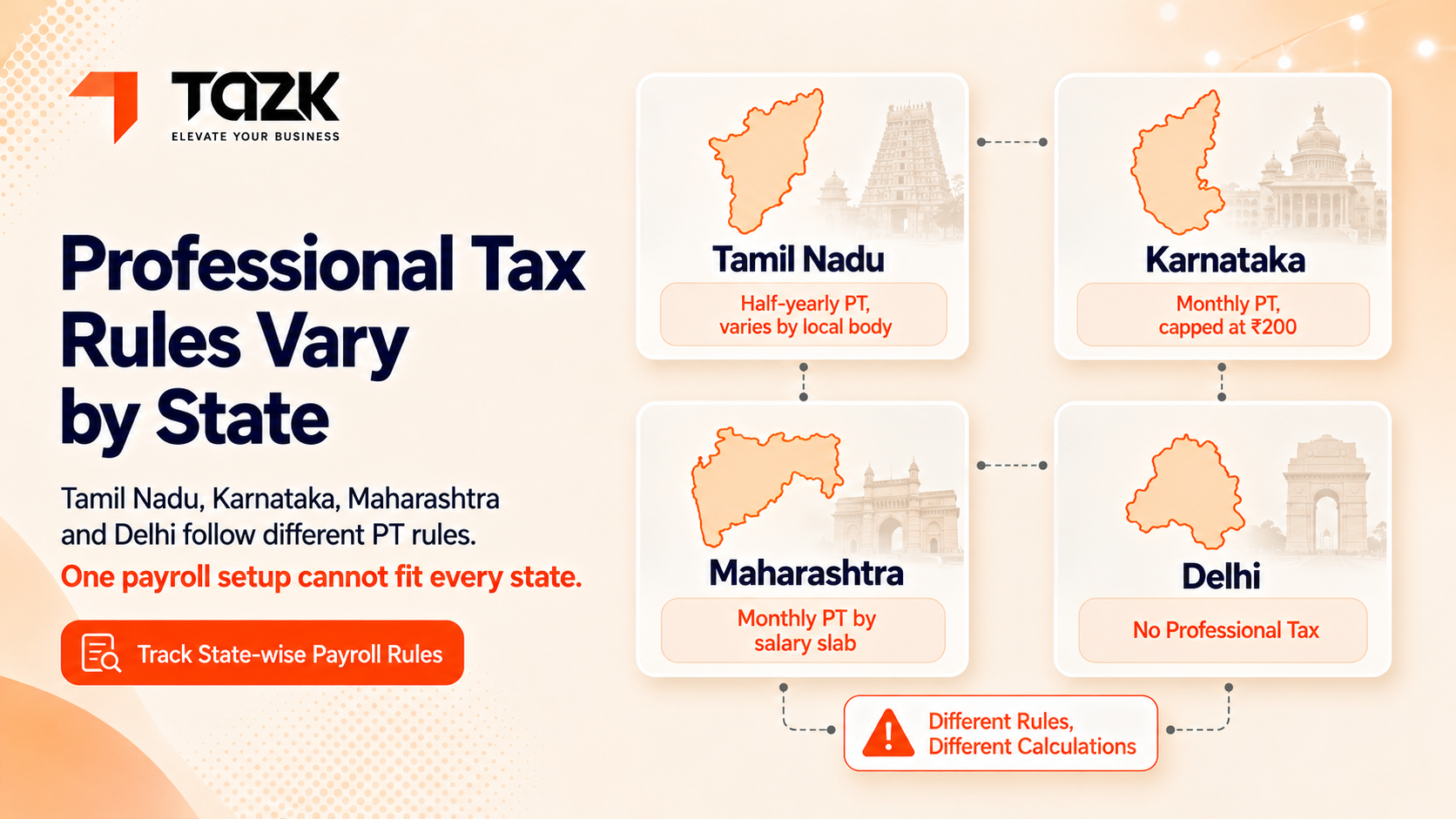
- Tamil Nadu charges professional tax half-yearly, not monthly. Someone earning above ₹75,000 a month pays up to ₹1,250 every six months (source: MyDigitalFiling, Professional Tax in India 2026).
- Karnataka charges a flat ₹200 a month for anyone earning above ₹25,000 —collected monthly, not half-yearly (source: HROne, Professional Tax Slab Rates 2026 - 27).
- Maharashtra has slabs that depend on gender. Men are taxed from ₹7,500 a month. Women are exempt until ₹25,000. It's also collected monthly, with a slightly higher amount in February (source: eZHRM, Professional Tax India 2026).
- Delhi, Haryana, Uttar Pradesh, and Rajasthan don't charge professional tax at all.
Now picture a restaurant chain with outlets in Chennai, Bengaluru, Mumbai, and Delhi. That's four outlets. And four completely different professional tax situations. One is half yearly. One is a flat monthly rate. One is gender-based with a February twist. One has no professional tax at all. If your payroll process was built around "how we did it at outlet one," at least three of these four outlets are being handled incorrectly.
What Else Changes State to State
Professional tax is the clearest example, but it's not the only one.
- Minimum wages are set separately by each state, and often by job category and city classification within that state.
- Shop and Establishment Act rules — covering working hours, weekly offs, and overtime — vary by state, and sometimes by municipality.
- Filing due dates differ too. Some states want professional tax paid by the 10th of the month. Others allow until the last working day (source: IncorpX, Professional Tax Registration State Wise 2026).
- Labour Code rules are rolling out at different speeds in different states. That means two branches of the same company can technically operate under different rulebooks during this transition period.
None of this is a reason to avoid expanding. It's simply the real complexity that a payroll process needs to be built for, from the start, rather than discovered by accident at outlet four.
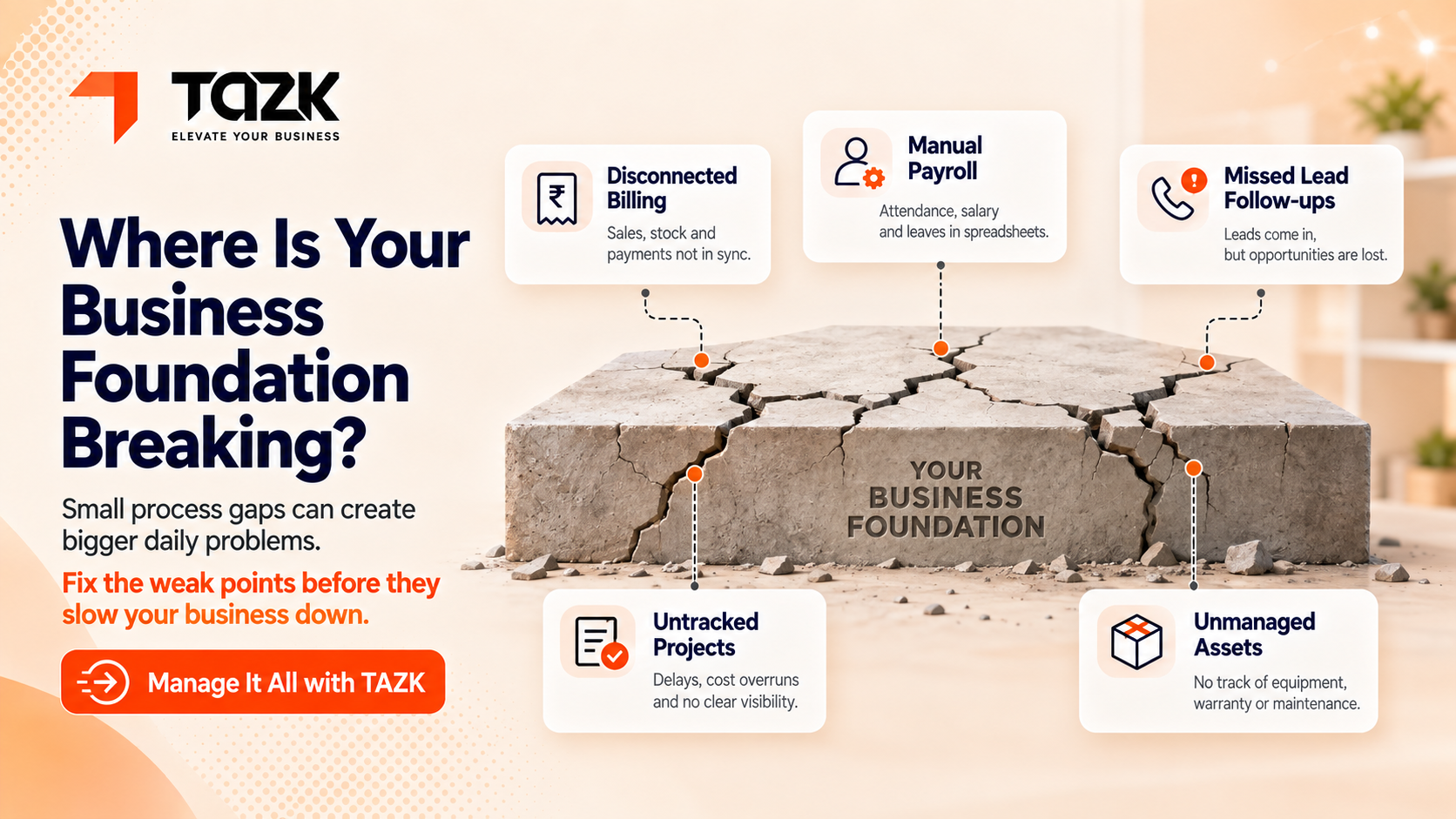
The Five Things That Break First at Outlet #4
Based on patterns we see across growing Indian chains, these are the first cracks to show up.
1. Head office loses real-time visibility. With one or two outlets, an owner can informally "just know" what's happening. By outlet four, that stops being possible. Problems get discovered weeks late, if at all.
2. Shift patterns stop being consistent. A restaurant open until midnight in one city might close at 10 PM in another, due to local rules or simply local customer habits. If shift templates aren't set up per location, attendance and overtime numbers drift out of accuracy.
3. Leave policies quietly diverge. Without a clear, centralised leave policy, different store managers start approving leave differently. This creates unfairness between staff. It also makes labour cost forecasting unreliable.
4. The compliance calendar becomes impossible to track by memory. Once you're juggling different PT filing dates, different PF and ESI nuances, and different state minimum wage revisions, something becomes clear. "Remembering" every deadline across every state stops being realistic for any one person.
5. Reporting becomes manual, and manual work introduces errors. Someone, somewhere, starts building a master spreadsheet by copying numbers from each outlet by hand. Every manual copy is a chance for a mistake. The bigger the chain gets, the more those small mistakes cost.
How Centralised Payroll Should Actually Work
Here's a practical structure that holds up as you add outlets.
Step 1: Build state-specific rule sets once, not per outlet. Set up Tamil Nadu's half-yearly PT rules, Karnataka's flat monthly rate, and Maharashtra's gender-based slabs as templates in your system. When you open a new outlet in a state you already operate in, the correct rules apply automatically.
Step 2: Give every outlet its own shift template, linked to one central system. Each location's actual operating hours should drive its shift and overtime calculations. You shouldn't need separate, disconnected software per city to make that happen.
Step 3: Centralise leave and attendance approval visibility, even if day-to-day approval stays local. Store managers can still approve routine leave locally. But head office should see all of it in one place, so patterns and fairness gaps are visible early.
Step 4: Put every state's compliance dates on one shared calendar, not in someone's head. This is less about fancy technology and more about simply refusing to rely on memory for something with real financial penalties attached.
Step 5: Make cross-location reporting automatic, not manually assembled. If a report needs someone to copy-paste from four separate exports, it will eventually be wrong. If it pulls live from one system, it won't be.
This is exactly what Tazk's Payroll & HRMS module is built to do. It's a single system that applies the right state rules automatically, tracks GPS and face-recognition attendance per location, and gives head office one live view across every outlet.
If you're also managing billing across these same locations, it helps to have that on the same platform too. Our POS module and Restaurant management module share the same login and the same attendance data. A location's staffing and its sales numbers are never sitting in two different systems.
Franchise vs Company-Owned — Does It Change Anything?
A common question from growing F&B and retail brands: does this look different for franchise locations versus outlets you own directly?
The compliance rules themselves don't change. Professional tax, minimum wage, and labour codes apply based on where the outlet operates, not who owns it. What does change is who's responsible for getting it right.
In a franchise model, each franchisee is typically their own legal employer, responsible for their own payroll compliance. But brand-level consistency still matters. A franchisee getting compliance wrong becomes a brand reputation problem, even if it isn't a direct legal problem for head office. Many growing brands now offer, or require, a standard payroll system across all franchise locations for exactly this reason. It protects the brand, not just the individual outlet.
There's a practical middle ground many brands land on. Head office doesn't need to process every franchisee's payroll directly. But it can still require that every location — owned or franchised — runs on the same underlying system, with the same state-specific rules built in. That way, a customer complaint about a franchisee's staff, or a labour inspection at any outlet, doesn't turn into a surprise about how differently that location was actually being run.
Multi-State Hiring: A Quiet Cost Most Chains Underestimate
There's one more cost worth naming directly: the time it takes someone to actually learn four states' worth of rules well enough to trust their own judgment.
A single payroll person can reasonably become confident in one state's rules within a few months. Learning four states' worth takes considerably longer. Each one has different thresholds, forms, and filing calendars. Mistakes during that learning period are exactly what tend to surface in an audit eighteen months later. This is a real, if often invisible, cost of manual multi-state payroll. It's not just the errors themselves — it's the months spent building expertise that a properly configured system could have applied correctly from day one.
A Realistic Example
Picture a quick-service restaurant brand that started in Chennai, then expanded to Bengaluru, then Hyderabad, then Mumbai. That's four outlets, four states, within about two years.
For the first year, one person in the Chennai office managed payroll for all locations using a shared spreadsheet. She applied Tamil Nadu's half-yearly PT logic to every outlet by default, since that's what she knew. Karnataka and Telangana outlets were quietly being taxed incorrectly for months before an audit flagged it.
After consolidating onto a single payroll system with state-specific rules built in, the fix wasn't just about avoiding future penalties. It freed up the person who used to spend a full week each month manually adjusting numbers by hand. She now spends that time actually reviewing labour cost trends across locations — a far better use of her role than chasing state tax tables.
What's Changing Next
Labour Code rollout will keep creating short-term inconsistency between states. As different states finalise their own rules on different timelines, multi-state employers need systems flexible enough to update per location, rather than applying one national assumption everywhere.
Digital-first professional tax filing is becoming the norm. More states are pushing toward online PT registration and payment. This reduces paperwork, but it also raises the bar for keeping registration numbers and filing accounts organised across every state you operate in.
Franchise brands are increasingly standardising payroll systems, not just menus and branding. As compliance complexity grows, more franchisors are treating "which payroll system our franchisees use" as a brand-protection decision, not just an operational preference.
The complexity that breaks multi-location payroll isn't really about having more staff or more sales. It's about crossing state lines, where the rules genuinely change underneath you. Build your payroll process to expect that from outlet one, and outlet four becomes routine instead of a crisis.
Talk to Tazk about multi-branch payroll — free migration from your current system. Book a demo or start a free trial today.
Related reading on the Tazk blog
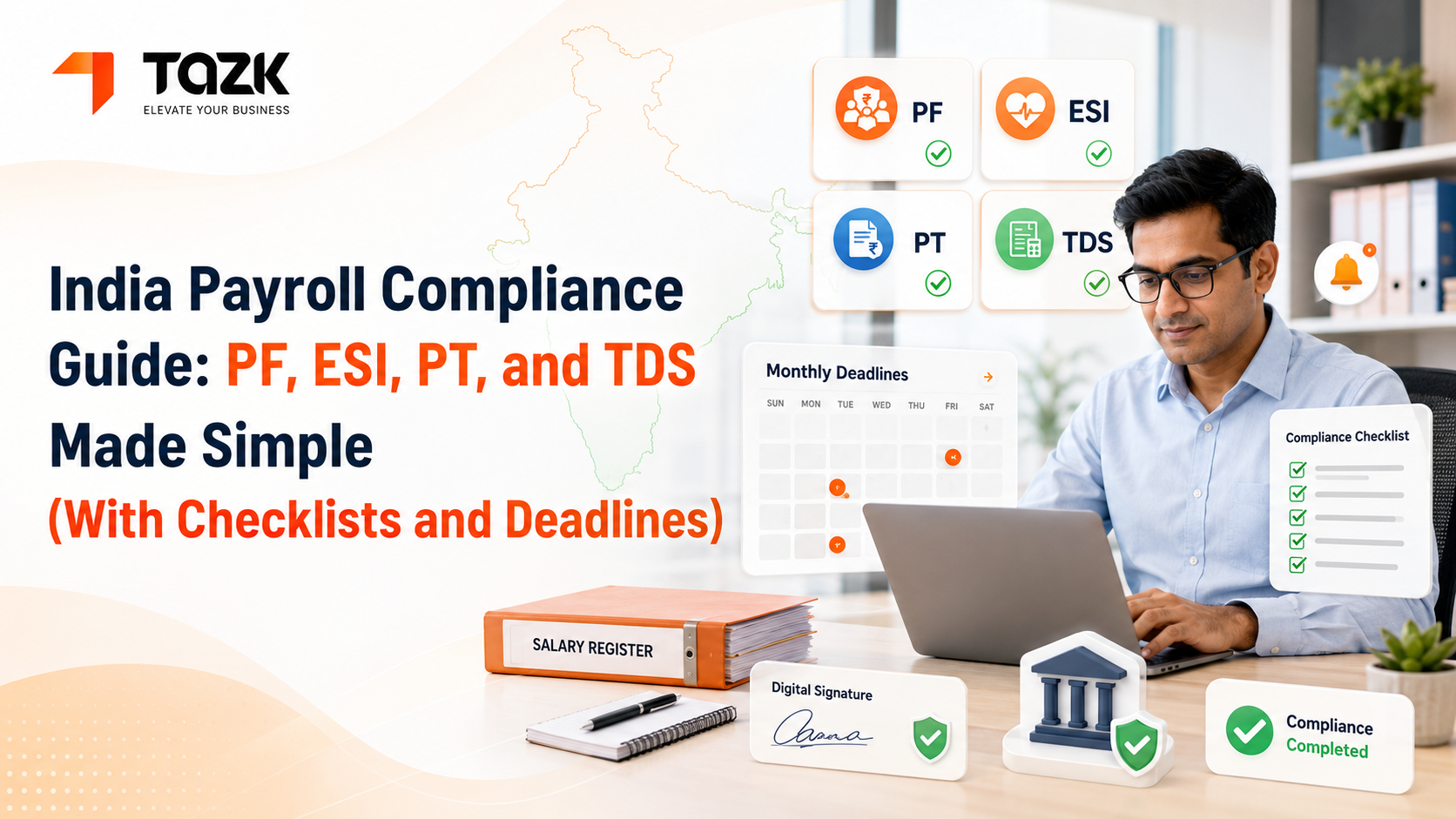
- India Payroll Compliance 2026: PF, ESI, PT, TDS Guide with Due Dates
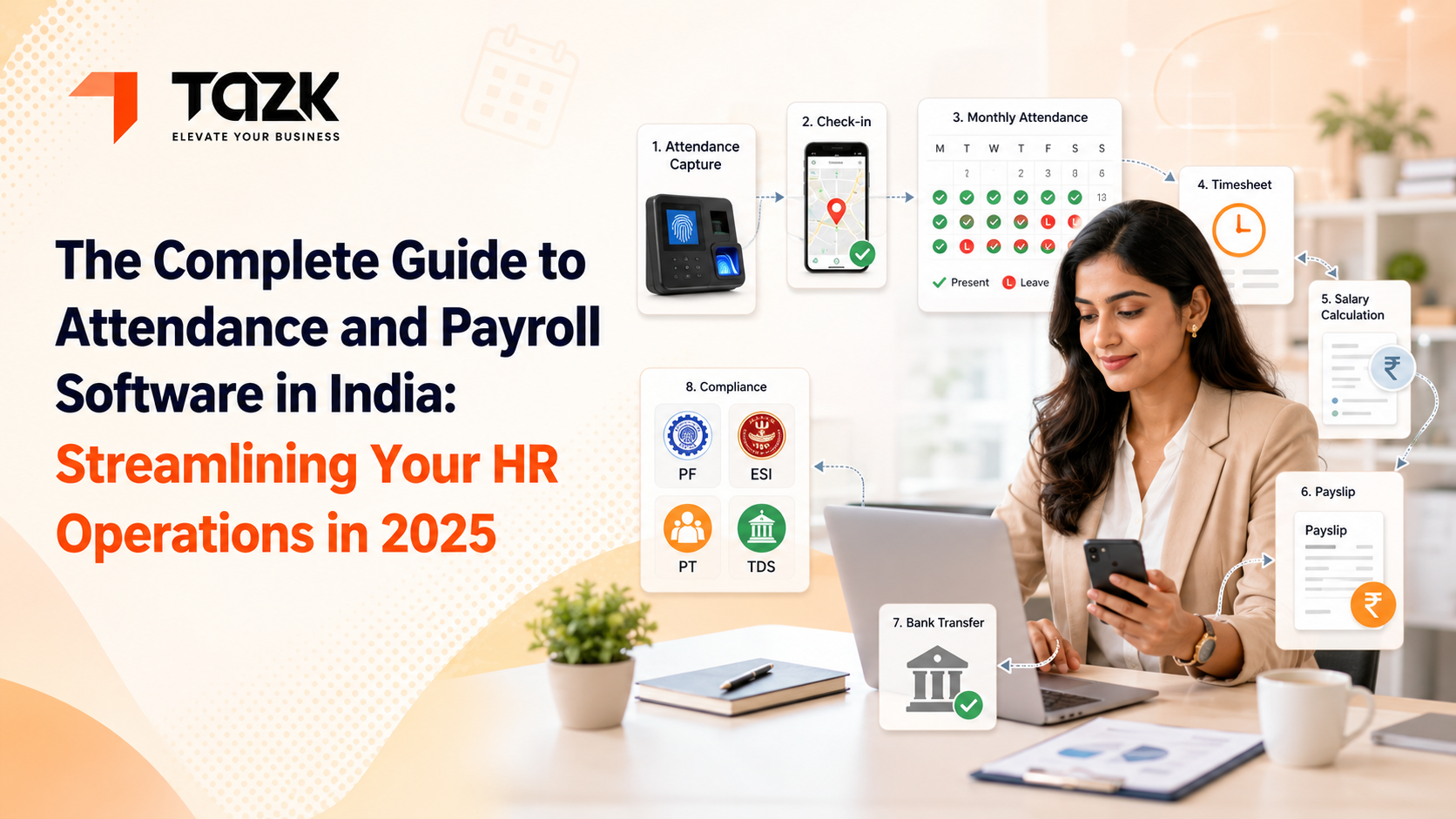
- The Complete Guide to Attendance and Payroll Software in India
- Tazk vs Petpooja: Best Billing & Back-Office Software for Restaurants
- Salary Calculation Guide: CTC, Gross, Net Pay & Payslip Formats