PF Wage Ceiling Raised to ₹25,000: What Changes in Your September ECR, Your Payslips and Your Payroll Cost
6 min read | By Lokesh A
Table Of Contents
Social Media



Think of PF as a piggy bank. Every month, you and your employer both drop money in. But the piggy bank does not count your whole salary. It counts only the part of your wage up to a line. That line is called the wage ceiling
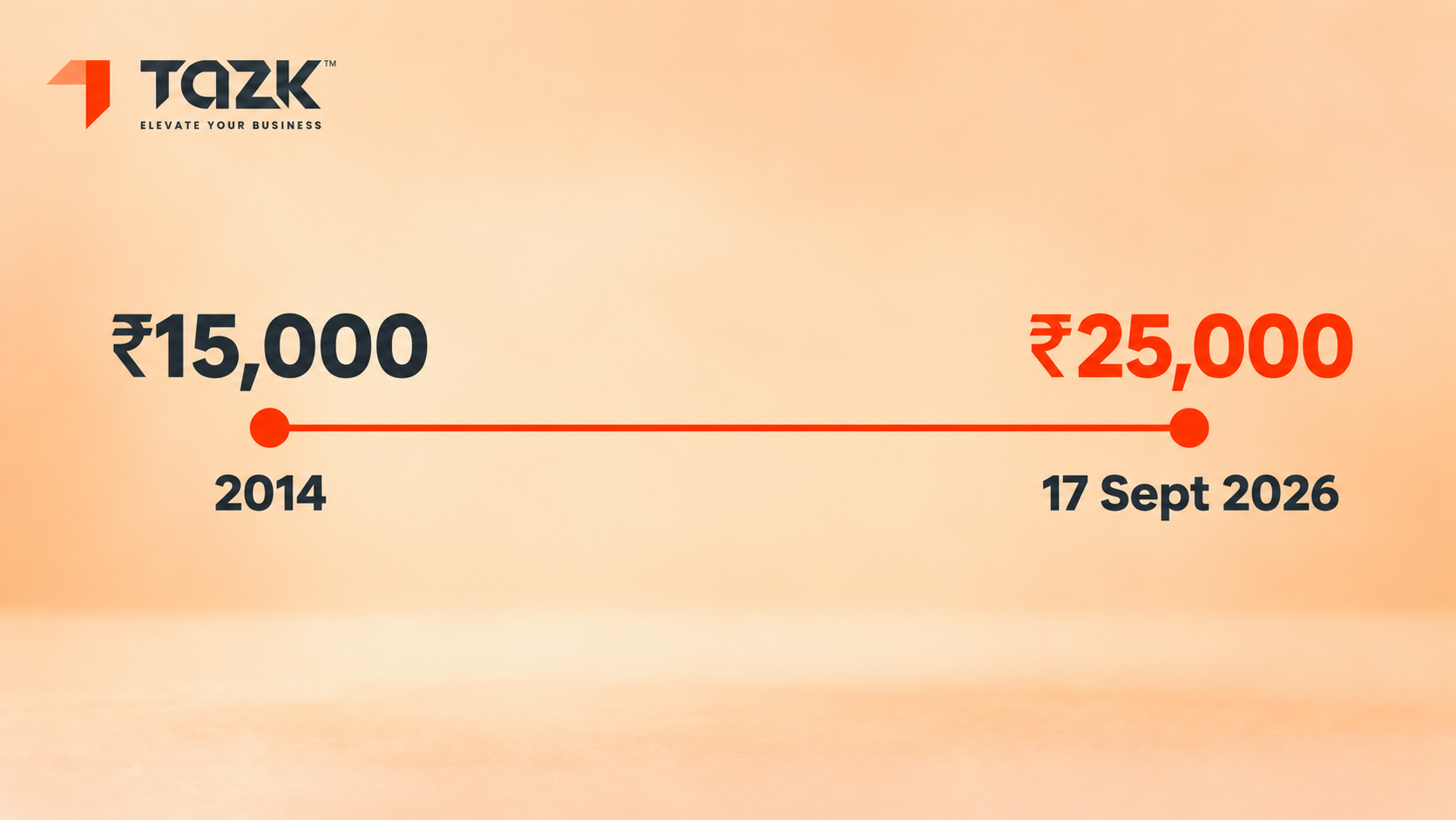
For twelve years the line sat at ₹15,000. On 17 September 2026 the Labour Ministry moved it to ₹25,000. A higher line means a bigger monthly deposit, from you and from your employer. It also means more people must now join PF.
If you run payroll, the date to watch is 15 October 2026. That is when the September return (the ECR) is ordinarily due, and September has two different ceilings inside it. This guide explains the EPF wage ceiling increase in plain words, shows the sums step by step, and ends with a checklist you can finish today.
The short version
- The new PF wage ceiling is ₹25,000 a month. It was ₹15,000. It started on 17 September 2026.
- The ceiling applies to PF wages (basic pay + DA + retaining allowance), not to your whole gross salary.
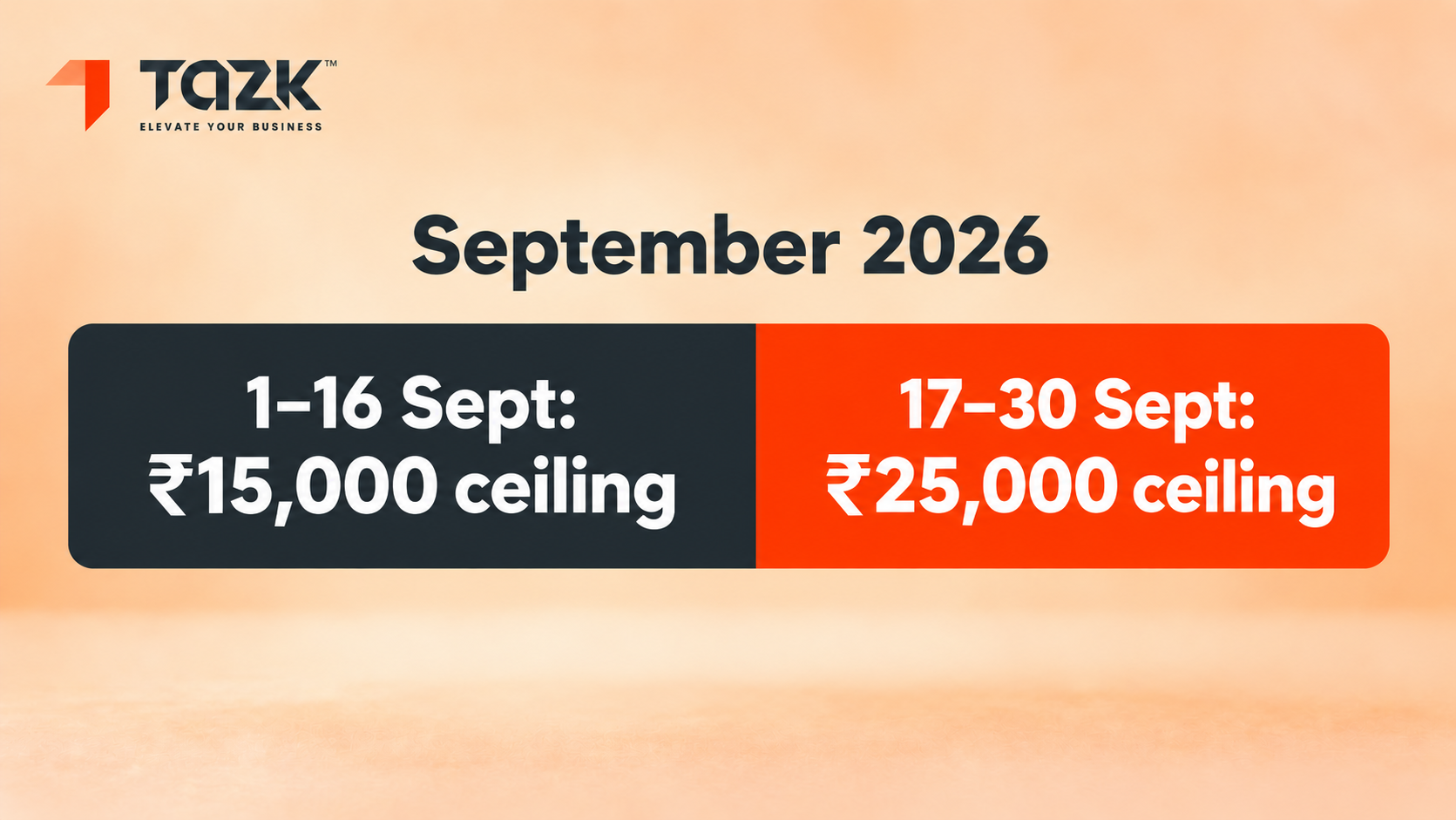
- September has two parts: 1–16 September at ₹15,000 and 17–30 September at ₹25,000. File one ECR for the month.
- Anyone with PF wages of ₹25,000 or less must be in EPF, EPS and EDLI. That includes people who were left out before.
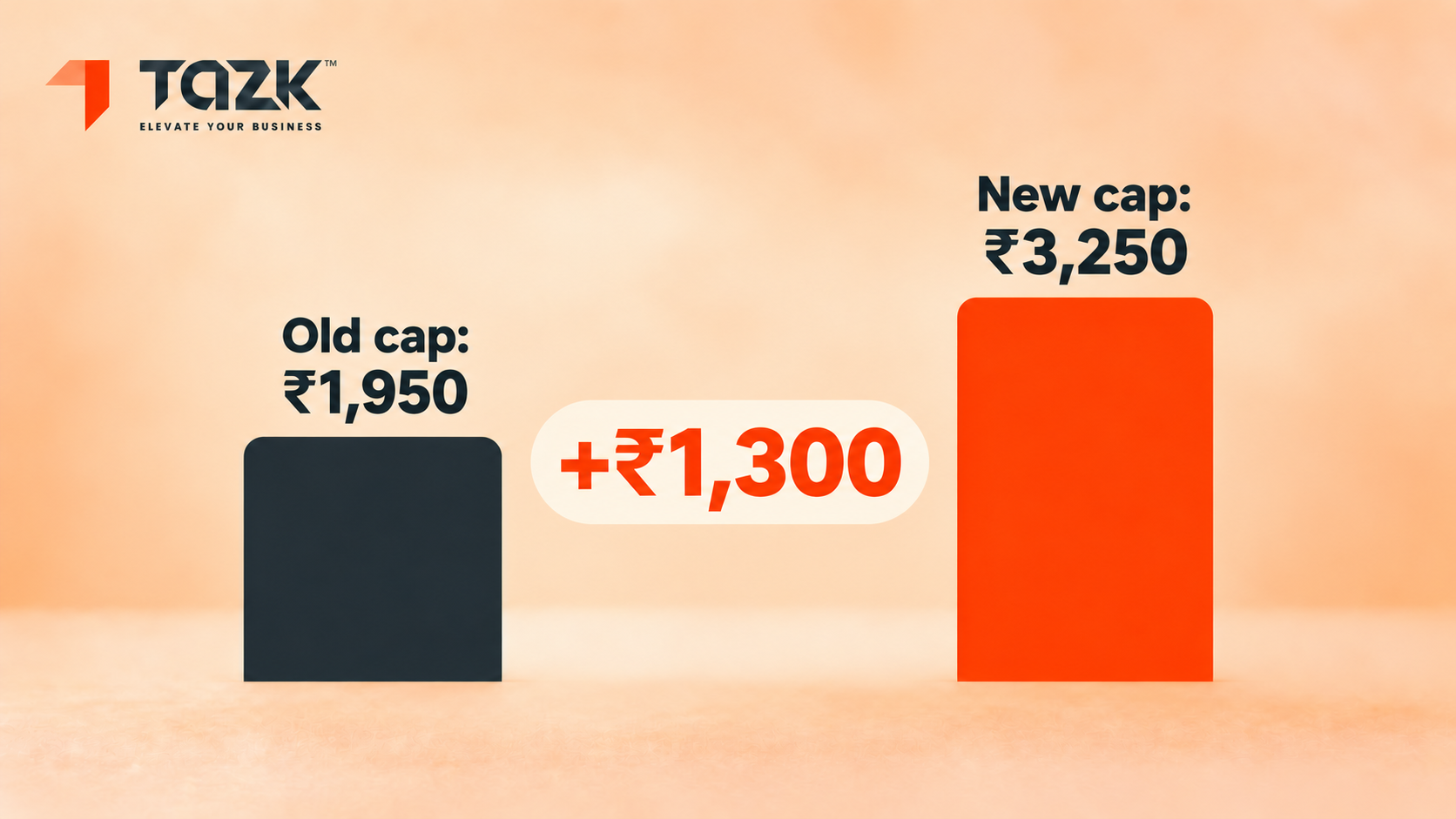
- Each employee who was capped at ₹15,000 now costs the employer up to ₹1,300 more per month.
- The ESI ceiling did not change. It is still ₹21,000.
Who is this for? Three readers: the payroll manager who files the return, the owner who pays the bill, and the employee who wonders why the payslip changed. Under each heading you will find a line called In simple words. Read only those lines and you will still understand the change.
Whatis the new EPF wage ceiling and when did ittake effect?
The EPF wage ceiling is now ₹25,000 per month, up from ₹15,000. It took effect on 17 September 2026, the day the Labour Ministry published notification S.O. 5109(E) under the Code on Social Security, 2020. It is the first change since September 2014, so many payroll sheets and offer letters still show the old number.
In simple words: The ceiling is a line drawn on your wage. The line moved up by ₹10,000.
Here is what happened, in order:
| Date | What happened | Source |
|---|---|---|
| September 2014 | Ceiling raised from ₹6,500 to ₹15,000 | KPMG |
| 16 Sept 2026 | Union Cabinet approves ₹25,000 | Labour Ministry release (PIB) |
| 17 Sept 2026 | S.O. 5109(E) published; effective the same day | BDO |
| By 24 Sept 2026 | EPFO's FAQs explain the September method | EPFO FAQ (PDF) |
| 15 Oct 2026 | September ECR ordinarily due | EPFO FAQ |
Why now? The ceiling had not moved since 2014, while wages had. EPFO's FAQ says that in at least eight major states and union territories, the minimum wage for unskilled workers already tops ₹15,000, so even minimum-wage earners sat outside PF cover. It estimates the change brings more than 51 lakh extra employees under mandatory PF coverage.
One rumour to ignore: some people said the start date might slip to 1 October. EPFO's FAQ says no. The date stays 17 September 2026.
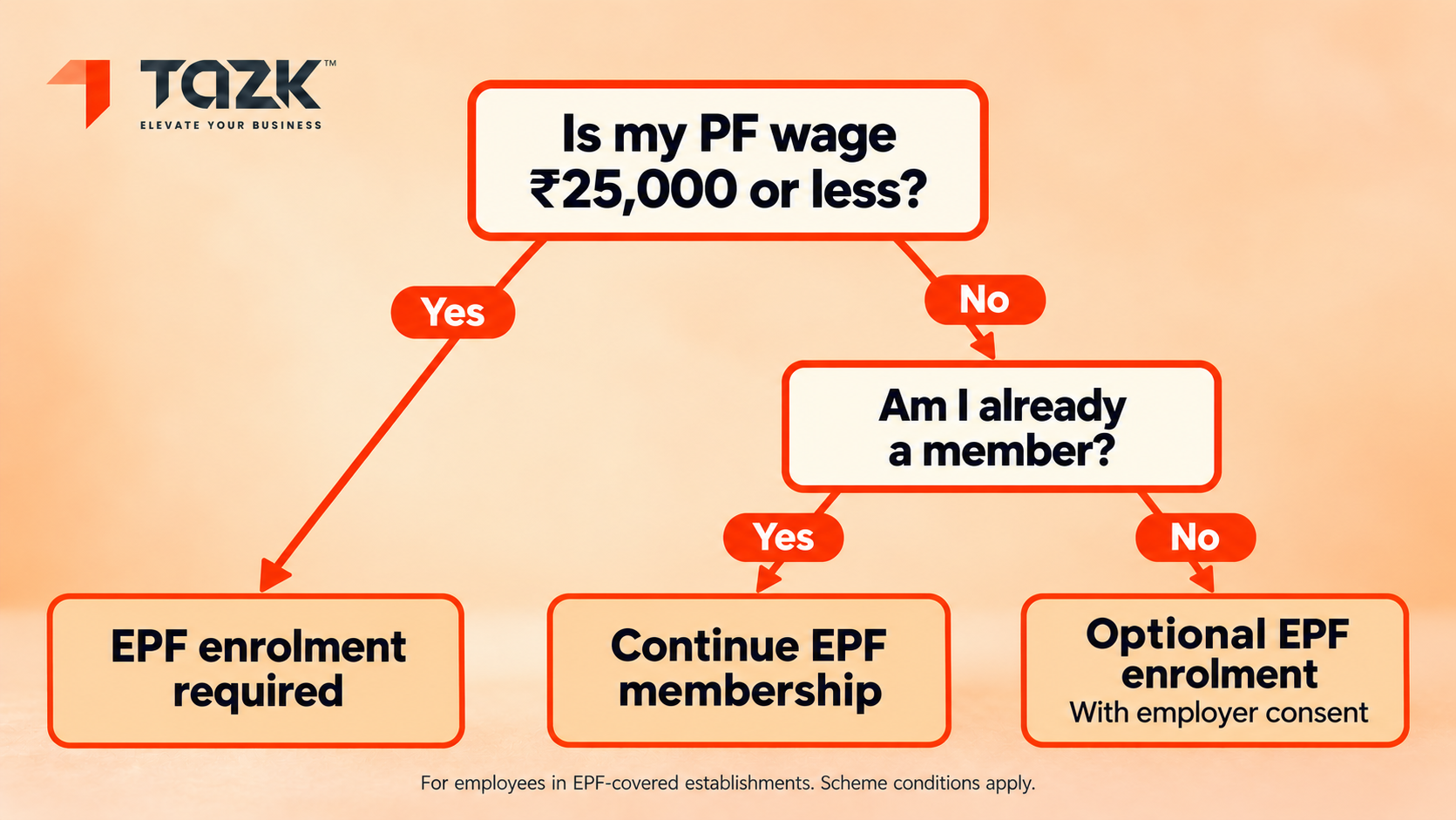
Does the ₹25,000 limit apply to existing employees or only new joiners?
It applies to both. From 17 September 2026, every employee whose PF wages are ₹25,000 or less must be a member of EPF, EPS and EDLI. That includes people who were left out earlier because they earned between ₹15,001 and ₹25,000. Members who were capped at ₹15,000 now have PF counted on up to ₹25,000.
In simple words: Old staff and new staff are both affected. Nobody has to apply. The employer does the sign-up.
PF wages are not the total on your salary slip. They mean basic pay plus dearness allowance (DA) plus retaining allowance. EPFO's FAQ gives two examples. If your gross salary is ₹60,000 but your PF wages are ₹30,000, you are not required to join (you may join if your employer agrees). If your gross is ₹50,000 and your PF wages are ₹25,000, you must join.
| Which group are you in? | What changes from 17 Sept 2026 |
|---|---|
| Not in PF, PF wages ₹15,001–₹25,000 | Must join EPF, EPS and EDLI. The employer enrols you. |
| In PF but capped at ₹15,000, with higher PF wages | PF now counts wages up to ₹25,000. |
| In EPF but not in EPS, PF wages ₹15,000– ₹25,000 | Must also join EPS. |
| In PF, PF wages ₹15,000 or less | No change |
| PF wages above ₹25,000, never in PF | Still not compulsory. You may join if your employer agrees. |
| Already contributing on wages above ₹25,000 | Your arrangement continues. No need to cut it down. |
Two words to learn. An excluded employee joined a company earning more than the old ceiling and had never been a PF member before. And EPS, the pension part, has one more rule: EPFO's FAQ says EPS is open only to people whose wages, when they joined or when the new ceiling began, were within the ceiling
Contract staff count too. EPFO's FAQ tells employers to check contractor compliance wherever contract workers are used.
What should an employee do? Check your payslip, ask HR for your UAN (the 12-digit PF number), and keep your September payslip safe. You do not fill any form for this change. This is mandatory PF coverage, and it is the employer's job.
How do I calculate PF for September 2026 when the ceiling changed on the 17th?
Split September into two parts. For 1–16 September, use the old ₹15,000 ceiling. For 17–30 September, use the new ₹25,000 ceiling. Add the two parts and file one ECR for the month. EPFO's own FAQ shows this method, with pro-rata wages for 16 days and 14 days out of 30.
In simple words: September wears two hats. The first 16 days use the old line. The last 14 days use the new line
Meet Meera. Her PF wages are ₹20,000 a month. She was already a PF member, but only on ₹15,000. This is EPFO's own example (its “Scenario C”):
- First 16 days: ₹15,000 × 16 ÷ 30 = ₹8,000.
- Last 14 days: ₹20,000 × 14 ÷ 30 = ₹9,333.33.
- Meera's share (12%): ₹2,080.
- Employer's 12%: ₹2,080, split as ₹1,443.87 to EPS, the pension part (8.33%), and ₹636.13 to EPF (3.67%).
- Employer's EDLI (0.5%) and admin charges (0.5%): ₹86.67 each.
- Total to deposit for Meera: ₹4,333.34.
EPFO shows two more ₹20,000 cases:
| Case | September PF wage | Employee share | Total deposit |
|---|---|---|---|
| A: not in PF until 16 Sept, joins 17 Sept | ₹9,333.33 | ₹1,120.00 | ₹2,333.34 |
| B: in EPF and EDLI only, joins EPS on 17 Sept | ₹20,000.00 (EPS wage ₹9,333.33) | ₹2,400.00 | ₹5,000.00 |
| C: Meera | ₹17,333.33 | ₹2,080.00 | ₹4,333.34 |
From October there is no split. The ceiling is ₹25,000 for the whole month. This is the PF contribution calculation on ₹25,000 and other wages, from EPFO's table:
| PF wages | Employee EPF 12% | Employer EPS 8.33% | Employer EPF 3.67% | EDLI 0.5% | Admin 0.5% |
|---|---|---|---|---|---|
| ₹15,000 (old cap) | ₹1,800 | ₹1,250 | ₹550 | ₹75 | ₹75 |
| ₹20,000 | ₹2,400 | ₹1,666 | ₹734 | ₹100 | ₹100 |
| ₹25,000 (new cap) | ₹3,000 | ₹2,083 | ₹917 | ₹125 | ₹125 |
| ₹35,000 (above cap) † | ₹3,000 | ₹0 | ₹3,000 | ₹125 | ₹125 |
+ EPS is only for people whose wages were within the ceiling when they joined or on 17 September 2026.
If the extra employee share could not be deducted in September, EPFO's FAQ lets you recover it in the next payroll. The ECR and the full deposit (both shares) are still due on 15 October. EPFO says it will relax portal checks for the split, so read its latest notes before filing.
How much extra will PF cost an employer per employee?
For each employee who was capped at ₹15,000 but has PF wages of ₹25,000 or more, the employer pays ₹1,300 more every month. That is ₹1,200 more in PF and pension, plus ₹100 more in EDLI and admin charges: ₹15,600 a year per employee. People newly brought into PF cost the employer 13% of their PF wages.
In simple words: A higher line means a bigger deposit. The company adds about 13 paise for every rupee of PF wages.
| PF wages | Employer pays each month (EPS + EPF + EDLI + admin) | Total |
|---|---|---|
| ₹15,000 (old cap) | ₹1,250 + ₹550 + ₹75 + ₹75 | ₹1,950 |
| ₹20,000 | ₹1,666 + ₹734 + ₹100 + ₹100 | ₹2,600 |
| ₹25,000 or more (new cap) | ₹2,083 + ₹917 + ₹125 + ₹125 | ₹3,250 |
To size the employer cost of the PF ceiling hike: extra monthly cost = (capped employees with PF wages of ₹25,000 or more × ₹1,300) + (newly covered employees × 13% of their PF wages). A shop with 10 capped employees and 4 newly covered employees on ₹20,000 each pays ₹13,000 + ₹10,400 = ₹23,400 more a month, about ₹2.81 lakh a year.
Do not cut anyone's basic pay or allowances to save PF. EPFO's FAQ says statutory wages must not be reduced against the law, and the employer's share cannot be moved onto the employee by calling it part of CTC. Small firms pay the same rates, and every establishment pays at least ₹500 a month in admin charges.
One cushion to check: the government's PMVBRY scheme pays employers up to ₹3,000 a month for each eligible additional hire made between 1 August 2025 and 31 July 2027, with conditions such as a minimum number of extra hires and six months of service. It helps with new jobs, not existing staff. SGCMS has a plain guide.
For the employee, the share rises by up to ₹1,200 a month. EPFO's FAQ says the employer matches it, the money goes into the employee's own PF account (8.25% interest in FY 2025-26), and up to 75% of the eligible balance can be withdrawn in specified cases. Takehome pay still dips, so tell your team early. A guide on take-home pay is coming on this blog.
When are the PF andESI returns due, and what changes in the ECR?
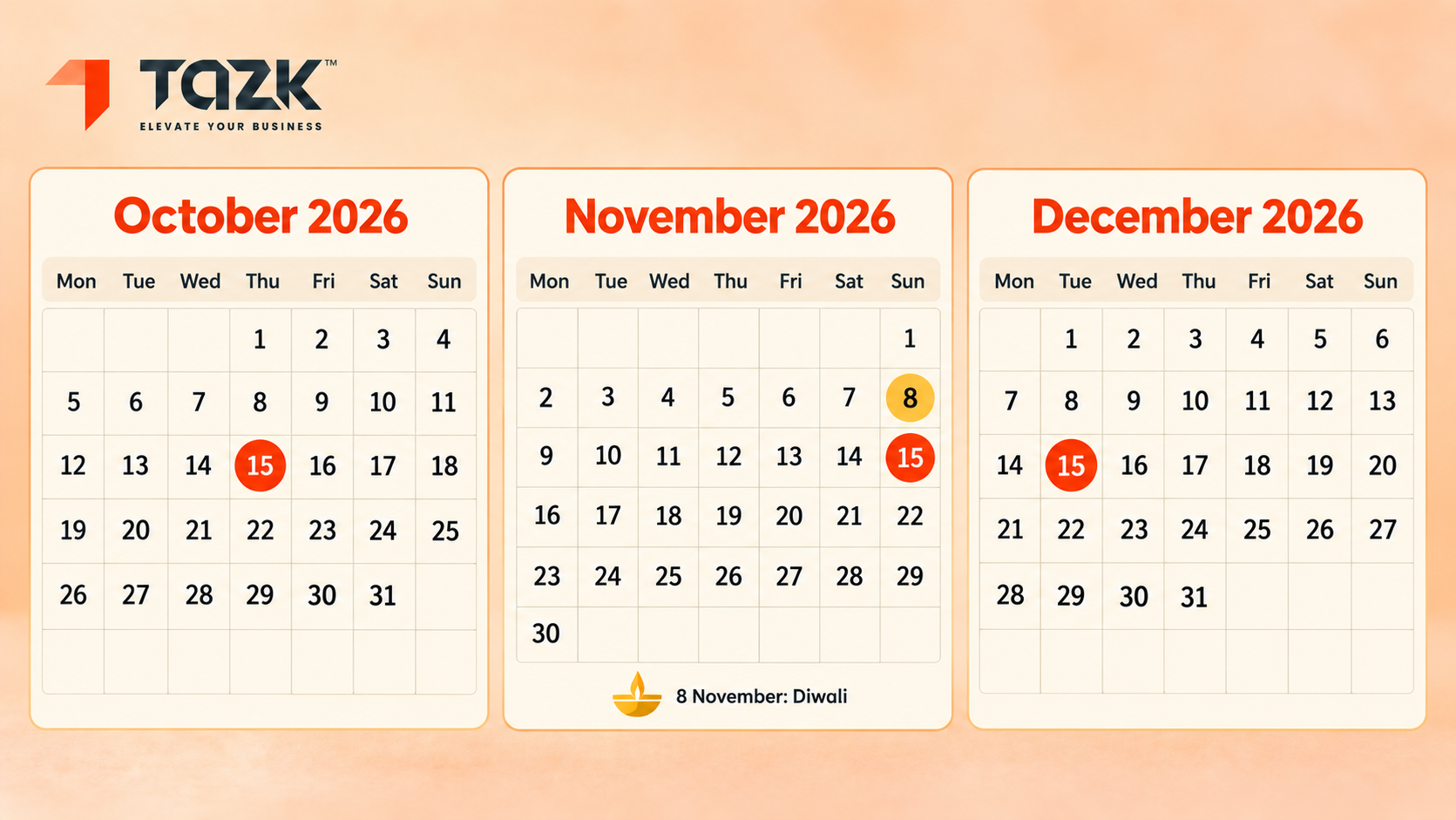
PF contributions and the ECR for a wage month are ordinarily due by the 15th of the next month. The PF ECR for September 2026 is due on 15 October 2026. It is a single return, with the two ceiling periods worked out inside it. ESI contributions are also due by the 15th, and the ESI ceiling did not change.
In simple words: Deadlines fall on the 15th. September is one return, not two.
| Wage month | PF ECR and deposit due | ESI deposit due | Note |
|---|---|---|---|
| September 2026 | Thu 15 Oct 2026 | Thu 15 Oct 2026 | Split month, one ECR |
| October 2026 | Sun 15 Nov 2026 | Sun 15 Nov 2026 | First full month at ₹25,000. Diwali is Sunday 8 Nov, so file early |
| November 2026 | Tue 15 Dec 2026 | Tue 15 Dec 2026 | Normal month |
What changes in the September ECR, according to EPFO's FAQ: one ECR, not two; wages counted for both periods as shown above; EPS for newly covered members from 17 September; and any extra employee share can be recovered in the next payroll, but the ECR and full deposit must be on time. From October, ECR filing looks normal, at ₹25,000 for the whole month.
Now ESI. The ESI wage ceiling is ₹21,000 a month (₹25,000 for persons with disabilities). The rate is 4% of wages: 3.25% from the employer and 0.75% from the employee. If wages cross ₹21,000 during a contribution period (April–September or October–March), the person usually stays covered until that period ends. People have talked about raising the ceiling, but we found no notification, so leave your ESI settings alone and check the ESIC website before each payroll. Late payment can bring interest and penalties. The ESI sources are listed at the end.
How can payroll software flag employees who cross PF orESI wage limits?
Good payroll software keeps two separate watch lists: one for the PF ceiling (₹25,000 from 17 September 2026) and one for the ESI ceiling (₹21,000). Each month it checks every employee's actual wages, raises an alert when someone is near or over a line, and builds the ECR from the same data, so the alert and the return never disagree.
In simple words: It works like a smoke alarm. It rings before the fire, not after.
Ask your vendor, or check your own setup, for these nine things:
- Effective dates. The ceiling changes on 17 September 2026 without touching old months.
- Split-month sums. September is worked in two parts and exported as one ECR
- A “newly eligible” list. Staff with PF wages of ₹15,001–₹25,000 who are not yet members.
- An EPS gap list. EPF members in that band who must now join EPS.
- A “capped members” report. Staff whose PF wages are above ₹15,000, so you see the extra cost early.
- An ESI watch. Gross wages against ₹21,000, with the April–September and October– March rule.
- Attendance-linked wages. Overtime, night shifts and leave without pay change wages every month.
- Member checks. UAN, KYC and Aadhaar-seeding status for newly covered staff.
- An audit trail. Who changed what and when. EPFO's FAQ asks employers to keep one.
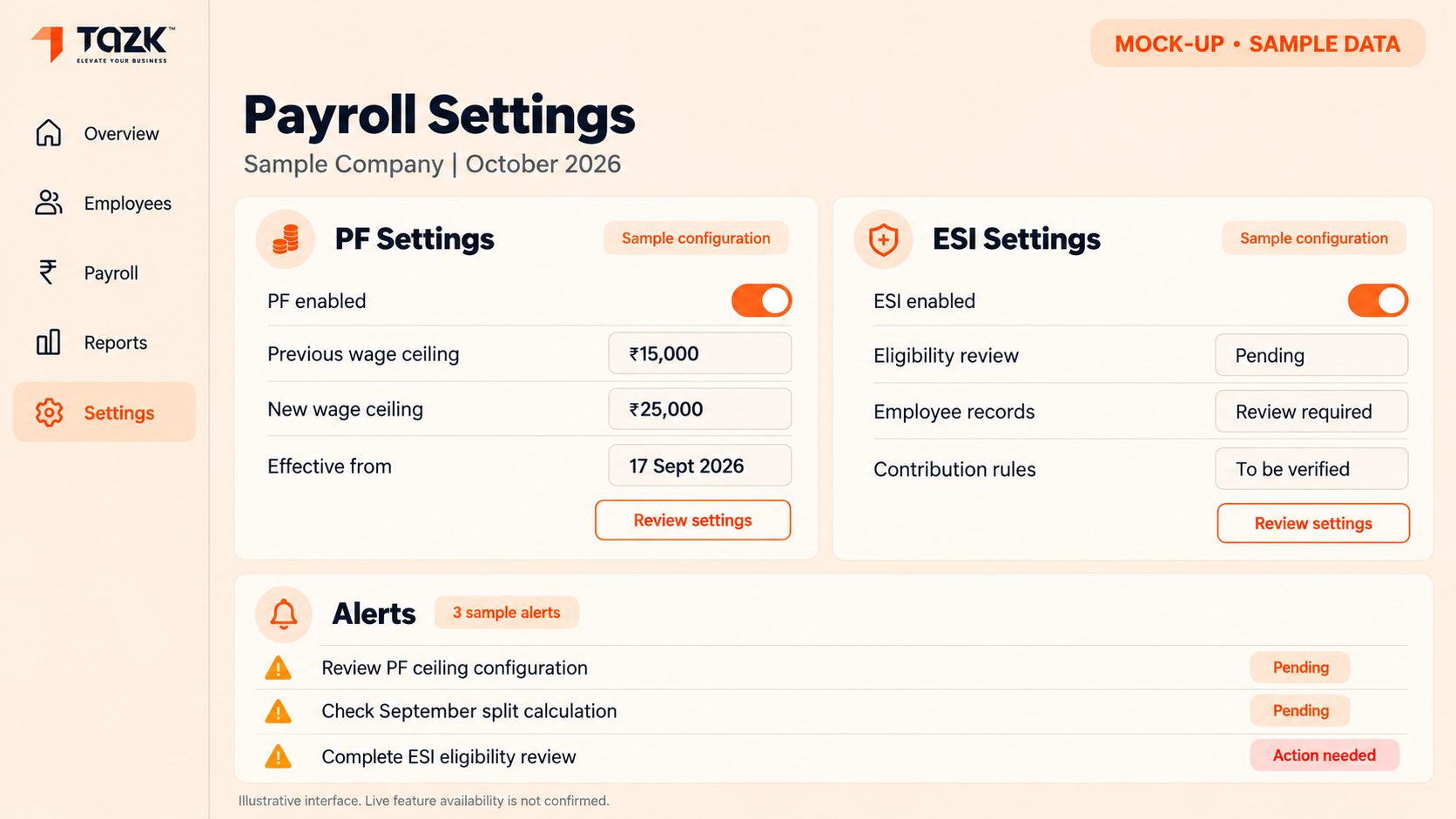
How Tazk helps. Tazk Payroll & HRMS connects attendance, leave, shifts and salary structures with payroll, and covers PF, ESI, Professional Tax and TDS. Staff can mark attendance by GPS or face, or through a linked biometric machine, and salary can be generated in one click. If you use Tazk, our team will check with you how the ₹25,000 ceiling is set in your account. Night shifts can push wages over a line, so read how to set up biometric attendance for night shifts without breaking PF and ESI compliance.
Your 10-minute checklist and 7 mistakes to avoid
Do these ten things this week.
- Export your employee list with PF wages (basic + DA + retaining allowance).
- Mark who is not in PF but has PF wages of ₹25,000 or less. Enrol them from 17 September.
- Mark members capped at ₹15,000 whose PF wages are higher. Raise their wage base.
- Mark EPF members in the ₹15,000–₹25,000 band who are not in EPS. Add EPS.
- Finish member enrolment: get a UAN and complete KYC for anyone new to PF.
- Set the ceiling in your payroll tool with the date 17 September 2026.
- Redo September in two parts and match it to your salary register.
- Check the EPFO portal's notes. File the ECR and deposit both shares by 15 October
- Tell your team in two lines: “From 17 September 2026 the PF wage ceiling is ₹25,000. Your deduction may rise, and your employer pays in more too.”
- Save your working sheets as your audit trail. Still on spreadsheets? See payroll spreadsheet errors.
Seven mistakes to avoid
- Using ₹25,000 for all of September.
- Using ₹25,000 for everyone, even people whose wages are lower.
- Mixing up gross salary and PF wages.
- Forgetting EPS for EPF-only members in the band.
- Waiting for October to enrol newly covered staff.
- Cutting statutory wages to save PF
- Changing the ESI ceiling by mistake. It is still ₹21,000.
What happens next: your 2026 to 2027 PF outlook
The ceiling will not move again soon, but the work around it will keep changing. Here are the dates we know, then a few expectations that we label as expectations.
| When | What | What to do |
|---|---|---|
| Thu 15 Oct 2026 | September ECR and deposit due | File one split ECR. Keep your working papers. |
| Tue 20 Oct 2026 | Dussehra | File before the holiday |
| Sun 8 Nov 2026 | Diwali | Bonus season: keep bonus and PF wages separate. Our Diwali bonus guide is on the way |
| Sun 15 Nov 2026 | October ECR and deposit due (first full month at ₹25,000) | Pay by Fri 13 Nov. |
| Dec 2026 to Mar 2027 | Appraisal season | A raise can push people over ₹15,000, ₹21,000 or ₹25,000. Run what-if checks first. |
| 31 Jul 2027 | PMVBRY hiring window closes | Time new hires to qualify, if eligible. |
What may come next (expectations, not promises):
- More EPFO instructions. EPFO's FAQ says instructions on deferring the employee share are being issued and the portal will be updated. Expect circulars.
- A wider PF base from the labour codes. The four labour codes have been in force since 21 November 2025. If allowances left out of wages go above half of total pay, the extra is added back to wages. That does not mean basic must be exactly 50% of CTC, but for many employers a bigger wage base means a bigger PF bill. See KS&K's explainer.
- ESI ceiling talk. Proposals to raise ₹21,000 have been discussed, but nothing is notified.
- More people near the line. Several states already have minimum wages above ₹15,000. As pay rises, more of your team will sit close to ₹25,000.
The safest plan is simple: date your ceiling settings, keep your working papers, and review PF wages every time you give a raise.