Buddy Punching, Fake Site Visits & Ghost Employees: How GPS-Verified Attendance Fixes Field Team Accountability
13 min read | By Lokesh A
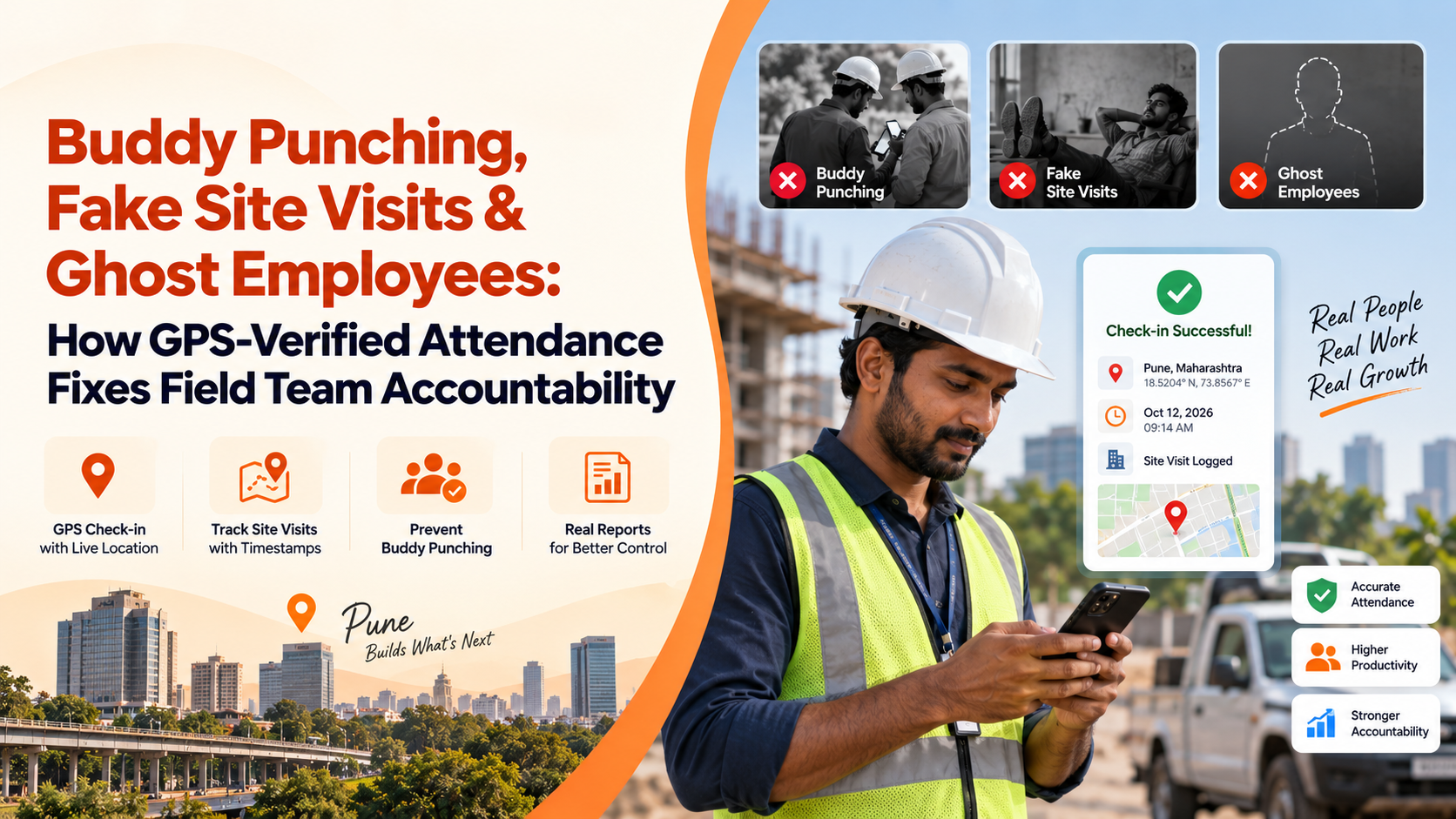
Table Of Contents
Social Media




The attendance sheet that lies without anyone lying
Here's a strange thing about attendance for field teams. The paperwork can be completely filled in, every box ticked, every visit logged — and still be almost entirely fiction.
Not because anyone set out to cheat, necessarily. A field sales rep types in "visited Client A" from a coffee shop because they ran out of time that day, intending to actually go tomorrow. A service technician marks a job complete before double-checking the customer is satisfied. A supervisor signs off on a report without really reading it. None of these individually feels like fraud. Together, they mean a business owner is making decisions based on records that don't reflect reality.
This is fundamentally different from office attendance, where at least someone physically has to show up to badge in. With a field team, the entire record depends on self reporting — unless there's a way to verify it. This article explains why this specific problem is so common, and how GPS-verified attendance fixes it without turning your workplace into a surveillance operation.
How Big Is This Problem, Really?
Time theft in general is more common, and more expensive, than most business owners assume.
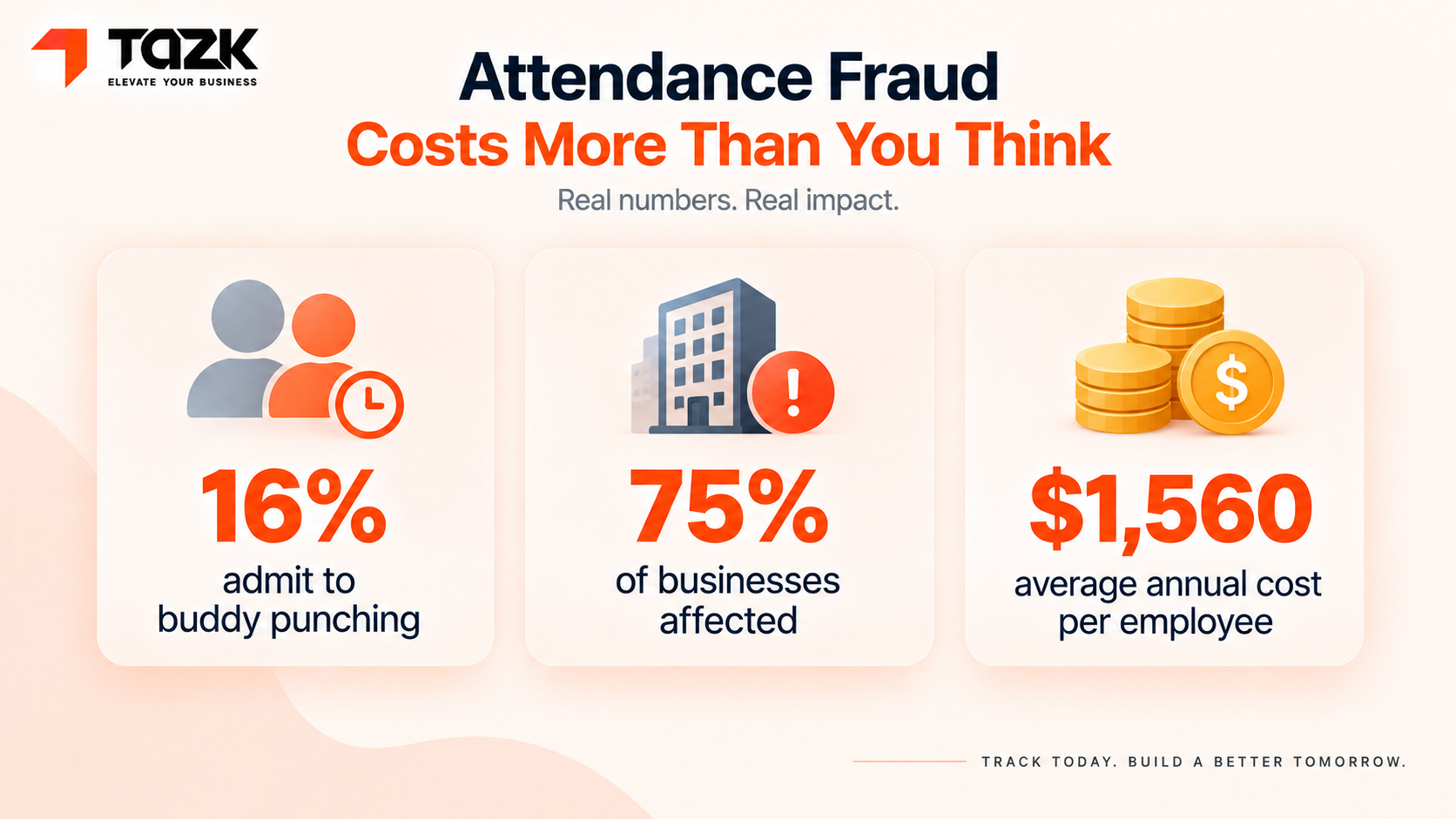
Industry research suggests 16% of employees admit to buddy punching — clocking in or out for a colleague who isn't actually there. Separately, 75% of businesses report being affected by it in some form (source: TimeTrex, Solutions to Buddy Punching). The average cost has been estimated at around $1,560 per employee per year in excess paid hours (source: Field servicely, What Is Buddy Punching?). Some estimates put total time theft losses as high as 7% of overall business profits (source: Taggd, Buddy Punching).
For field-based businesses specifically — sales reps, service technicians, delivery staff, construction site supervisors — the risk is arguably higher, because there's often no physical device to fake at all. There's no swipe machine at a client's office. The record exists purely because someone typed it in.
Industries with high staff turnover and shift-based work see this most acutely. Hospitality and food service report buddy punching rates above 30%, largely due to high turnover and shared work environments (source: Employee Monitoring, Time Theft Statistics 2026). Many of the same conditions apply just as strongly to field sales and service teams — a young workforce, high turnover, and minimal formal oversight.
Three Distinct Problems, Often Confused as One
It helps to separate these clearly, because each needs a slightly different fix.
1. Buddy punching — one employee marking attendance for another who isn't actually present. Classic office-based time theft, but it happens in field teams too, especially when attendance is marked from a shared device or app login.
2. Fake or exaggerated site visits — a field rep claims to have visited a client, completed a delivery, or serviced equipment, when they didn't. Or they did so far more briefly than logged. This is specific to field roles, and it's much harder to catch without location data, since there's no fixed device to check against.
3. Ghost employees — a more serious version of the same underlying issue. Someone remains on the payroll and appears to be "working," despite doing little or no actual field work. This often happens because nobody has visibility into whether their claimed activity actually happened.
All three share the same underlying weakness: attendance and activity data that can't be independently verified. GPS-based verification doesn't fix all three equally, but it directly addresses the visibility gap that makes all three possible in the first place.
Why This Isn't (And Shouldn't Be) About Distrust
It's worth addressing this directly, because it's the most common objection field teams raise: "Are you saying you don't trust us?"
The honest answer is that GPS verification isn't really about any individual employee — it's about removing ambiguity for everyone. When attendance is self-reported with no way to verify it, something happens. The honest majority of your team is effectively working under the same unclear rules as the small minority who might exploit them. Verified attendance protects honest employees just as much as it catches dishonest ones — it means a hardworking field rep's actual effort is visible and provable, not just assumed.
There's also a practical framing that helps here: GPS check-in data should verify presence, not monitor every movement throughout the day. A well-designed system logs where and when someone checked in at a site. It isn't continuously tracking someone's location every minute. That would be a very different, and much more invasive, kind of system — one that most field employees would, understandably, object to.
How to Actually Introduce This Without Creating Resentment
How a business rolls this out matters almost as much as the technology itself. A few practical guidelines make a real difference.
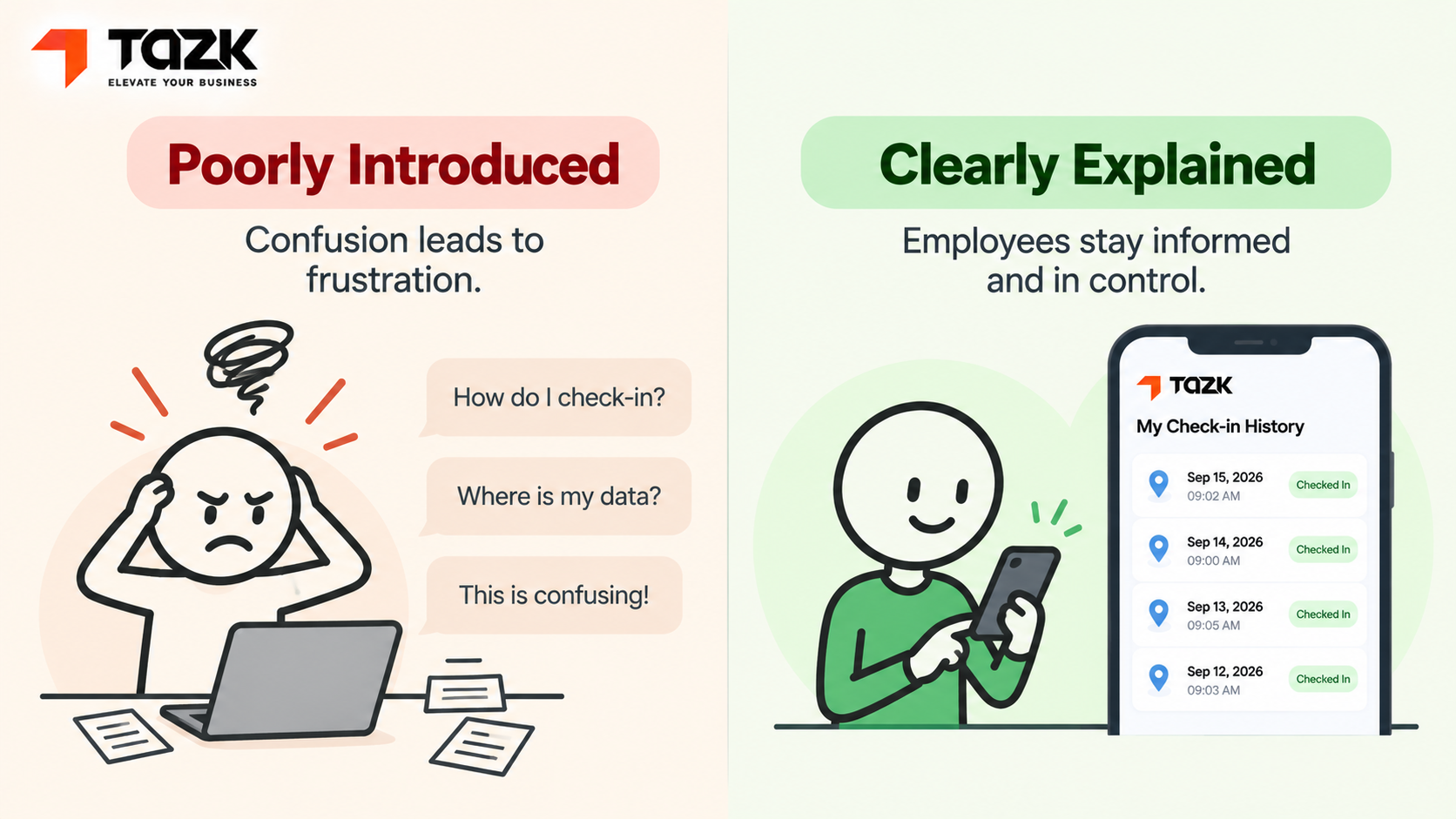
Explain the "why" before the "what." Teams respond very differently when they understand this protects honest work, rather than just catching dishonest work. Compare that to teams who feel a new tracking tool was simply imposed on them without explanation.
Be specific about what is and isn't tracked. Vague announcements breed suspicion. A clear statement — location captured only at check-in, no continuous tracking, no monitoring outside working hours — removes most of the anxiety before it starts.
Apply it consistently, not selectively. GPS verification shouldn't only seem to apply to certain employees, or get enforced inconsistently. That reads as targeted suspicion rather than a fair system, undermining the "this protects everyone" framing entirely.
Give employees access to their own data too. A field rep who can see their own verified visit history has proof of the work they actually did. This often feels reassuring rather than threatening, especially when performance conversations come up later.
What Good GPS-Verified Attendance Actually Looks Like
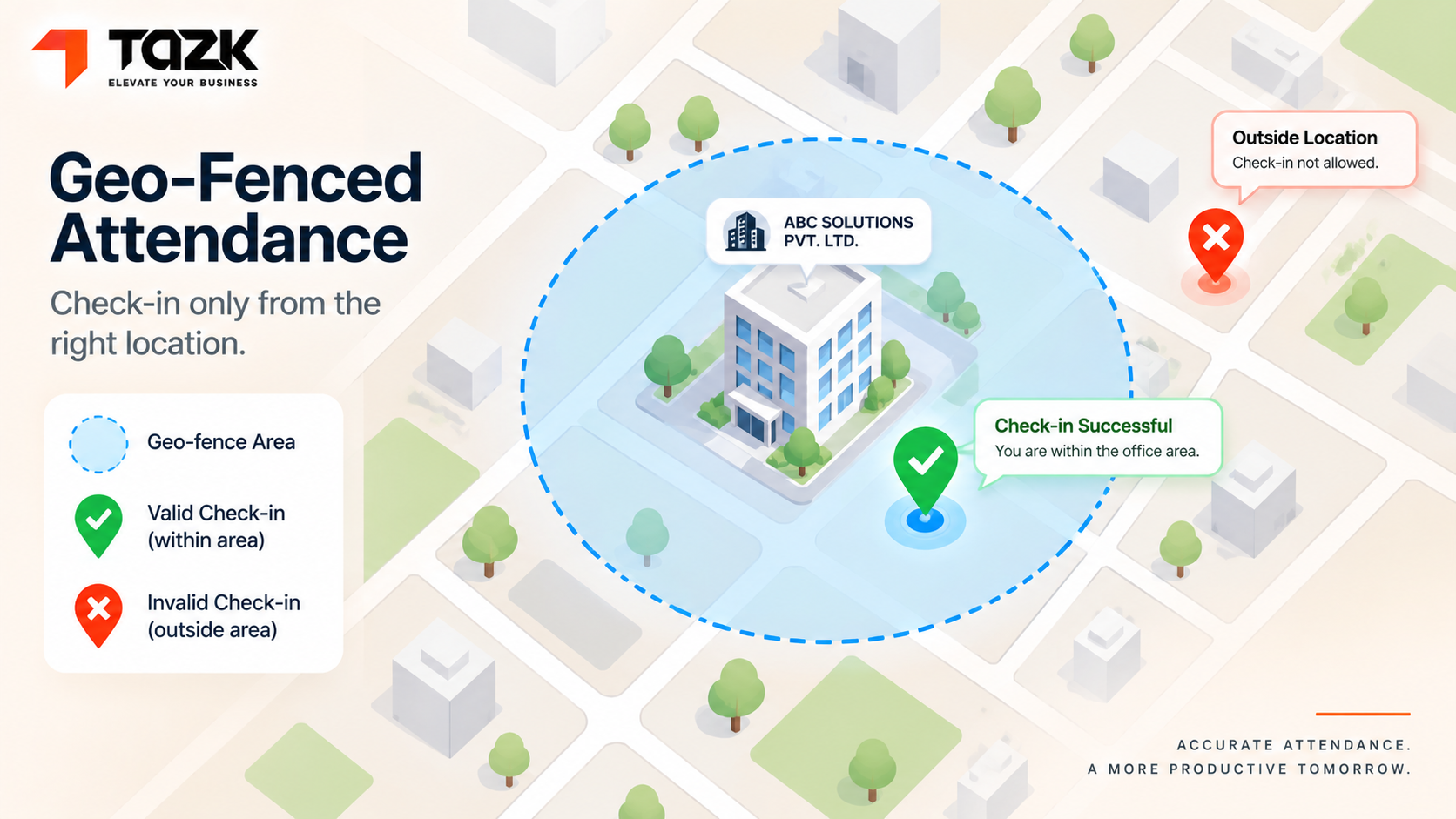
1. Check-in happens at the actual location, not from anywhere. The system should capture GPS coordinates at the moment of check-in, confirming the employee was physically at (or near) the intended site — not simply logged from wherever they happened to be.
2. Geo-fencing sets a reasonable radius, not an unreasonably tight one. A site visit should be confirmed within a sensible distance of the actual location — accounting for GPS accuracy limitations — rather than requiring pinpoint precision that creates false failures for honest employees.
3. Photo or note verification adds a second layer, when it matters. For higher-stakes visits, a quick photo or short note attached to the check-in gives a manager useful context, without requiring constant supervision.
4. Managers see patterns, not just individual check-ins. The real value isn't scrutinising one single visit — it's noticing patterns, like a rep who consistently logs suspiciously short visit durations, or checks in from unusual locations repeatedly.
5. The system is transparent with employees, not hidden from them. Field staff should know clearly what's being tracked (location at check-in) and what isn't (constant movement, personal time). Transparency turns this into a fair system rather than covert surveillance.
How Tazk Handles This
Tazk's Payroll & HRMS module includes GPS-verified attendance built specifically for field and mobile teams:
- Location-stamped check-ins, confirming a field employee was actually at the intended site, not just claiming to be.
- Geo-fencing with a sensible radius, avoiding false failures from normal GPS variation while still catching genuinely implausible check-ins.
- Manager visibility into visit patterns, not just individual records, so unusual patterns surface automatically instead of requiring manual review of every entry.
- Integration directly with payroll, so verified attendance data flows straight into salary calculation — no separate system, no manual reconciliation.
If your field team's core challenge is more about missed follow-ups and route efficiency than attendance specifically, our guide on Field sales beat plan revenue leaks in India covers that closely related problem in depth.
A Realistic Example
Picture a facilities maintenance company in Chennai with 30 technicians visiting client sites across the city every day, logging each visit through a basic mobile form with no location verification.
Over several months, a manager noticed a pattern that felt off but couldn't quite prove: certain technicians consistently reported very short visit durations for jobs that should reasonably take longer. Without location data, there was no way to confirm whether visits were genuinely rushed, or not fully happening as reported — and raising the issue without proof risked accusing honest employees unfairly.
After introducing GPS-verified check-ins, the picture became clear within weeks — not through a dramatic confrontation, but through simple, visible data. Two technicians showed a consistent pattern of check-ins from locations well outside any reasonable radius of their assigned sites. The conversation that followed was straightforward, backed by clear records rather than suspicion. Just as importantly, the other 28 technicians had been doing honest, accurate work all along. They now had objective proof of exactly that, visible to management without anyone needing to ask.
What's Changing Next
Field-based work keeps growing as a share of the Indian workforce, across service, delivery, construction, and sales roles — meaning the attendance-verification gap this article describes affects a growing number of businesses, not a shrinking one.
Expectations around transparency are rising alongside verification technology. As GPS based systems become more common, employees increasingly expect clarity about exactly what's tracked and why — businesses that communicate this openly see far less resistance than those that roll it out silently.
Verification data is becoming useful beyond just catching problems. Patterns in verified visit data — average time per site, travel patterns between locations — are increasingly used for more than fraud prevention. They help improve route planning and staffing decisions too, turning a compliance tool into an operational one.
Field team attendance built on trust alone isn't really a management strategy — it's an assumption that quietly costs businesses money and creates unfair situations for honest employees. GPS-verified check-ins fix the actual gap: the total absence of a way to confirm the record matches reality, without turning the workplace into constant surveillance.
Book a demo — see GPS-verified attendance and site-visit logs on Tazk's mobile app. Schedule a demo or start a free trial today. Visit tazk.in to explore all connected modules.