What Has Actually Changed One Year After India's Labour Codes? A Plain-English Check for Small Employers
6 min read | By Tazk Team
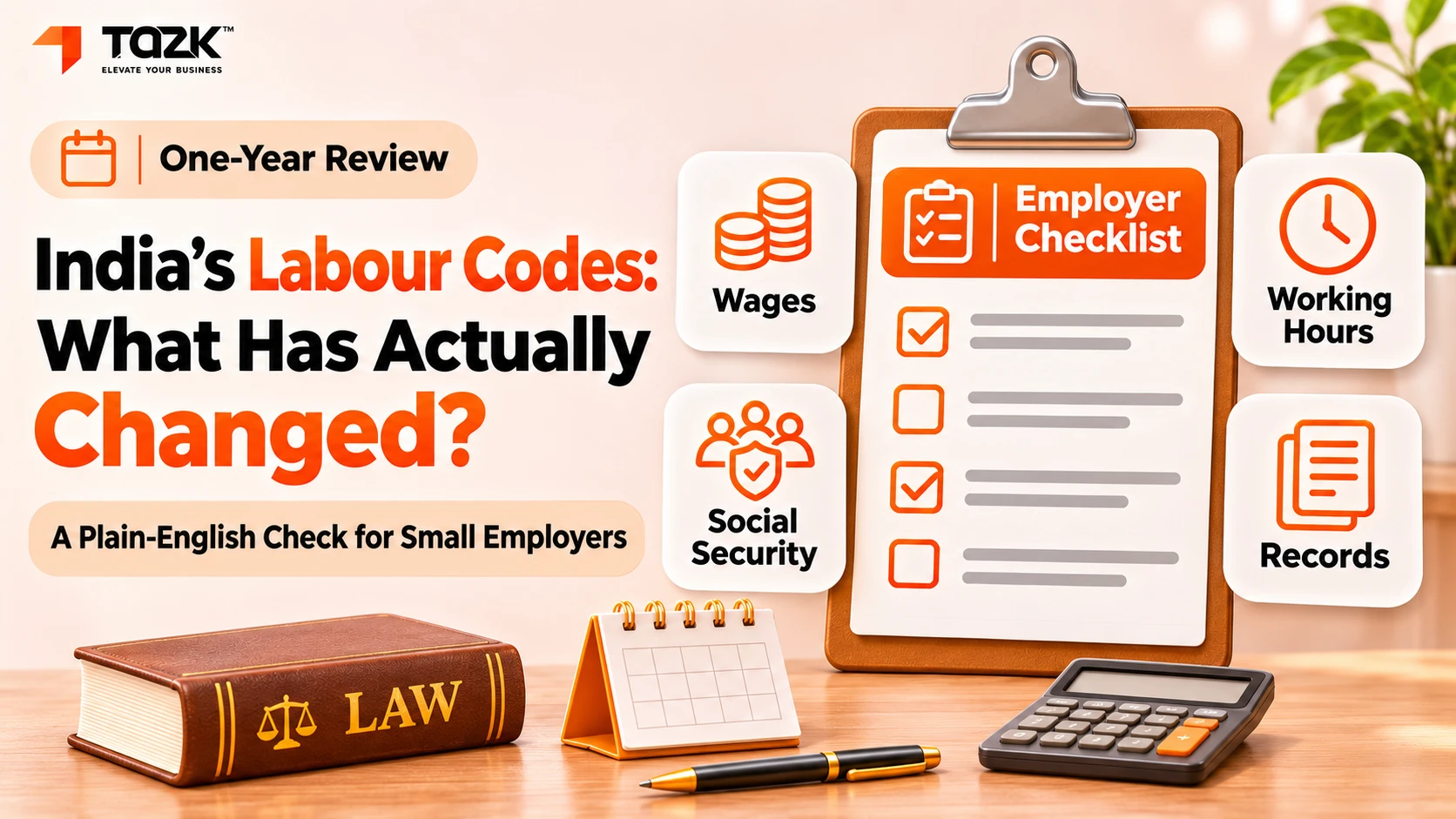
Table Of Contents
Social Media


On 21 November 2025, India switched on its four new labour codes. The news was big. Then, for many small business owners, nothing seemed to happen. Salaries went out as usual. Payslips looked the same. So a fair question one year later is: what has actually changed for me?
The honest answer is: some things have changed, some are still waiting on your state, and a few you should fix now so you are not caught out later.
This guide is for owners, HR and payroll managers in firms with 10 to 200 people. We keep it simple. We tell you what is settled, what to watch, and three things to do this quarter.
Note: This article is general information, not legal advice. Labour law depends on your state, your industry and your headcount. Please check with a labour-law advisor or CA before changing contracts or pay.
Why trust this guide?
This guide is written by the payroll team at Tazk. We build payroll and attendance software for Indian businesses, so we track statutory changes that affect salary runs, payslips and final settlements. Facts in this post are linked to government pages or named law-firm summaries.
What has changed one year after the labour codes took effect?
The four codes replaced 29 older central labour laws with four shorter ones:
| Code | What it mostly covers |
|---|---|
| Code on Wages, 2019 | Minimum wages, the definition of "wages", timely payment, bonus, equal pay |
| Code on Social Security, 2020 | PF, ESI, gratuity, maternity benefit, gig and platform workers |
| Industrial Relations Code, 2020 | Standing orders, layoffs, retrenchment, fixed-term employment, unions |
| Occupational Safety, Health and Working Conditions Code (OSH Code), 2020 | Working hours, overtime, leave, safety, appointment letters |
Here is the timeline so far:
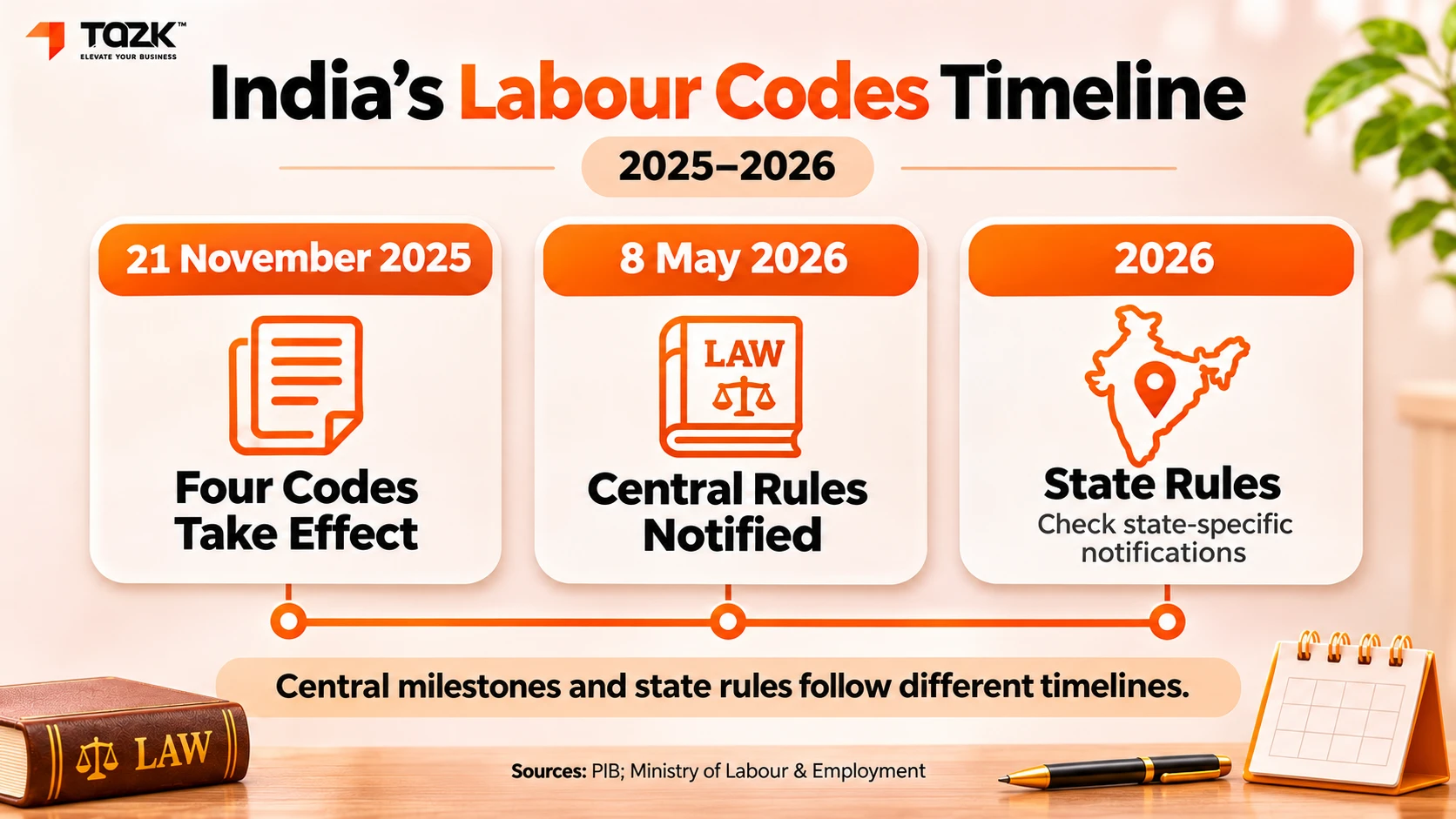
- 21 November 2025: The four codes came into force.
- 8 May 2026: The central government notified its rules under the codes. A good plain summary is Trilegal's summary of the central rules.
- Through 2026: States have been notifying their own rules, but not all at the same speed.
For the official text and updates, use the Ministry of Labour and Employment website.
What feels different on the ground? The biggest practical changes for small employers are about money and paperwork:
- How you split salary into basic pay and allowances (the 50% wage rule).
- Gratuity for fixed-term staff after one year.
- Faster full and final settlement when someone leaves.
- A written appointment letter for every worker.
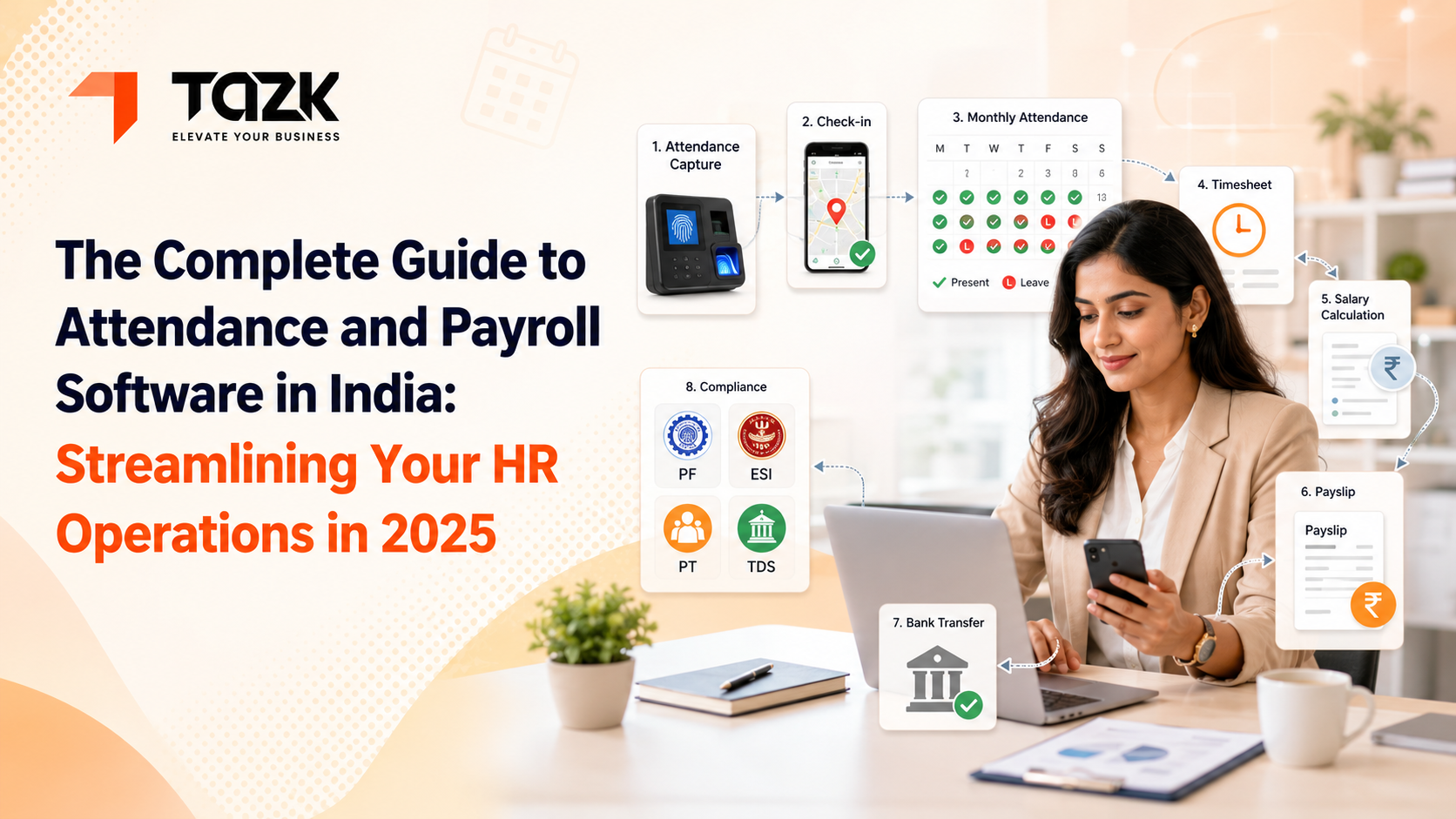
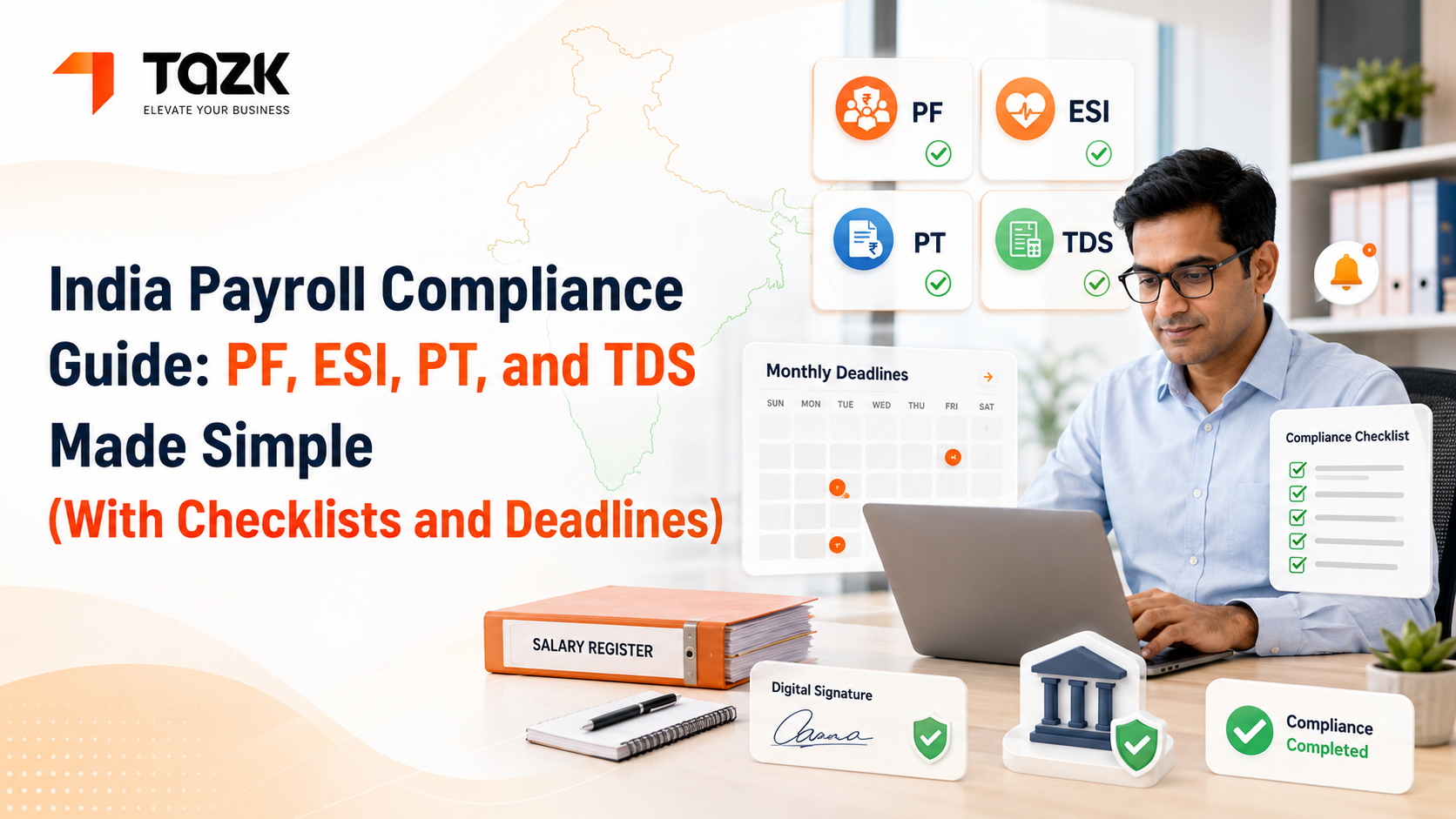
PF, ESI, PT and TDS still need to be filed every month as before. For the full monthly calendar, see our India payroll compliance guide for PF, ESI, PT and TDS.
Do the labour codes apply in my state yet?
The codes apply across India. But here is the catch: labour is a shared subject between the Centre and the states. For most private businesses, the state government is the "appropriate government". That means your state's rules decide many details, such as:
- Working hours spread-over and shift rules
- Overtime limits
- Registers, returns and forms
- Some minimum wage details
So, "do the codes apply to me?" has two parts:
- The codes themselves: Yes, they are in force.
- The detailed rules for your business: These depend on whether your state has notified final rules under each code.
How to check your state's status in 10 minutes:
- Open your state labour department's website.
- Look for "Rules under the Code on Wages", "Code on Social Security", "Industrial Relations Code" and "OSH Code".
- Note whether each is a draft (open for comments) or final (notified in the Gazette).
- Cross-check the notification on the e-Gazette of India or your state's Gazette.
- If you have staff in more than one state, repeat this for each state.
| Your state | Code on Wages rules | Social Security rules | IR Code rules | OSH Code rules |
|---|---|---|---|---|
| (fill in) | Draft / Final / Not yet | Draft / Final / Not yet | Draft / Final / Not yet | Draft / Final / Not yet |
What if your state has not finished its rules? Follow the code and the central rules where they apply, keep using your current state forms where new ones are not out, and keep notes of what you checked and when. Ask your advisor where the two overlap.
Is the 50% wage rule in force, and how does it change my salary structure?
Yes. The new definition of "wages" is part of the Code on Wages, which is in force.
What the rule says, simply: Your salary has two kinds of parts:
- Wages: basic pay, dearness allowance (DA) and retaining allowance.
- Excluded parts: such as HRA, conveyance, overtime pay, commission and some other allowances.
If the excluded parts add up to more than 50% of total pay, the extra amount above 50% is added back into "wages".
A short example:
| Component | Monthly amount |
|---|---|
| Basic pay | ₹15,000 |
| HRA | ₹15,000 |
| Conveyance and other excluded allowances | ₹10,000 |
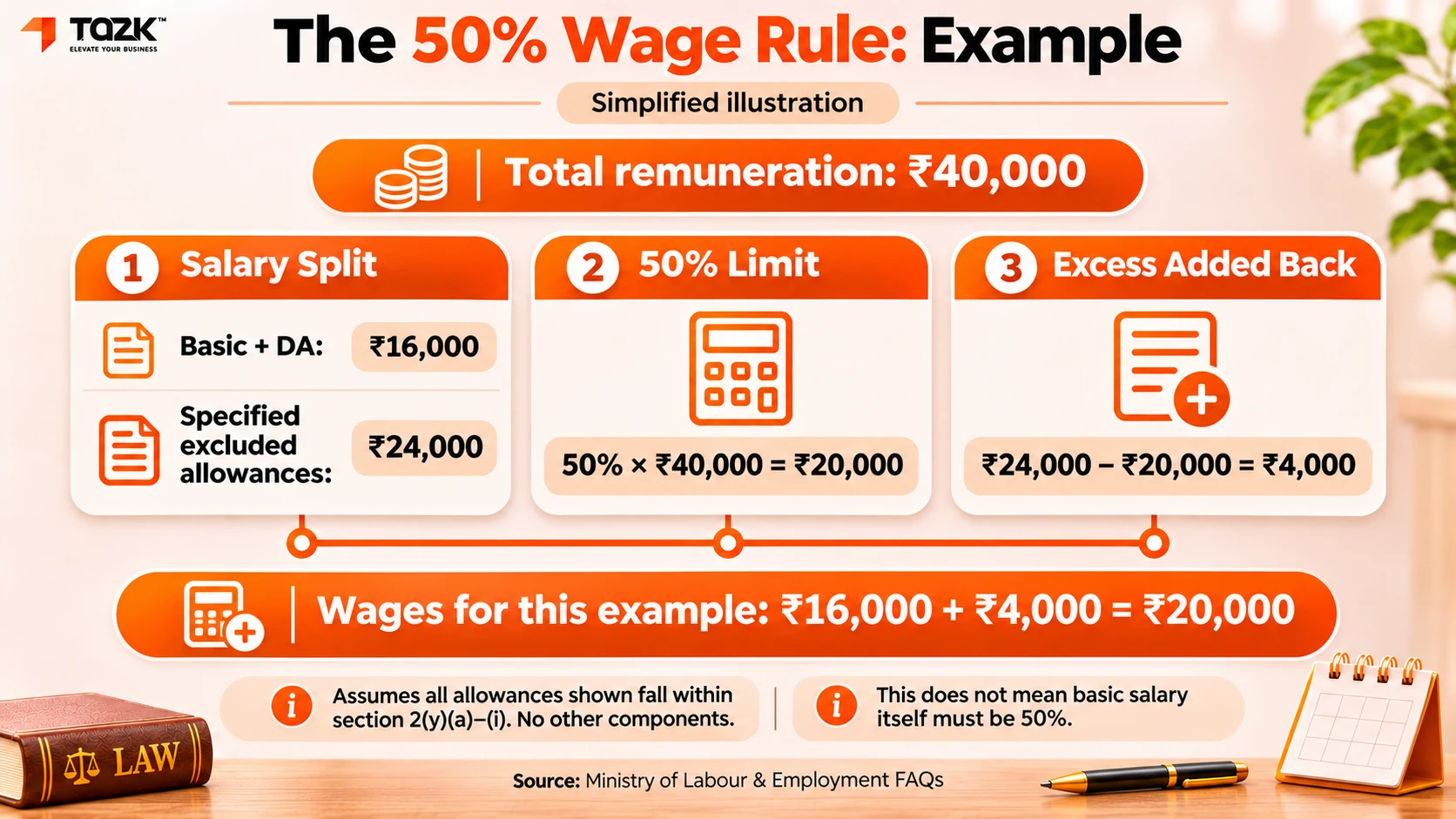
Excluded parts = ₹25,000. Half of total pay = ₹20,000. The extra ₹5,000 is added to wages. So wages for the code become ₹15,000 + ₹5,000 = ₹20,000.
Why it matters: Several benefits are calculated on "wages", such as gratuity and, in many cases, PF and leave encashment. A higher wage base can mean higher employer cost and, sometimes, a slightly lower take-home pay.
How much your PF changes also depends on the PF wage ceiling. For worked numbers, read our post with take-home pay examples after the ₹25,000 PF ceiling and the 50% rule.
What to do: List every salary structure you use. For each, check if excluded parts are above 50%. If they are, either restructure (with care and with consent where needed) or make sure your payroll calculates benefits on the adjusted wage. Good payroll software that handles salary structures and statutory deductions lets you change a template once and apply it to everyone on that structure.
When is gratuity payable to fixed-term employees?
Under the Code on Social Security, fixed-term employees become eligible for gratuity after one year of continuous service. Gratuity is paid in proportion to the time they worked.
Regular, permanent employees still generally need five years of continuous service, except in cases like death or disablement.
Who is a fixed-term employee? Someone hired on a written contract for a fixed period, such as 12 or 18 months, who gets the same hours, wages and benefits as a permanent worker doing similar work.
What this means for you:
- If you hire people on one-year or two-year contracts, budget for gratuity from the first year.
- Make sure contracts clearly say "fixed-term", the start and end date, and the job.
- Do not break service into short gaps just to avoid gratuity. That is risky and unfair to staff.
Quick example: A fixed-term employee works for 18 months and leaves when the contract ends. Under the code, they qualify for gratuity on a pro-rata basis for that period. Under the old law, they would usually get nothing.
How fast must a final settlement be paid after someone leaves?
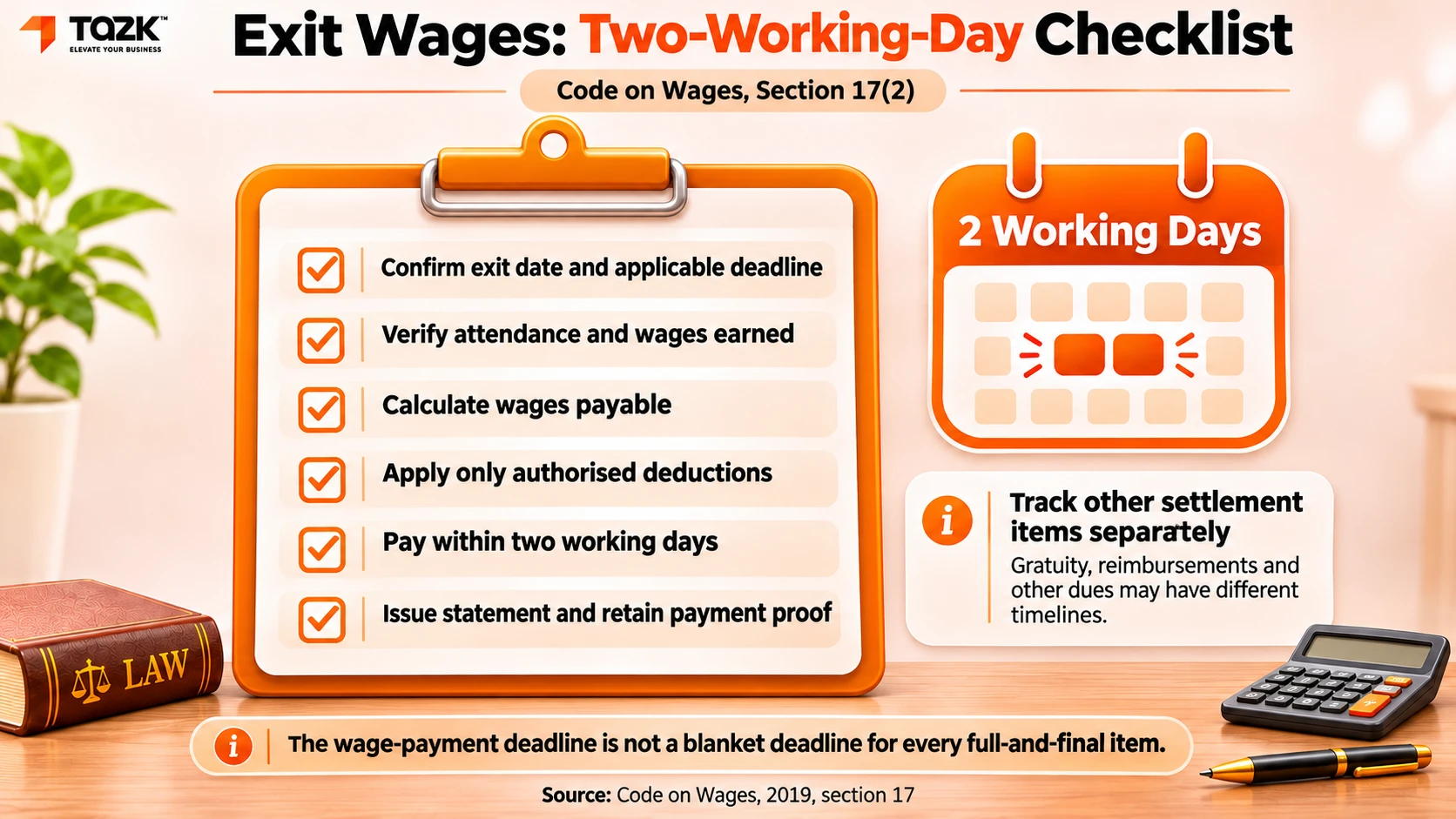
The Code on Wages says that when an employee is removed, dismissed, retrenched or resigns, or becomes unemployed because the business closes, their wages must be paid within two working days.
Many firms used to take 30, 45 or even 60 days for full and final settlement. Under the code, the wage part needs to be much faster. Law-firm summaries describe this as two working days in most cases; confirm the exact scope for your state with your advisor.
What to change in your exit process:
- On the day notice is given, start the settlement checklist: attendance till last day, leave balance, loans or advances, and asset return.
- Freeze attendance and loss-of-pay days for the final month quickly.
- Calculate final wages and keep the bank transfer ready.
- Pay wages within two working days of the exit. Other dues, such as gratuity, follow their own time limits under the codes.
- Give a settlement statement that shows every line clearly.
Fast settlement is much easier when attendance, loans and salary sit in one system instead of three spreadsheets.
Are appointment letters now mandatory?
Yes. Under the OSH Code, employers must give every employee a written appointment letter. Government announcements and law-firm summaries describe this as mandatory for all workers.
A good appointment letter should include at least:
- Name, job title and department
- Date of joining
- Whether the job is permanent or fixed-term (with end date)
- Salary and how it is split
- Working hours and weekly off
- Notice period
- Social security benefits, such as PF and ESI where applicable
If you have older staff without letters, issue letters to them too. It protects both sides and makes audits simple.
While you are at it, check working hours and overtime. The codes keep a cap of 48 hours a week, and overtime is paid at twice the ordinary rate. Your state rules may set the daily hours, spread-over and overtime limits, so follow those once they are final.
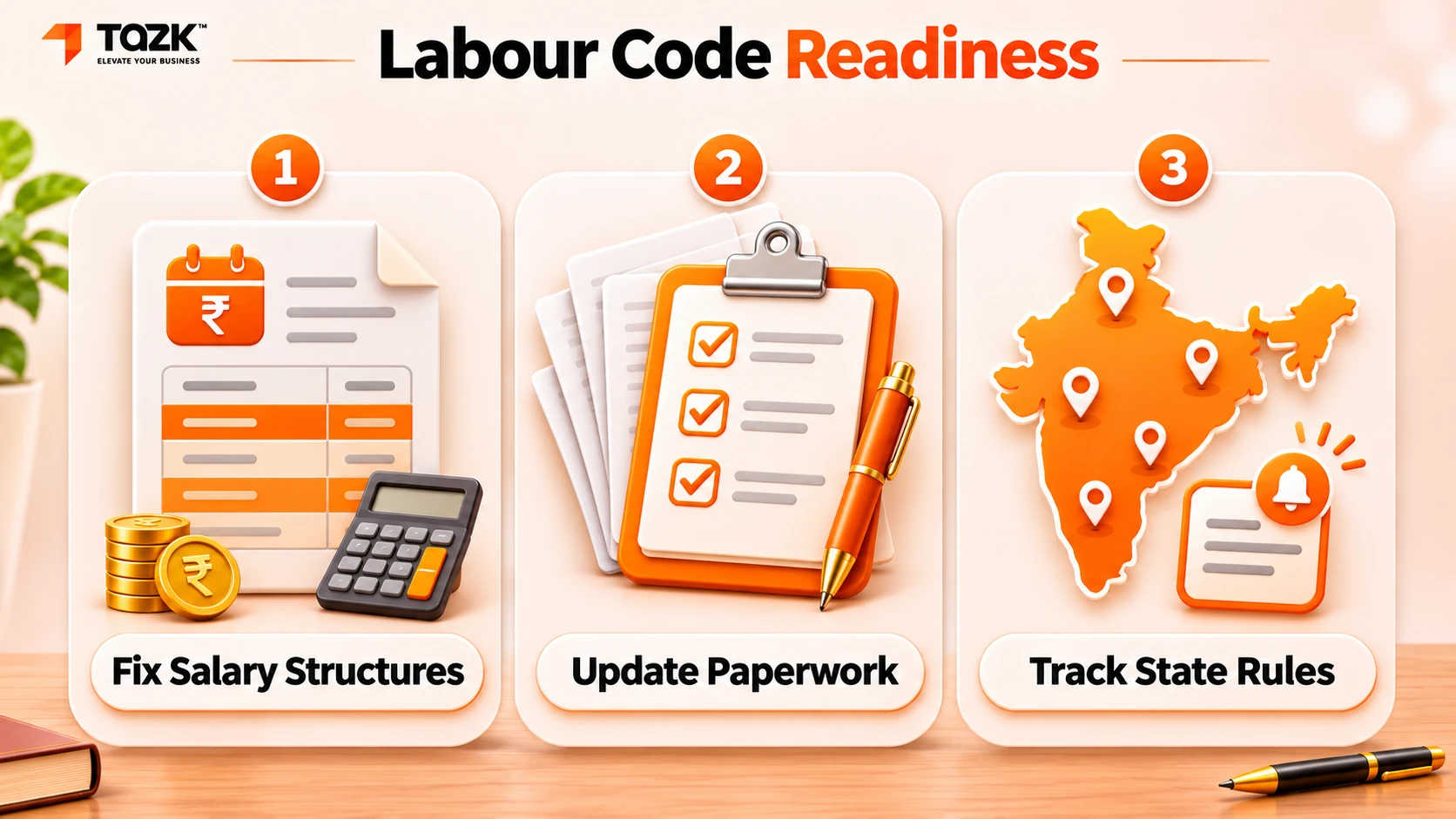
Which three things should a small employer do this quarter?
You do not need to rebuild your HR department. Do these three things in the next 90 days.
1. Fix your salary structures. Run the 50% check on every structure. Decide whether to restructure or to calculate benefits on adjusted wages. Write down the decision and the reason.
2. Update your paperwork.
- Issue appointment letters to all staff who do not have one.
- Rewrite fixed-term contracts so the gratuity rule is clear.
- Update your exit checklist so final wages can go out within two working days.
3. Track your state's rules. Fill in the state status table once a month. When a rule becomes final, update your process and payroll settings that week.
How software helps: With Tazk payroll software, you set up salary structures with Basic, HRA, allowances, PF, ESI, PT and TDS once, assign them in bulk and keep a full change history. Variance checks flag mismatches against last month before you pay, which helps when you are changing salary splits
Book a 15-minute payroll readiness review. We will look at your salary structures and exit process with you. Book a 15-minute payroll readiness review