The Hidden Cost of Payroll on Spreadsheets: 5 Calculation Errors That Are Silently Draining Indian Businesses
9 min | By Lokesh A
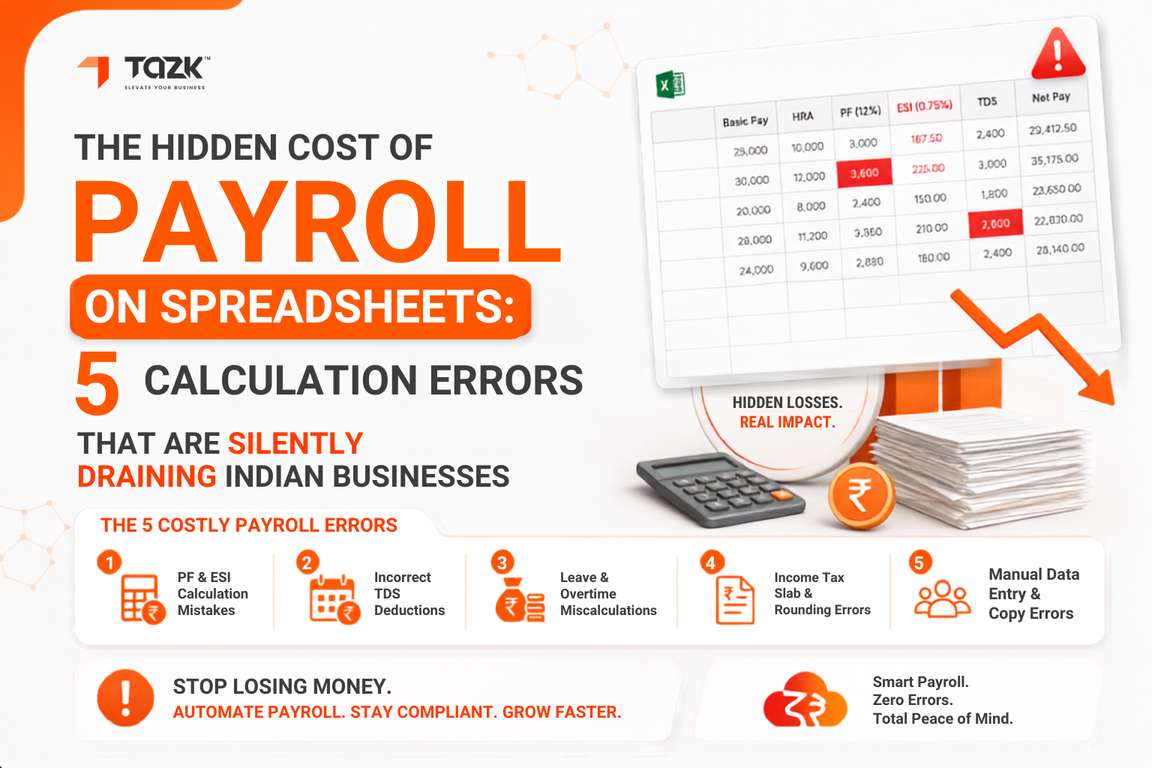
Table Of Contents
Social Media


The Hidden Cost of Payroll on Spreadsheets: 5 Calculation Errors That Are Silently Draining Indian Businesses
Payroll looks simple on the surface — multiply hours by rate, add allowances, deduct PF and TDS, transfer salary. In practice, India's payroll framework has enough moving parts — PF wage-base rules, ESI eligibility periods, dual tax regimes under the Income Tax Act, LOP calculations, and changing statutory thresholds — that spreadsheet-based payroll fails predictably and expensively. According to HROne's India Payroll Problems Report, 45–49% of Indian companies encounter significant payroll errors at least once a year.
This post documents the five calculation errors that appear most frequently in Indian SMB payrolls — the ones that generate PF department notices, employee disputes, and year-end tax rectification headaches. Each error has a direct cost attached to it. If your payroll still runs on Excel, read this against your own salary sheet. Tazk's payroll automation is specifically designed to eliminate each of these five failure points.

Error 1: PF Calculated on the Wrong Wage Base
The Employees' Provident Fund requires 12% contribution on 'basic wages' — but what qualifies as basic wages is still a point of contention that many spreadsheet-based payroll systems get wrong. The Supreme Court's Regional Provident Fund Commissioner v. Vivekananda Vidyamandir ruling established that allowances that are universally, necessarily, and ordinarily paid to all employees in a category must be included in the PF wage base, even if paid under separate allowance heads. Allowances structured purely to reduce PF liability — without genuine differentiation criteria — cannot be excluded.
How this error appears in spreadsheets: The salary sheet has a Basic + HRA + Conveyance + Special Allowance structure. PF is calculated only on Basic. HRA, Conveyance, and Special Allowance are excluded — sometimes legitimately, sometimes not. When the excluded allowances are flat amounts paid to all employees without condition, the exclusion is likely legally incorrect. The result: PF underdeposit that surfaces in a EPFO inspection or assessment, with interest at 12% per annum plus damages of 5–25% of the shortfall.
The fix: Audit your allowance structure against the standard: is the allowance paid to all employees in the category? Does it vary based on individual attendance or performance? If yes to the first and no to the second, it likely belongs in the PF wage base.
Error 2: ESI Eligibility Misapplication After Increments
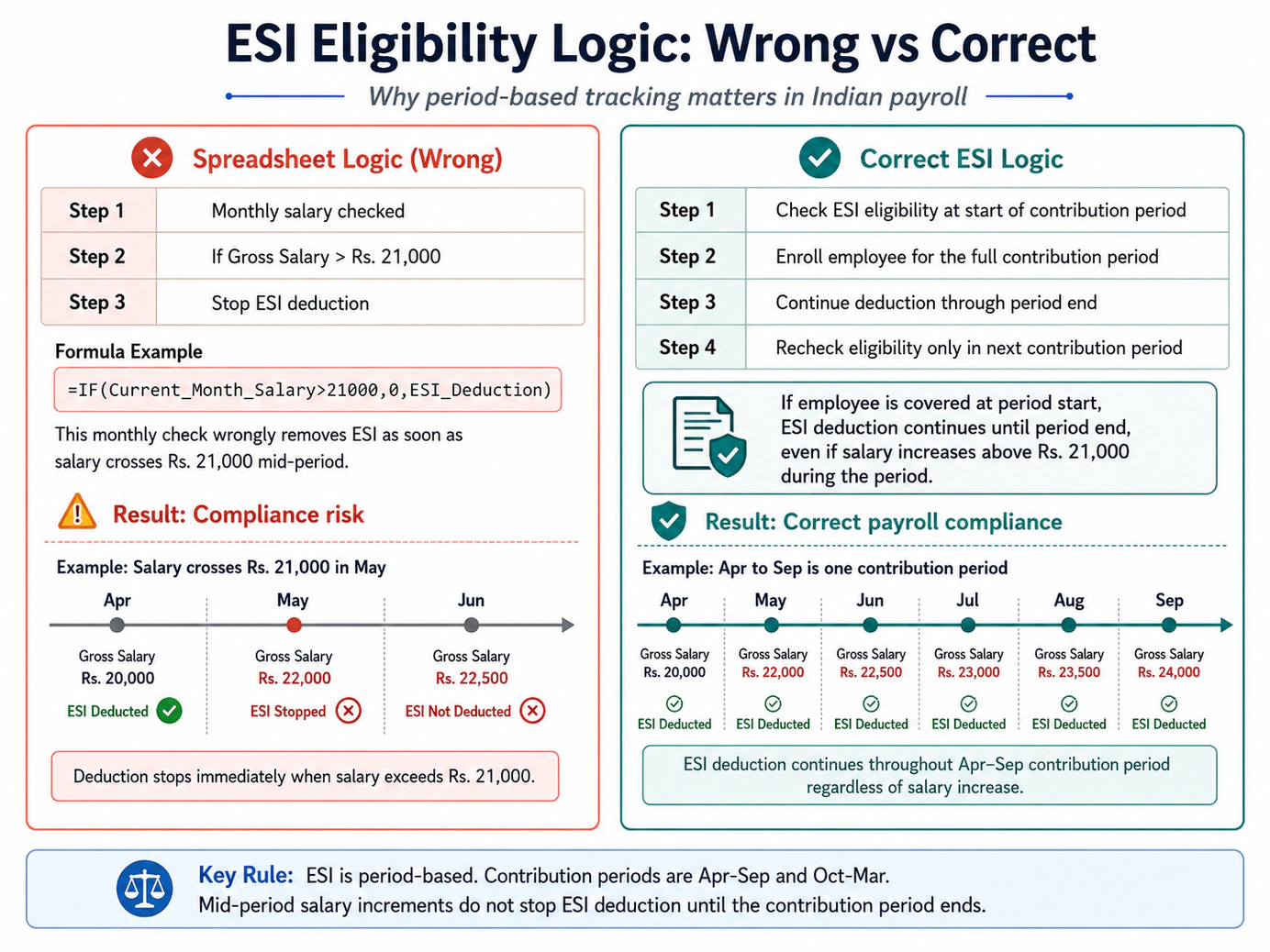
ESI applies to employees earning ₹21,000 or below per month. The coverage period trap is where most payroll errors occur. ESI operates on a contribution period system (April–September and October–March). Once an employee is covered in a period, they remain covered for that entire period — regardless of whether their salary crosses ₹21,000 mid-period due to an increment. FutureX's 2026 compliance guide documents this as the most commonly mishandled ESI scenario in Indian manufacturing and retail operations.
How this appears in spreadsheets: An employee's salary moves from ₹19,500 to ₹22,000 in July (mid-period). The spreadsheet formula checks current month salary against ₹21,000 and stops ESI deduction immediately. This is wrong — ESI must continue through September (end of the current contribution period). The employee also remains eligible for ESI benefits during the subsequent benefit period (January–June of the following year).
Error 3: Dual Tax Regime TDS Without Employee Declaration
Since FY 2020-21, India has had two income tax regimes — the old regime with exemptions and the new regime with lower flat rates. Since FY 2023-24, the new regime is the default, but employees can opt out by submitting a declaration at the start of the financial year. Payroll spreadsheets that do not systematically capture and store this declaration make TDS errors almost inevitable: either the employer deducts under the new regime when the employee has opted for the old (resulting in TDS shortfall that surfaces in the employee's ITR), or deducts under the old regime by default without a valid declaration.
The compounding problem: employees who submitted Form 12BB at the start of the year to declare old-regime investments but whose investment proof collection was never reconciled against their declarations. At year-end, the employer discovers that declared amounts and actual proof submissions do not match — and TDS must be adjusted retroactively across the March salary, often creating negative net salaries or large one-time deductions that damage employee trust.
Error 4: LOP Days Calculated Without Attendance System Integration
Loss of Pay (LOP) calculations require accurate daily attendance data. Without a direct integration between your attendance system and your payroll sheet, LOP days are manually entered — and manual entry is the primary source of LOP errors. Tazk's HRMS and attendance module eliminates this manual step entirely: attendance data flows directly into payroll calculation, with LOP days auto-computed from biometric or app-based check-in data.
The dispute risk is significant: LOP errors are among the most frequently disputed payroll items because they directly affect employee pay in a visible, quantifiable way. An employee who can demonstrate — from their phone-based check-in records or access card logs — that they worked 22 days in a month but was paid for 20 has grounds for a formal labour dispute. In an environment where retaining skilled employees is challenging, payroll disputes have outsized retention consequences.
Error 5: Missed Deadline Penalties — PF, ESI, and TDS
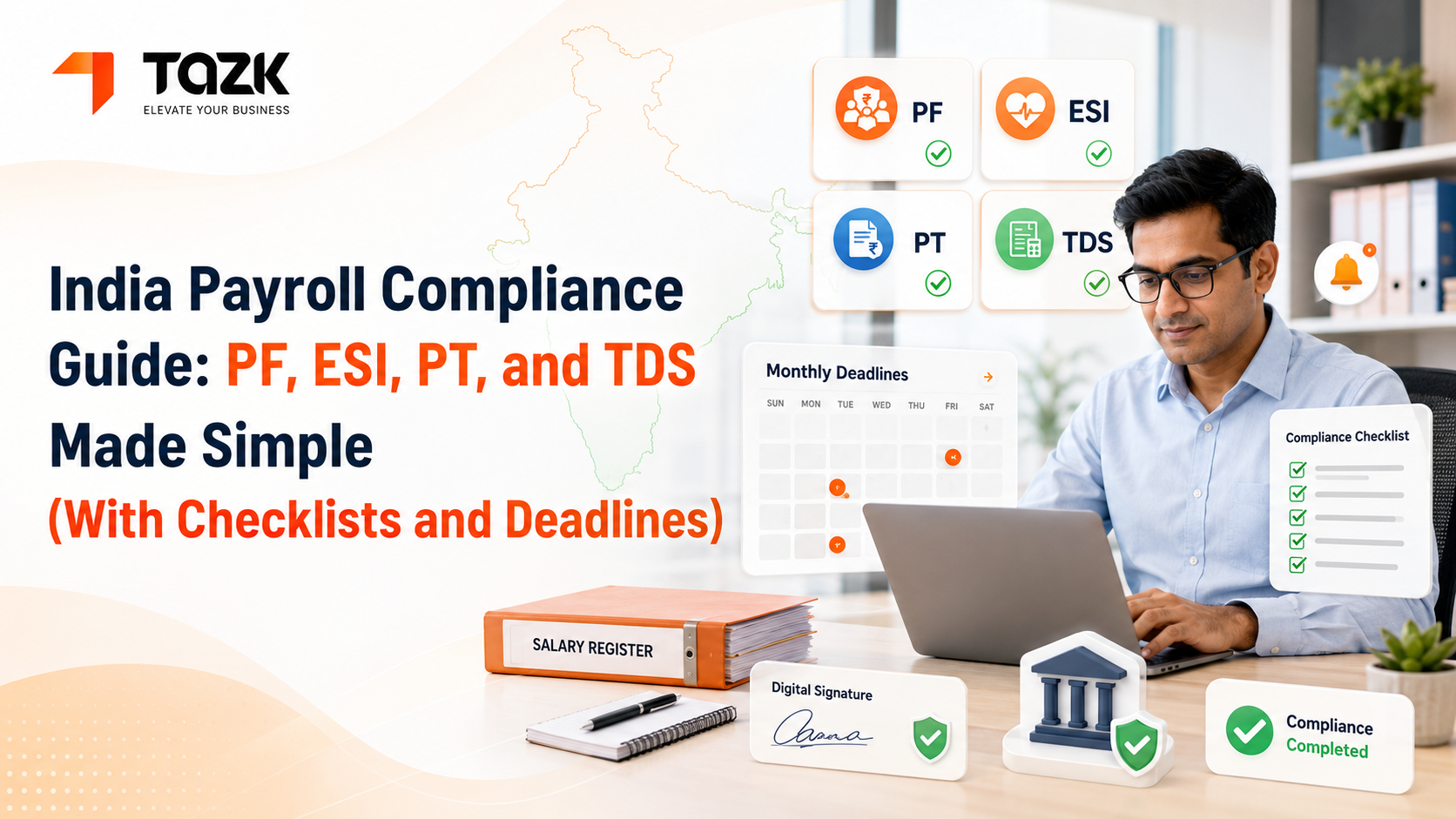
PF must be deposited by the 15th of the following month. ESI by the 21st. TDS by the 7th (with specific rules for March deposits). BCL India's employer branding research found that payroll processing delays are among the top five drivers of voluntary attrition in Indian SMBs — and delayed statutory deposits compound the problem by adding financial penalties on top of the reputational cost. Interest on delayed PF deposits runs at 12% per annum; damages range from 5% to 25% depending on the delay duration.
Spreadsheet-based payroll almost universally lacks automated deadline tracking. The deadline is someone's calendar reminder — and calendar reminders get missed during month-end close, during audit periods, or simply when the HR manager is on leave.
How Automated Payroll Eliminates These Five Errors
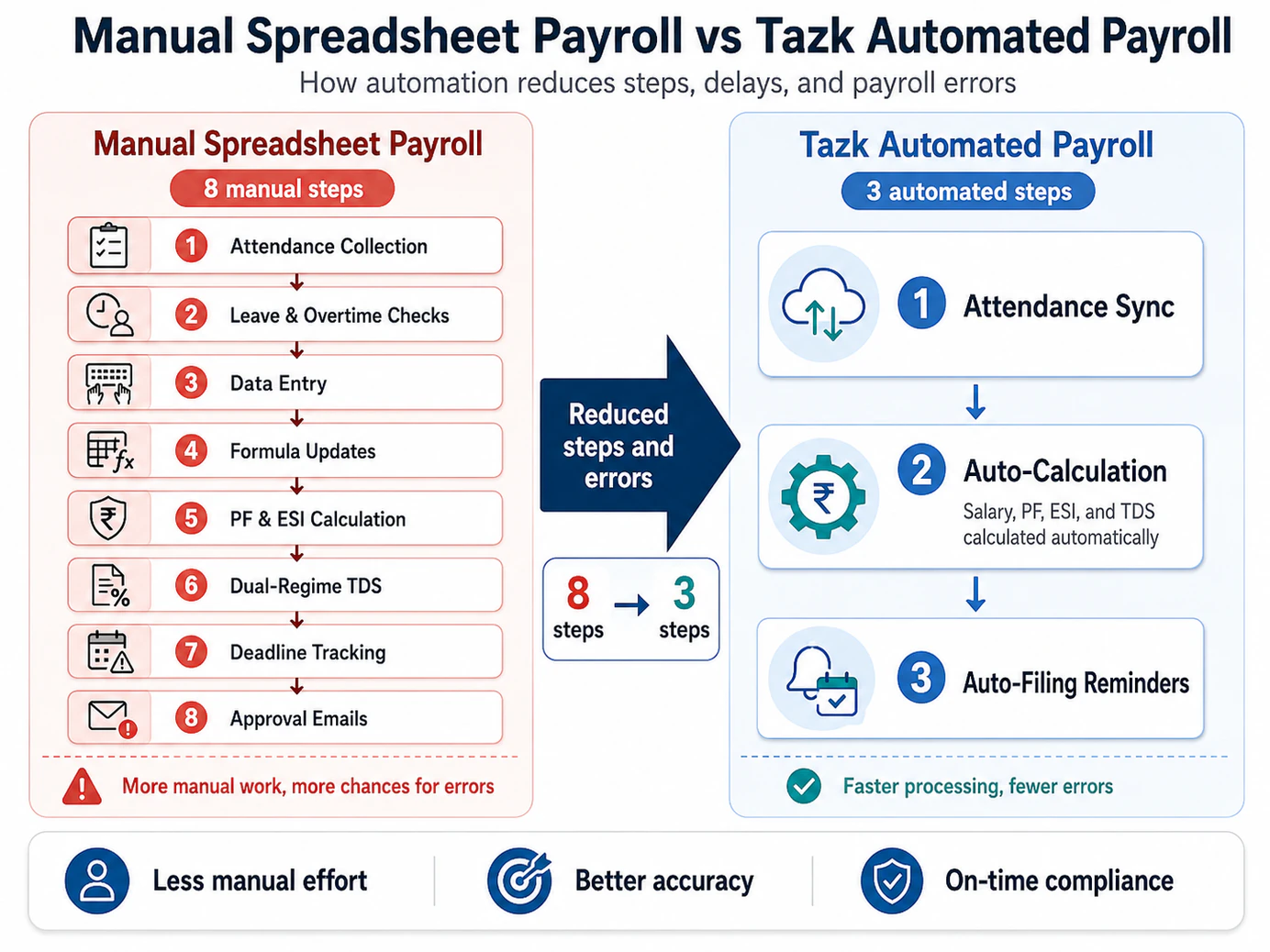
Tazk's payroll management software addresses each of these five failure points at the architecture level, not through checklists. PF wage base computation is rule-based, with configurable allowance classification that can be audited against your EPFO registration. ESI contribution period tracking automatically manages eligibility windows without mid-period manual adjustment. Tax regime TDS operates from employee declarations collected and stored digitally at the start of each FY, with year-end reconciliation alerts before March payroll runs. Attendance data flows directly from Tazk's HRMS module into LOP calculation — no manual entry, no disputes. And statutory payment deadlines are tracked with multi-level alerts: 7 days out, 3 days out, and day-of reminders ensure deposits never miss statutory due dates.
See how Tazk Payroll automates PF, ESI & salary calculation — book a live 20-minute demo with our payroll compliance team.