Your Field Sales Team Is Losing ₹3–4 Lakhs Every Month Without a Beat Plan — Here's the Proof, and the Fix
11 min | By Lokesh A
Table Of Contents
Social Media


Your Field Sales Team Is Losing ₹3–4 Lakhs Every Month Without a Beat Plan — Here's the Proof, and the Fix
Ask any FMCG distribution business owner or pharma sales head in India to describe their biggest operational problem and you will hear a version of the same answer: 'I don't really know what my field team does every day.' Routes are self-reported. Collections are logged in notebooks. Outlet visits are a matter of trust. And month after month, the gap between what the team claims to have done and what actually happened compounds silently into revenue the business never sees. FieldAssist's analysis of Indian FMCG field sales data, citing Bain & Company 2025 research, places this gap at ₹3–4 lakhs per month for a typical 12–15 person field sales team. This post breaks down exactly where that number comes from, and what a properly implemented beat plan closes.

Revenue Leak 1: Unoptimised Routes Burning Fuel and Time
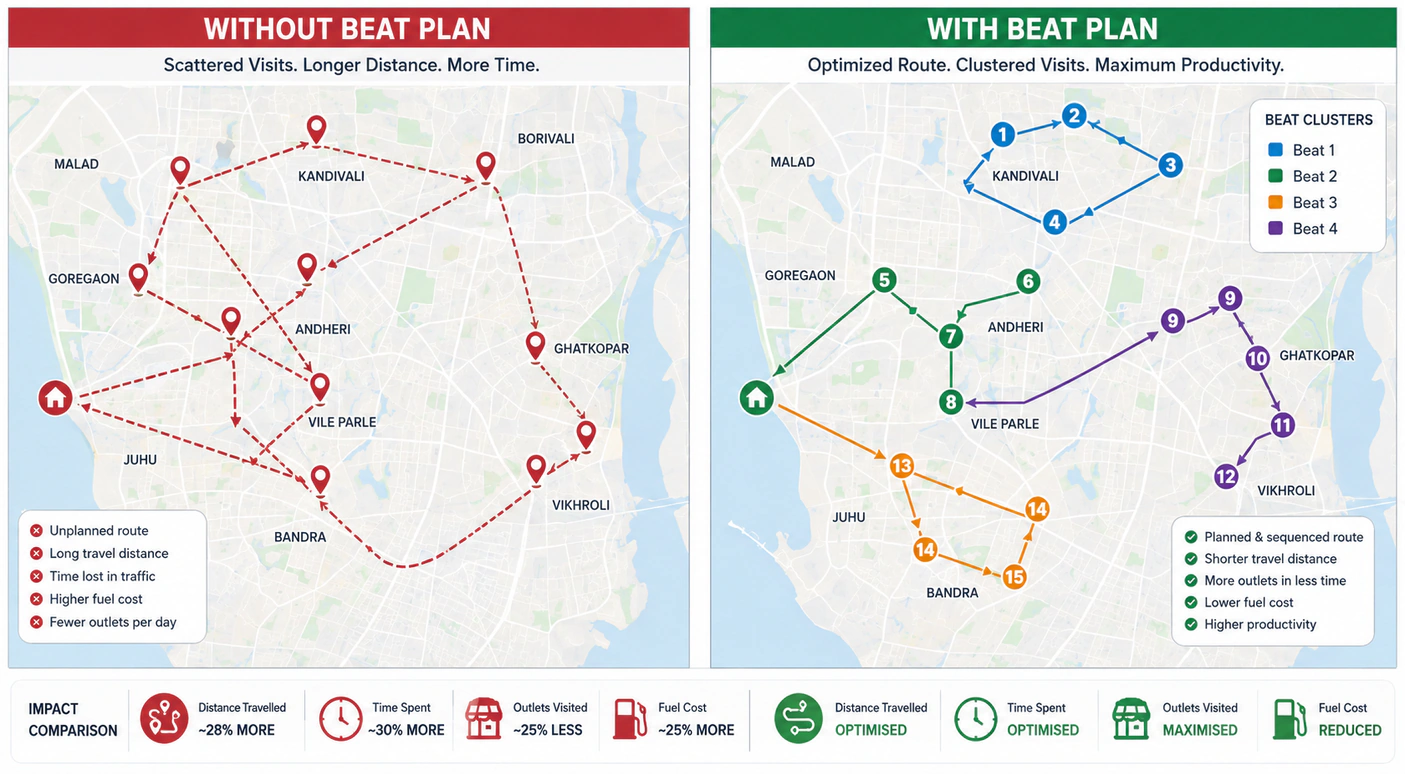
Without a structured beat plan, field reps design their own daily routes based on personal convenience, proximity to home, or familiarity — not outlet priority or business value. Proxima SFA's 2026 field sales software analysis estimates that unoptimised field sales routes waste 18–22% of a representative's productive day in excess travel time compared to GPS-optimised routes covering the same outlet set. For a 15-rep team at ₹45,000 average CTC per month, 20% of productive time is approximately ₹1.35 lakhs per month in compensation cost that generates no outlet visits and no orders.
The fuel cost is separate. At current petrol prices in tier-2 and tier-3 Indian cities, a 15-rep team running unoptimised routes typically burns ₹25,000–₹45,000 per month in excess fuel that a GPS-optimised route plan would eliminate. Combined, the route inefficiency cost alone is ₹1.5–1.8 lakhs monthly — before accounting for missed outlets and delayed collections.
Revenue Leak 2: Missed Outlet Visits — 180–240 Per Month
Every missed outlet visit is an order that did not happen, a competitor who filled the shelf instead, and a retailer relationship that frays slightly with each missed service cycle. Retail Insider's 2026 field sales technology report documents that unoptimised field teams miss 3–4 outlet visits per representative per week in Indian market conditions. For a 15-rep team, that is 45–60 outlet misses per week — approximately 180–240 missed outlet interactions per month.
Even if only 30% of those missed interactions would have resulted in an order at an average transaction value of ₹3,500, the monthly opportunity cost is ₹1.9–2.8 lakhs in orders that competitors are earning instead. High-priority outlets — the ones that account for 60–70% of total outlet volume — are also the ones that competitors are actively servicing. Without a system that tracks visit adherence and surfaces missed outlets to the sales manager in real time, these accounts gradually shift purchasing loyalty to whoever shows up consistently.
Revenue Leak 3: Untracked Collections — Bad Debt in Disguise
Indian distribution businesses operate heavily on credit. Retail partners typically get 15–45 day payment terms. Without real-time digital collection tracking, the field rep's notebook or memory becomes the de facto accounts receivable ledger — and a notebook can be misread, disputed, or 'lost' with no recovery option.
Distribution operations without digital collection tracking report outstanding payment ages of 60–90 days on accounts that should be settled in 30 days. For a business doing ₹40 lakhs per month in sales with an average 30-day credit cycle, a 30-day slippage on collections represents ₹40 lakhs of working capital tied up for an additional month. At the cost of working capital debt (typically 10–14% per annum in India), that is ₹33,000–₹47,000 per month in implicit financing cost — before accounting for receivables that eventually age into bad debt and are written off entirely.
Revenue Leak 4: No Real-Time Visibility for the Sales Manager
Without a beat plan app, the sales manager's only monitoring tool is the phone call. 'How many visits today?' 'Did you go to Rajeev Traders?' 'Why didn't you collect from Anand Wholesale?' This is reactive, not management — and it consumes 2–3 hours of the manager's day while producing unreliable data, because self-reported activity and actual activity frequently diverge.
The consequence: decisions about territory assignments, rep performance, and outlet prioritisation are made on gut feel rather than data. High-performing territories are not identified for expansion. Underperforming reps remain on the same territory because there is no objective performance record to trigger a structured conversation. High-value outlets that need more frequent service do not get it because no system surfaces the information.
Revenue Leak 5: Ghost Visits — The Silent Integrity Problem
A ghost visit occurs when a rep logs a customer visit that did not happen. Without GPS-verified check-in, a field visit app becomes an alibi app. Field sales managers who implement GPS-verified check-in systems consistently report a 15–25% gap between self-reported visit counts and GPS-verified visit counts during the first 30 days after implementation — before the new system becomes the new normal. Once GPS verification is the standard, this gap closes and the underlying behaviour changes.
What a Proper Beat Plan Module Does for Indian Field Teams
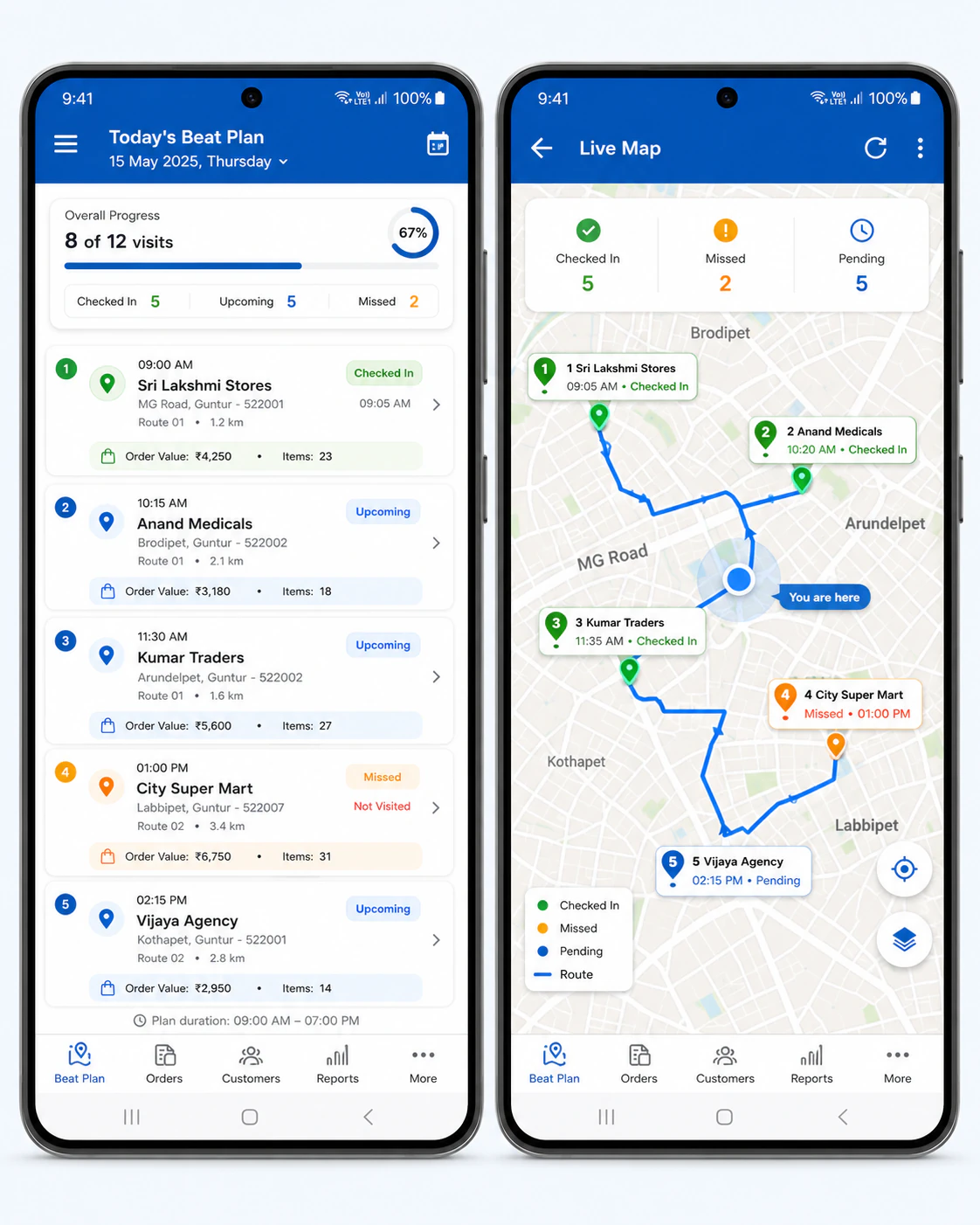
A field sales beat plan module built specifically for Indian conditions assigns optimal daily routes based on outlet priority, geography, visit frequency requirements, and territory design — not the rep's preference. It requires GPS check-in and check-out at each outlet, making ghost visits detectable. It captures orders, applied trade schemes, stock checks, and merchandising notes at point-of-visit on the rep's mobile, including in areas with poor connectivity (offline-first sync architecture). It tracks collections against outstanding invoices in real time. It alerts the sales manager when visits are missed or when reps fall behind schedule. And it generates daily and weekly performance dashboards — visits completed, orders captured, collections logged, outlets not covered — that make manager reviews evidence-based rather than opinion-based.
How Tazk's Sales and Field Management Module Delivers This
Tazk's field sales and CRM module gives your team the complete beat plan and real-time tracking capability — integrated directly with the same platform managing your billing, inventory, and payroll. There is no separate SFA software subscription, no duplicate data entry between sales app and ERP, and no disconnect between what the field team records and what appears in the business's financial systems. Your sales head sees a live dashboard of today's field activity. Each rep sees their planned day-route on their mobile the moment they log in. Your accounts team sees collection receipts posted in real time as reps log them. Your GM sees weekly trends in outlet coverage, order conversion rates, and collection efficiency — without asking anyone for a report.
The ₹3–4 lakh monthly leak does not disappear overnight — it closes gradually as the new system becomes operational habit. Most businesses using Tazk's beat plan and field management system recover 60–70% of the identified revenue within the first 90 days.
Book a live demo — see Tazk's beat plan, real-time GPS tracking, and collection management on mobile. Takes 20 minutes. Schedule your demo here.