Tazk vs Petpooja (2026): Best Billing & Back-Office Software for Restaurants Growing Beyond One Outlet
13 min read | By Lokesh A
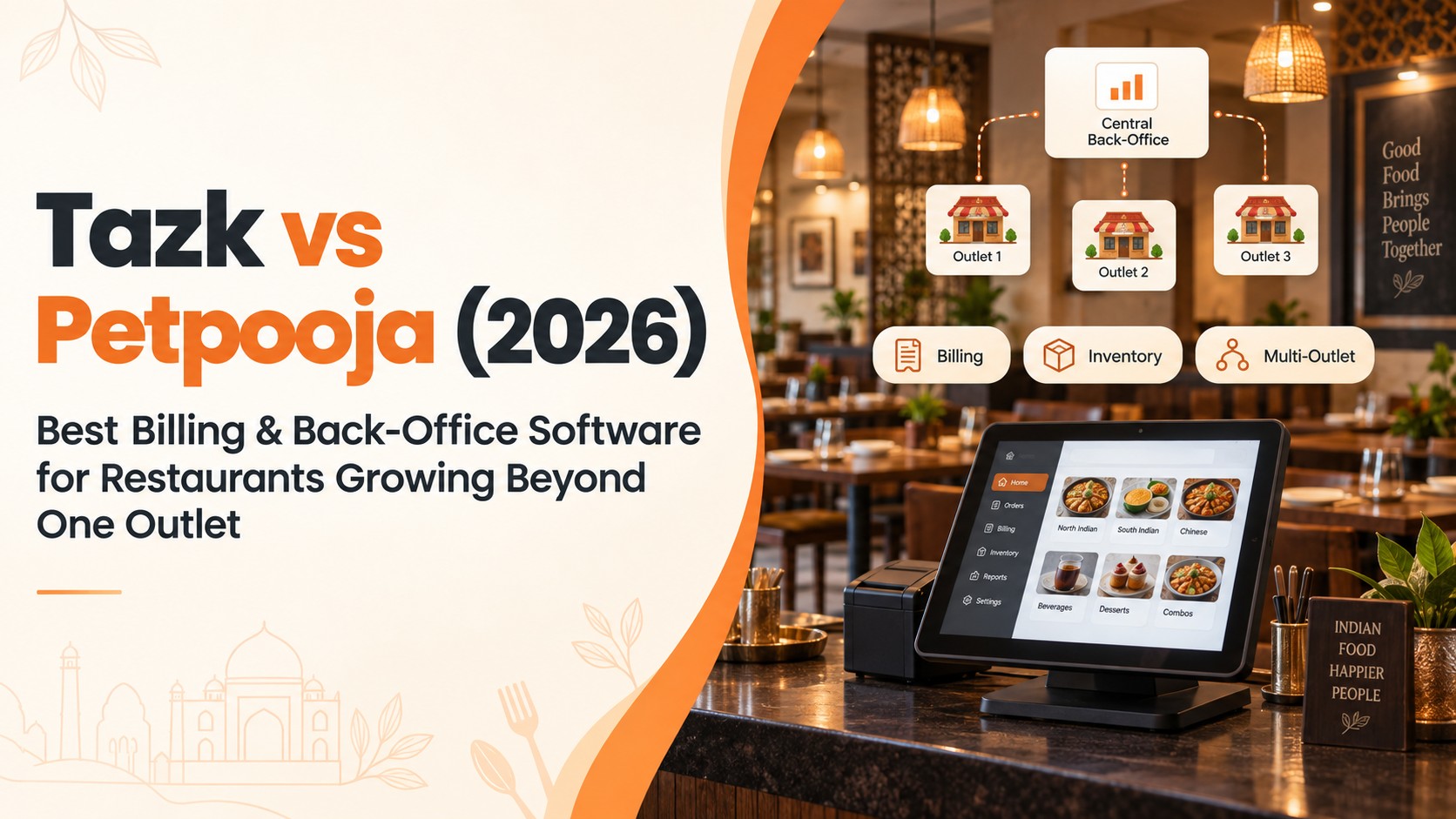
Table Of Contents
Social Media




A question that comes up a lot
Imagine you run a busy restaurant in Coimbatore. Two years ago, you picked Petpooja for billing. It worked well. Orders went to the kitchen fast. Zomato and Swiggy orders came in without much fuss.
Now things have changed. You've opened a small retail counter selling snacks and packaged foods next door. You're planning a second restaurant branch across town. And you're tired of running payroll for 22 staff on a separate spreadsheet.
Suddenly, your restaurant-only software feels like it's built for a business you no longer are.
This is one of the most common questions Indian F&B owners search for today: Tazk vs Petpooja — which one actually fits a growing business? This article gives you an honest, detailed answer. No exaggeration on either side.
What Is Petpooja?
Petpooja is a cloud-based restaurant billing and management system. It was started in 2011 in Ahmedabad, by two founders named Parthiv Patel and Apurv Patel. Today, it's used by more than 100,000 food outlets across India — from single cafés to large chains.
Petpooja focuses on one thing and does it well: running the front and back of a restaurant. That means billing, kitchen order tickets (called KOTs), inventory, and connecting to food delivery apps like Zomato and Swiggy.
Petpooja is especially strong in Tier 2 and Tier 3 Indian cities, where it has built years of trust with restaurant owners.
What Petpooja Does Well
To be fair, Petpooja earns its popularity. Real user reviews consistently point to a few genuine strengths:
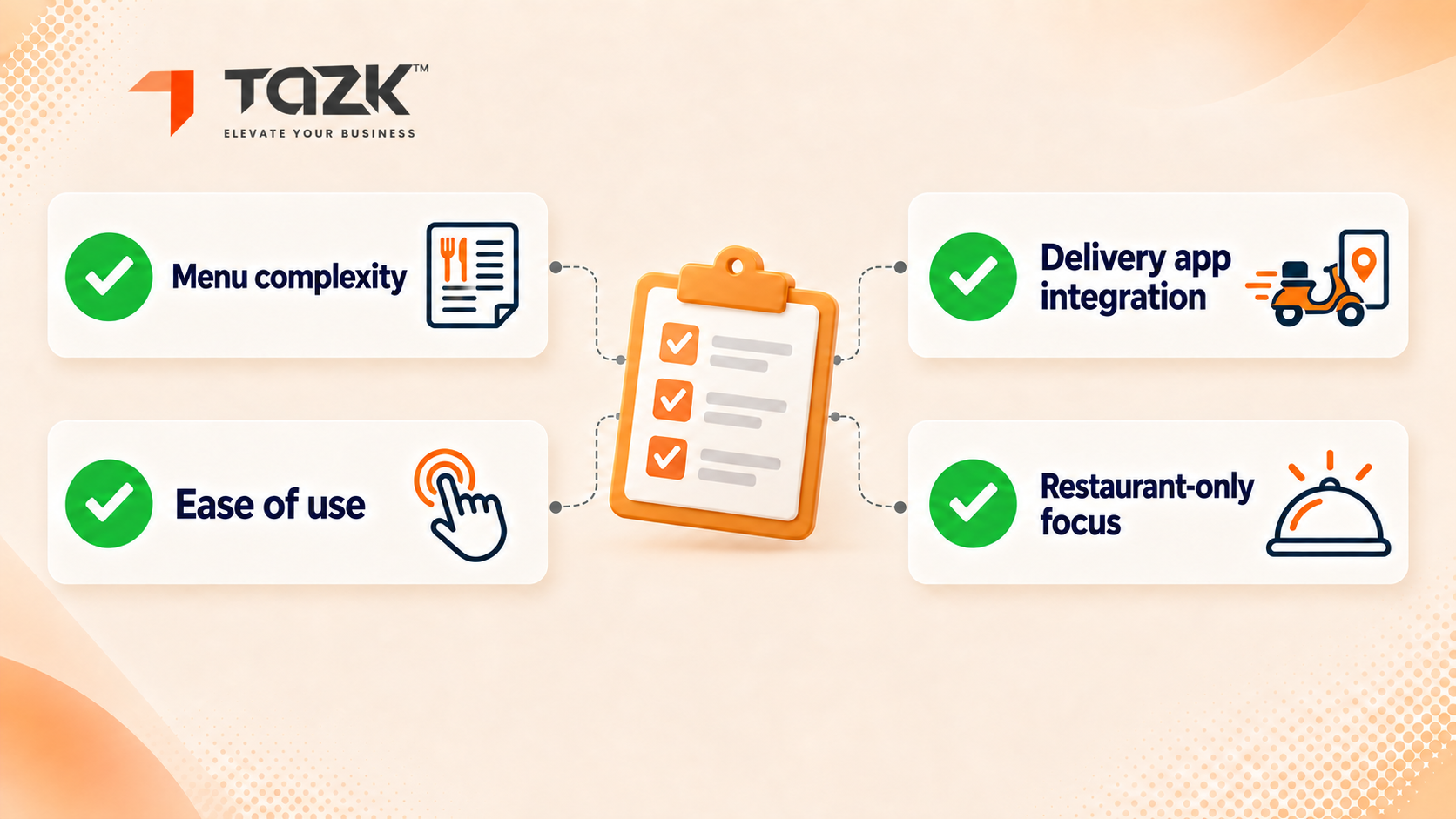
- It handles complex menus well. If your restaurant has 200-plus items, with variants and combo deals, Petpooja manages that complexity better than many competitors.
- It's easy to learn. Most staff, even without much tech experience, pick it up quickly
- It integrates smoothly with food delivery apps. Orders from Zomato, Swiggy, and similar platforms usually flow in without much manual work.
- It has a large, established user base. With over 100,000 outlets already using it, there's a lot of shared experience and know-how in the market.
If your business is a single restaurant, with no plans to add other kinds of operations, Petpooja is a genuinely solid choice. This comparison isn't about pretending otherwise
Where Petpooja Runs Into Limits
Here's where things get more specific — and where growing businesses start to feel friction.
1. Pricing isn't public, and real costs add up. Petpooja doesn't publish its pricing openly. You need to talk to their sales team. Pricing usually comes bundled with hardware and an annual contract. Restaurant owners commonly report paying somewhere between ₹15,000 and ₹30,000 a year for a single outlet. That climbs further once you add inventory, CRM, or online-ordering modules separately (source: DineOpen, Petpooja Review 2026). Many genuinely useful features — like loyalty programs and WhatsApp ordering — cost extra, on top of the base plan.
2. Support can be slow outside normal hours. Multiple reviews on G2 and Capterra mention this problem. Getting help late at night can take a while. That's exactly when a busy bar or cloud kitchen might need it most (source: G2, Petpooja POSS Reviews). Support is also largely based out of Ahmedabad. That can mean less familiarity with regional needs elsewhere in India.
3. The interface feels dated to newer users. Compared to newer, more visual POS systems, Petpooja's screens can feel cluttered. Staff training often takes longer than it needs to, especially for people who aren't very comfortable with technology (source: DineOpen).
4. AI-based features are still limited. In 2026, features like predictive inventory, voice ordering, and smart menu suggestions are becoming common in newer POS platforms. Petpooja has moved more slowly here.
5. It doesn't manage a business beyond food and beverage. This is the big one. Petpooja was built for restaurants — full stop. If you add a retail counter, a second business line, field sales, or a growing HR and payroll need, none of that lives inside Petpooja. You end up buying, and manually connecting, separate tools.
What Changes When You're Not "Just a Restaurant" Anymore
This is exactly the gap Tazk is built to close.
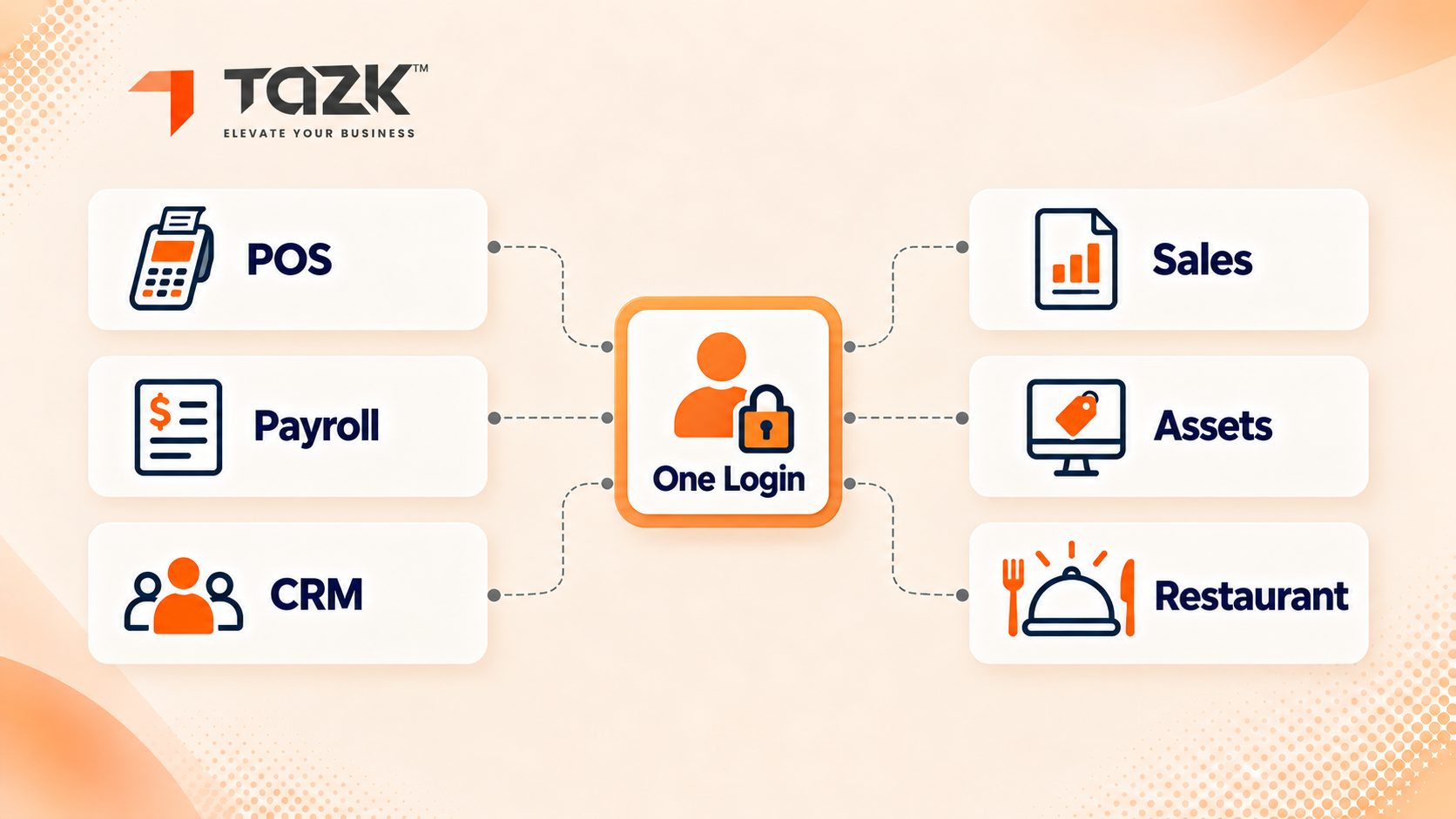
Tazk isn't a restaurant-only tool that we're trying to stretch into other areas. It's a single business platform — Restaurant management, POS, Payroll & HRMS, CRM, Sales, and Assets — all under one login.
Here's what that means in practice for a growing F&B business:
- Billing works the same way at your restaurant counter and your retail counter. No second system, no separate reports to reconcile at month-end.
- Payroll and attendance are built in, not bolted on. Kitchen staff, servers, and delivery riders can all be paid correctly from the same attendance data. This includes GPS and face-recognition attendance for people who aren't sitting at a fixed counter all day
- Inventory and billing talk to each other automatically, whether you're tracking raw ingredients for the kitchen or packaged snacks for the retail shelf.
- You get GST-ready billing for both restaurant and retail sales, from day one.
Feature-by-Feature Comparison
| Feature | Petpooja | Tazk |
|---|---|---|
| Restaurant billing & KOT | Yes | Yes, strong |
| Retail / non-food billing | No | Yes |
| Food delivery app integration | Yes, mature | Yes |
| Payroll & HR built in | No | Yes |
| Field sales / distribution | No | Yes |
| Asset tracking | No | Yes |
| Offline billing during outages | Partial, sync delays reported | Yes |
| Pricing transparency | Contact sales, bundled hardware | Published starter plan, free tier available |
| Setup / go-live time | hardware dependent | Typically 2 -3 working days, |
This table isn't meant to declare a universal winner. A single-location restaurant with no other plans may still be well served by Petpooja's deep restaurant focus. But a business managing more than food — or planning to — usually starts running into the walls this table shows.
What About Running Multiple Restaurant Branches?
Here's something worth flagging even if you never touch retail at all. Say you stay purely in food service, but you open a second and third restaurant branch.
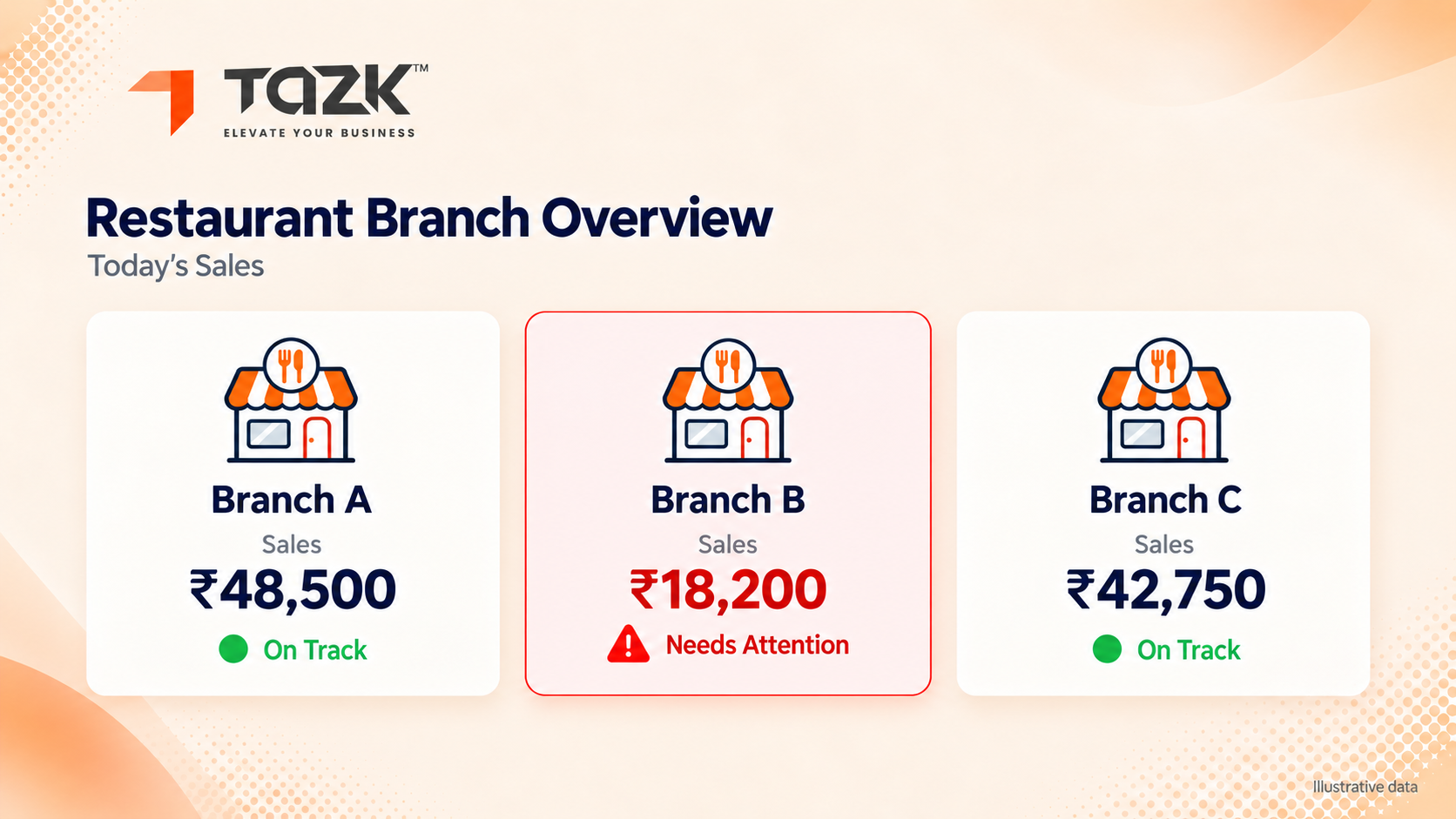
Petpooja is generally licensed and set up per outlet. Each branch effectively runs its own system. Head office can pull reports from each one, but a single, live, combined view across branches isn't naturally built into the core product the way it is in platforms designed around multi-location management from day one.
This matters more than it sounds. If Branch A is quietly losing money on food waste while Branch B is thriving, you want to see that gap the same week — not at the end of the month, after someone manually combines three separate exports.
Tazk's dashboards are built around exactly this. Owners and managers see sales, staff attendance, and inventory across every branch on one screen, with the ability to drill into a single location when something looks off. We cover this pattern in more depth in our guide on payroll and attendance for multi-location restaurant and retail chains
Pricing — What You Actually Pay For
Petpooja's pricing model bundles software with hardware. It also locks you into an annual contract. Many small owners say they didn't fully understand the total cost until after signing (source: DineOpen).
Tazk works differently. There's a free starter plan with no time limit and no credit card required. You can genuinely test the system with your real menu and real staff before paying anything. You add modules — like payroll or CRM — only when your business actually needs them. You don't pay for a bundle you might grow into someday.
This difference matters most in year two or three, not on day one. A single-outlet restaurant might not notice much difference in month one. But once you're deciding whether to add a second branch, or whether to finally digitise payroll, a system that already has those modules ready — at a clear, incremental cost — is a very different position to be in than starting a fresh vendor search from scratch
A Realistic Example
Picture a restaurant owner in Madurai running one popular outlet on Petpooja for three years. Business grows. She opens a second branch and adds a small retail counter selling her own packaged pickles and snacks.
Within months, she's juggling problems that have nothing to do with food quality. Two separate KOT systems that don't share data. A spreadsheet for payroll across both locations, updated by hand every month. No single view of which branch is actually more profitable once staff costs are counted in.
Her accountant flags a bigger issue: professional tax and staff attendance records for the new branch aren't tracked the same way as the original outlet, because nobody set up a consistent process when the second location opened.
After switching her whole operation — both restaurant branches and the retail counter — onto one platform, the change wasn't really about better food billing. Petpooja already did that part well. It was about finally seeing payroll, inventory, and sales across both branches on one screen, without exporting anything to Excel first, and without wondering if this month's numbers from Branch 2 were even entered correctly.
What's Changing Next
AI features are becoming a real differentiator, not a nice-to-have. Predictive inventory, smart reordering, and voice-assisted ordering keep maturing through 2026 and beyond. Restaurant software that can't keep pace on AI will start to feel noticeably behind. That's true even when its core billing is still strong.
"All-in-one" is winning over "best-of-breed" for growing SMBs. Indian small business owners increasingly say they'd rather manage one login and one support number. Stitching together several specialist tools that don't talk to each other is starting to feel like the old way of doing things, not the safe choice.
Offline-first billing will matter more, not less. More F&B businesses are expanding into Tier 2 and Tier 3 towns. Power and internet reliability still vary a lot in these areas, so billing that keeps working through an outage stops being a nice extra and becomes a real requirement.
For more on running a retail counter without depending on constant internet, see our guide on POS setup for Indian retail.
Petpooja is a strong, focused restaurant tool — and if food service is genuinely all your business will ever be, it remains a reasonable choice. But the moment your business adds a second location, a retail line, or outgrows spreadsheet payroll, the cost of stitching together separate tools starts to outweigh whatever you saved on the software itself.
Start a free trial and see POS, kitchen billing, payroll, and inventory in one login. Sign up free or book a live demo today.
Related reading on the Tazk blog
- Top 10 POS Software in India (2026): Comparison Checklist
- POS Software in Chennai: Retail Setup Guide 2026
- Tazk vs Zoho vs Vyapar vs Tally
- The Complete Guide to Attendance and Payroll Software in India
External sources referenced in this article
- DineOpen — Petpooja Review 2026: Real Pricing, Hidden Fees & Better Alternatives
- G2 — Petpooja POSS Reviews
- SpotSaaS — Petpooja POS Software Review 2026
Petpooja is a registered trademark of its respective owner. This comparison is based on publicly available information and user reviews as of September 2026, and is intended to help business owners evaluate their options — always confirm current pricing and features directly with each vendor
Ready to upgrade your retail billing?
Tazk POS handles billing, inventory, GST invoices, and multi-store management. Free plan available — no credit card required.
Free plan available. No credit card required. Go live in hours.