Tazk vs Zoho vs Vyapar vs Tally: Which Business Management Software Actually Delivers for Indian SMBs in 2026?
13 min | By Lokesh A
Table Of Contents
Social Media


Tazk vs Zoho vs Vyapar vs Tally: Which Business Management Software Actually Delivers for Indian SMBs in 2026?
Every Indian SMB owner eventually faces this conversation. You outgrow Excel. Your accountant insists on Tally. Someone in a business WhatsApp group swears by Vyapar. A sales representative pitches Zoho. And somewhere in the mix, someone mentions Tazk. Four products, four passionate user bases, and four completely different philosophies about what business software is supposed to do.
This is not a sponsored comparison. We are going to be honest about what each platform does well and where it falls short — because choosing the wrong software costs you not just money, but the months of implementation effort before you realise the tool does not fit your operations. Sources used in this comparison include G2 user review data, SaaSworthy's category comparison, and BluePeacock's 2026 India accounting software analysis.
Who Each Platform Is Actually Built For
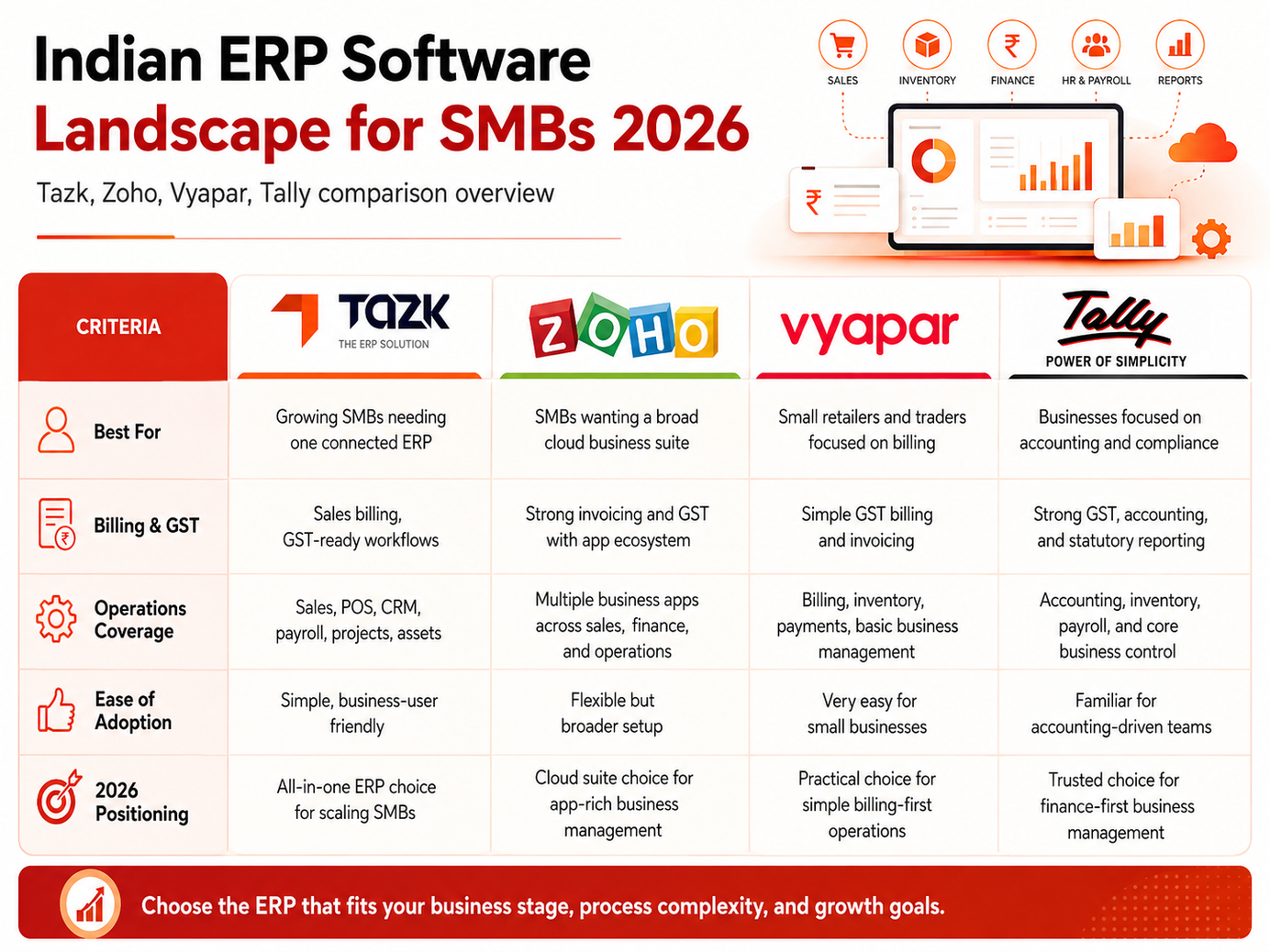
Tazk was built specifically for Indian SMBs that need operations — sales pipeline and CRM, field sales beat plans for distributor-facing teams, point-of-sale billing, multi-location inventory, and payroll with PF/ESI/TDS compliance — without managing four separate software subscriptions.
Zoho Books (and Zoho One) was built for global businesses with India GST support layered on. Zoho's architecture is modular — separate products for accounting, CRM, inventory, payroll — that communicate well when configured correctly, but you are assembling a stack, not using a single integrated product. For service businesses already inside the Zoho ecosystem, this modularity is a strength. For businesses that need to move fast, it is complexity. We break this down in more detail in our Tazk CRM vs Zoho comparison.
Vyapar was built for micro and small businesses that need GST billing and basic inventory tracking with minimal learning curve. The Android app is genuinely excellent for solo operators and small shop owners. Its greatest strength — radical simplicity — is also its ceiling: no payroll, no CRM, no field sales, no multi-branch inventory.
Tally Prime was built for Indian businesses where accountant-managed books are the primary requirement. Tally has decades of trust from the Indian CA community and deep accounting capability. What Accountune's 2026 Tally alternative analysis makes clear: 'Tally Prime is the most powerful accounting tool and the least capable operations platform' in the Indian SMB market. There is no CRM, no field sales module, no native mobile access, and no payroll system that qualifies as HRMS by 2026 standards.
Feature-by-Feature: What Each Platform Actually Delivers
GST Compliance and e-Invoicing
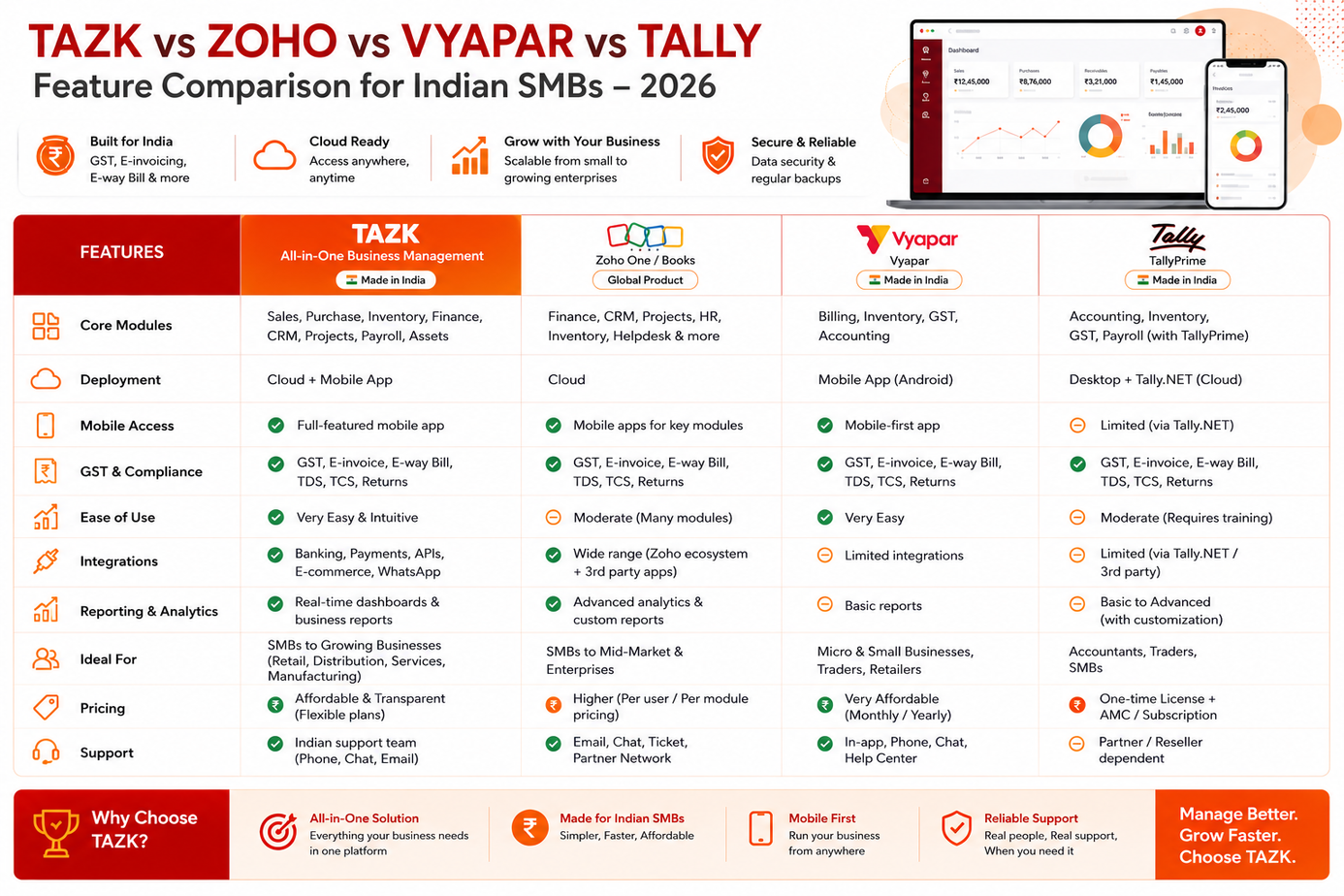
All four platforms support GST-compliant billing and GSTR-1/GSTR-3B computation. The differentiation is in e-invoicing automation. Tazk's GST billing module integrates directly with IRPs — IRN and QR code are embedded on every B2B invoice without leaving the platform. Tally Prime has built-in e-invoicing through its connected GST features. Zoho Books has e-invoicing through its GST filing module. Vyapar supports e-invoicing on higher-tier plans but requires additional configuration.
Inventory and Stock Management
Tazk provides multi-branch, real-time inventory synchronisation — stock at Branch A is visible from Branch B, transfers are logged, and reorder alerts fire automatically. Tally Prime has robust inventory with batch tracking and bill of materials for manufacturers. Zoho Books handles basic inventory for service businesses; product-heavy businesses typically need Zoho Inventory as a separate module. Vyapar has basic inventory tracking suitable for single-location businesses with simple SKU ranges.
Point of Sale
Tazk's POS module runs on mobile, tablet, or desktop — the same platform, not a separate app. It supports barcode scanning, UPI payments, cash management, GST billing at the counter, and real-time central inventory sync. Zoho has a separate Retail POS product with its own licensing. Tally Prime has a POS module, primarily desktop-based and not optimised for mobile-first retail. Vyapar has no dedicated POS module. For a direct look at this specific matchup, see Tazk POS vs Tally.
Field Sales, Beat Plan, and CRM
Tazk's beat plan and CRM module provides GPS-tracked route planning, visit verification, order capture in the field, collection recording, and manager dashboards — all native to the platform. Zoho CRM is capable but a separate module with separate licensing, designed for office-based pipeline management rather than field rep outlet visits. Tally Prime and Vyapar have no CRM or field sales capability.
Payroll and HRMS
Tazk's payroll module handles salary structure configuration, PF and ESI calculations on the correct wage components, dual tax regime TDS management, Form 16 generation, and salary slips — with a leave management module that connects directly to payroll so LOP days are never manually re-entered. Zoho Payroll is a separate, India-specific module that covers statutory requirements but adds cost. Tally Prime has a payroll module for statutory compliance but lacks employee self-service and the HR workflow features of a modern HRMS. Vyapar has no payroll capability.
Mobile Access and Cloud Architecture
Tazk is cloud-native and mobile-first — designed from the start for a business owner who checks sales numbers from a phone at 9 PM and a field rep who captures orders from an outlet. Zoho Books and its modules are cloud-based with functional mobile apps, though the admin experience is more desktop-oriented. Vyapar started as an Android app and retains genuine offline capability — a real advantage for businesses in areas with unreliable connectivity. BluePeacock's analysis summarises Tally's position: 'Tally remains dominant due to audit acceptance, but lacks a native cloud/mobile architecture.' Cloud usage depends on third-party hosting, increasing TCO.
Pricing: What You Actually Pay in 2026
Pricing changes frequently — verify current plans directly with each vendor. As of mid-2026, based on Accountune's Tally alternative comparison: Vyapar desktop is approximately ₹4,353 per year; the combined web, Android, and iOS plan is around ₹5,999. Tally Prime Silver (single user) is approximately ₹22,500 as a one-time licence fee plus ₹4,500 per year AMC. Zoho Books is free for turnover below $50,000 USD; paid plans scale with users and modules. Zoho One is ₹2,800–3,500 per user per month. Tazk's ERP is priced for the Indian SMB market — contact the team for a module-specific quote.
The pricing comparison alone does not tell the full story. A ₹4,353 Vyapar licence that cannot handle payroll or CRM means you are also paying for separate payroll software and managing sales on WhatsApp — the combined cost of the fragmented stack often exceeds a more capable integrated platform.
When Should You Choose Each Platform?
Choose Tazk if your business has field sales or distribution operations, a retail store (or multiple stores), employees that need managed payroll, a sales pipeline that needs systematic follow-up, or any combination of these. If you want one login, one dataset, and one vendor relationship for operations + sales + HR + POS, Tazk was built for this.
Choose Zoho if you already use Zoho CRM or are deeply embedded in the Zoho ecosystem, and your business is primarily service-oriented with no complex multi-branch inventory or field sales requirements. International operations are another valid reason — Zoho's global compliance and multi-currency support are genuine strengths.
Choose Vyapar if you are a micro-business or sole proprietor who needs clean GST billing and basic inventory tracking with minimal learning curve. If your team is two to three people and you do not need payroll, CRM, or field ops, Vyapar's simplicity and offline capability are genuine advantages.
Choose Tally Prime if your CA insists on it, your business is audit-heavy, and your accountants have years of Tally workflow built up. Understand that you will need separate tools for sales, HR, and any field operations.
The Hidden Cost of Running a Fragmented Software Stack
The majority of Indian SMBs that move to Tazk were running a fragmented stack: Vyapar or Tally for invoicing, a separate HR software for payroll, WhatsApp groups for sales coordination, and Excel for everything else. Every data transfer between these tools is manual. Every month-end involves someone copying invoice totals into a GST filing tool, reconciling payroll data against attendance records in a spreadsheet, and chasing field sales staff for updates that should be captured automatically. BluePeacock's 2026 analysis identifies this exact pattern: 'Three-Software Stack: SMEs often operate Vyapar (Invoicing) + Suvit (Data Transfer) + Tally (Accounting), leading to manual reconciliations and limited automation.'
This fragmentation is not a line item on any budget — it is absorbed as working hours, errors, and delayed decisions. Integrated software does not just save time — it enables a quality of operational decision-making that the fragmented stack structurally cannot support. If your business is still running on Excel alongside these tools, our Tazk vs spreadsheets comparison covers what changes when that layer goes away.
Start a free trial of Tazk — we will help you import your data from Tally or any other system and go live within days, not months. Begin your free trial here.