What Is a Beat Plan, and How Do You Build One Your Field Team Will Actually Follow?
11 min read | By Tazk Team

Table Of Contents
Social Media


Picture a normal Monday for a field salesperson. He starts his bike, thinks for a minute, and heads to the shops he knows best. The friendly shop owner near the bus stand gets a visit. The big store across the flyover, which always argues about schemes, gets skipped again. By evening, he has made 18 visits. But the three outlets that buy the most from you did not see anyone this week.
Nobody did anything wrong on purpose. There was simply no plan.
That is the problem a beat plan fixes. In this guide, we explain the beat plan meaning in plain words, show a simple beat plan format, and walk you through how to make a beat plan your team will actually follow. You can also download our free weekly sales beat plan template at the end.
Why trust this guide?
This guide is written by the team at Tazk. We build business software for Indian companies, including a field sales app that distributors and sales teams use to plan visits, book orders and record collections. The steps below come from how sales managers in FMCG, pharma and hardware distribution plan their weeks. We have kept the examples neutral and have not named any customer
What is a beat plan in field sales?
A beat plan is a fixed weekly schedule that tells each field salesperson three things:
- Where to go: the list of outlets (shops, chemists, dealers or clinics) in their area.
- When to go: which day each outlet is visited and how often.
- What to do there: take an order, collect money, check stock, explain a scheme or fix a complaint.
A "beat" is one day's route. If a rep works six days a week, they usually have six beats. Beat 1 is Monday's route, Beat 2 is Tuesday's route, and so on. Every week, the same outlets come up on the same day. The shop owner starts to expect the visit, and the rep stops wasting time deciding where to go.
You may also hear the term journey plan or PJP (permanent journey plan). These mean almost the same thing. Some companies use "journey plan" for the monthly calendar and "beat" for one day's route. The idea is the same: a planned route, not a random one.
What a beat plan is not: It is not a target sheet. Targets say how much to sell. A beat plan says where and when to show up so the selling can happen.
How do I build a weekly beat plan for my field team?
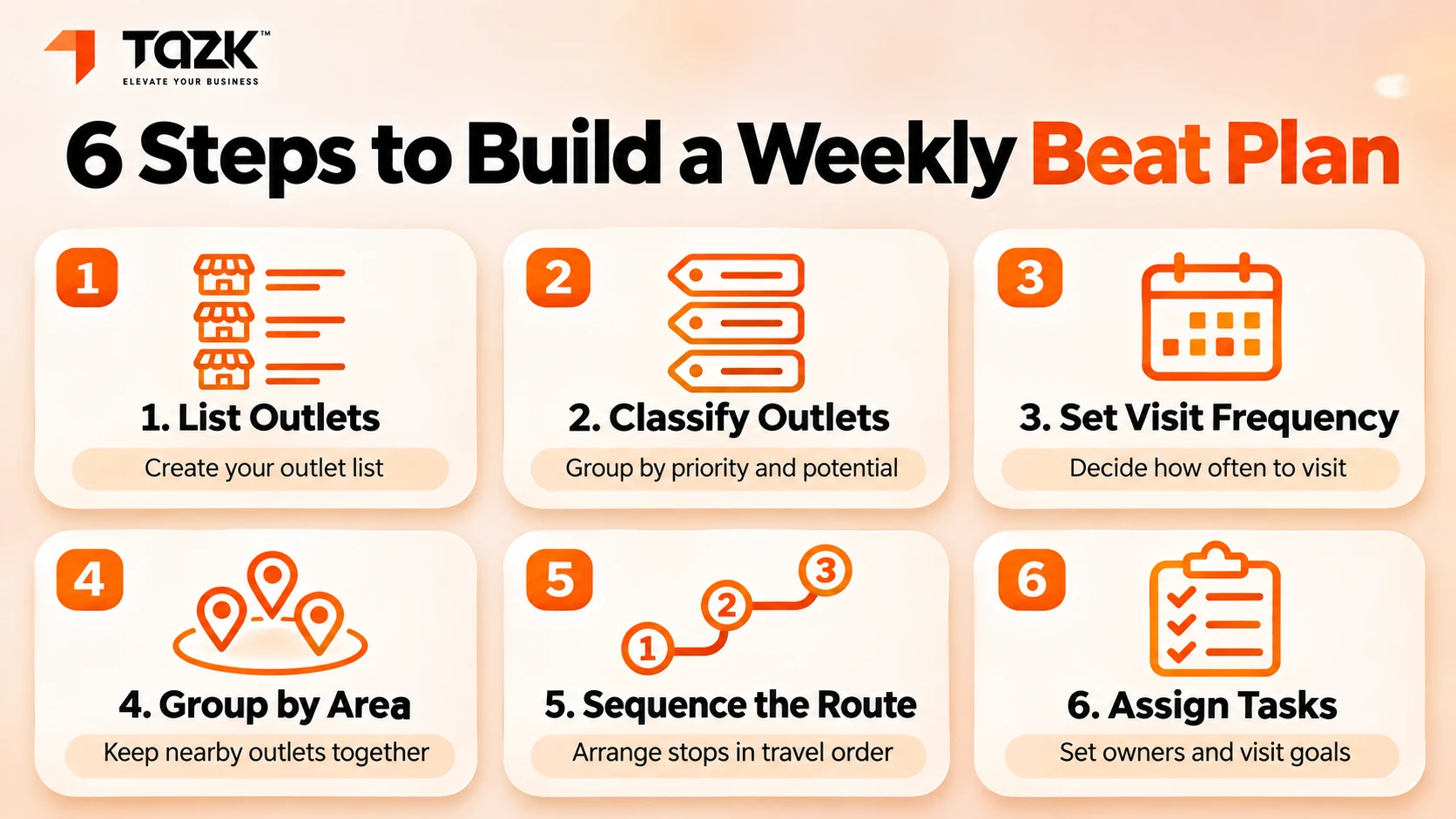
You can build your first beat plan in an afternoon with a spreadsheet. Follow these six steps.
Step 1: List every outlet. Write down every outlet in the territory. Add the address, area, phone number, owner's name, and how much they bought from you in the last three months. If you are a distributor, your billing data already has most of this.
Step 2: Classify the outlets. Sort outlets into classes based on their sales or potential. The simplest outlet classification is A, B and C:
- A outlets: your biggest buyers. Often a small group of outlets brings in a large share of sales.
- B outlets: regular, steady buyers.
- C outlets: small or occasional buyers, and new outlets you want to grow.
Step 3: Decide the visit frequency. Bigger outlets get more visits. We cover this in the next section.
Step 4: Group outlets by area. Put outlets that sit close to each other into the same beat. One beat should be a route a rep can finish in one working day.
Step 5: Set the route sequence. Arrange the outlets in each beat in the order the rep will visit them. Start near the rep's home or the depot, move in one direction, and end close to home. Avoid zig-zagging across a main road or a railway line.
Step 6: Write down the task at each stop. For each outlet, note what the rep should do: book an order, collect a payment, check stock and schemes, or place display material.
A simple beat plan format
Here is a sample beat plan format for one rep with six beats. Your numbers will be different. Use it as a starting point.
| Day | Beat name | Area | A outlets | B outlets | C outlets | Total visits | Main tasks |
|---|---|---|---|---|---|---|---|
| Monday | Beat 1 | Market Road and Bus Stand | 4 | 8 | 10 | 22 | Orders, scheme check |
| Tuesday | Beat 2 | Station Road | 3 | 9 | 10 | 22 | Orders, collections |
| Wednesday | Beat 3 | Industrial Estate | 5 | 7 | 8 | 20 | Orders, stock check |
| Thursday | Beat 4 | Market Road (repeat A outlets) and Temple Street | 4 | 8 | 10 | 22 | Orders, collections |
| Friday | Beat 5 | New Colony | 2 | 9 | 12 | 23 | New outlets, orders |
| Saturday | Beat 6 | Old Town | 3 | 8 | 10 | 21 | Collections, weekly due list |
For each outlet inside a beat, keep one row with: outlet name, class, sequence number, phone, last order date, amount due and the task for this visit. That one sheet is your sales beat plan template.
How often should each outlet be visited?
Visit frequency depends on how much the outlet buys and how fast your products sell there. A simple rule many sales teams start with:
| Outlet class | Suggested visit frequency | Why |
|---|---|---|
| A | Once or twice a week | They sell fast. Missing one visit can mean an empty shelf. |
| B | Once a week | Steady buyers. A weekly visit keeps orders regular. |
| C | Once every two weeks | Smaller orders. Too many visits cost more than they bring in. |
| New or inactive | Once every two weeks, then review | Give them a chance to grow, then reclassify. |
Two tips help here:
- Match the visit to the stock cycle. If a chemist reorders every 10 days, a weekly visit is enough. If a grocery store sells your product out in three days, plan two visits.
- Review classes every quarter. A C outlet that has grown should move up to B. An A outlet that has stopped buying needs a talk, not more visits.
Remember, every extra visit costs fuel and time. The goal is the right number of visits, not the most visits.
How do I add collections and order booking to a beat plan?
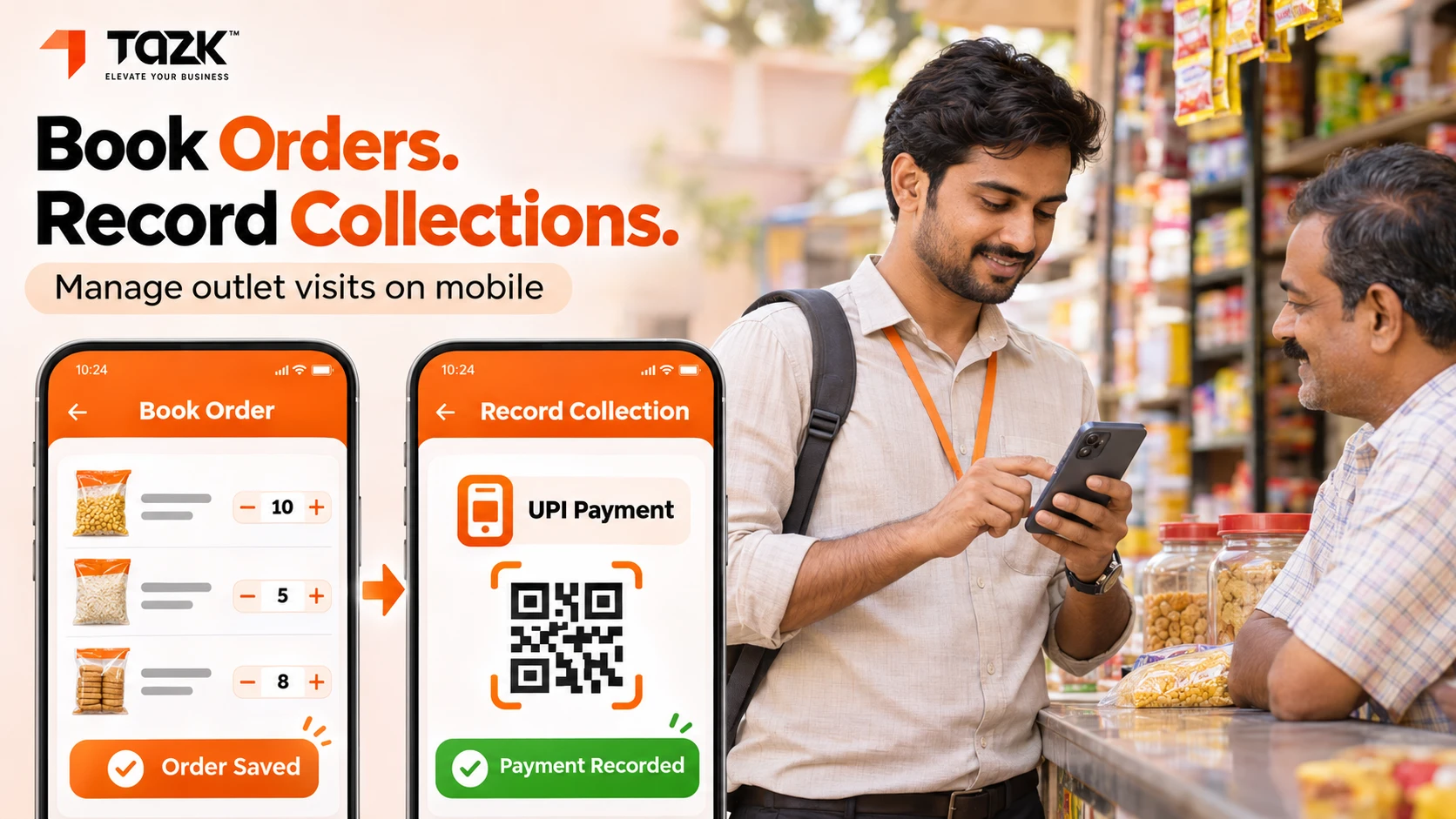
A visit is most useful when the rep does two jobs at once: books the next order and collects money that is due. Build both into the plan.
For order booking:
- Before the visit, the rep should see the outlet's last three orders and current stock.
- The rep should suggest an order based on what sold, not just ask "what do you need?"
- The order should go straight to the office so dispatch can start the same day.
For collection follow-up:
- Give each rep a daily list of outlets on today's beat that have money due. Show how many days each bill is overdue.
- Ask the rep to record each payment at the outlet: cash, cheque or UPI. The office then sees it the same day.
- If an outlet is over its credit limit, the rep should know before taking a new order.
If credit control is a bigger worry for you, read our guide on how distributors control credit before it turns into bad debt.
Stock and scheme check: At A and B outlets, ask the rep to check shelf stock, near-expiry items and whether the current scheme is shown to customers. This takes two minutes and often leads to a bigger order.
Doing all this on paper is hard. With Tazk sales management software , reps can book orders, check stock and record cash, cheque or UPI payments from their Android phone, and the office sees each order and payment as it happens.
Which metrics show whether a beat plan is working?
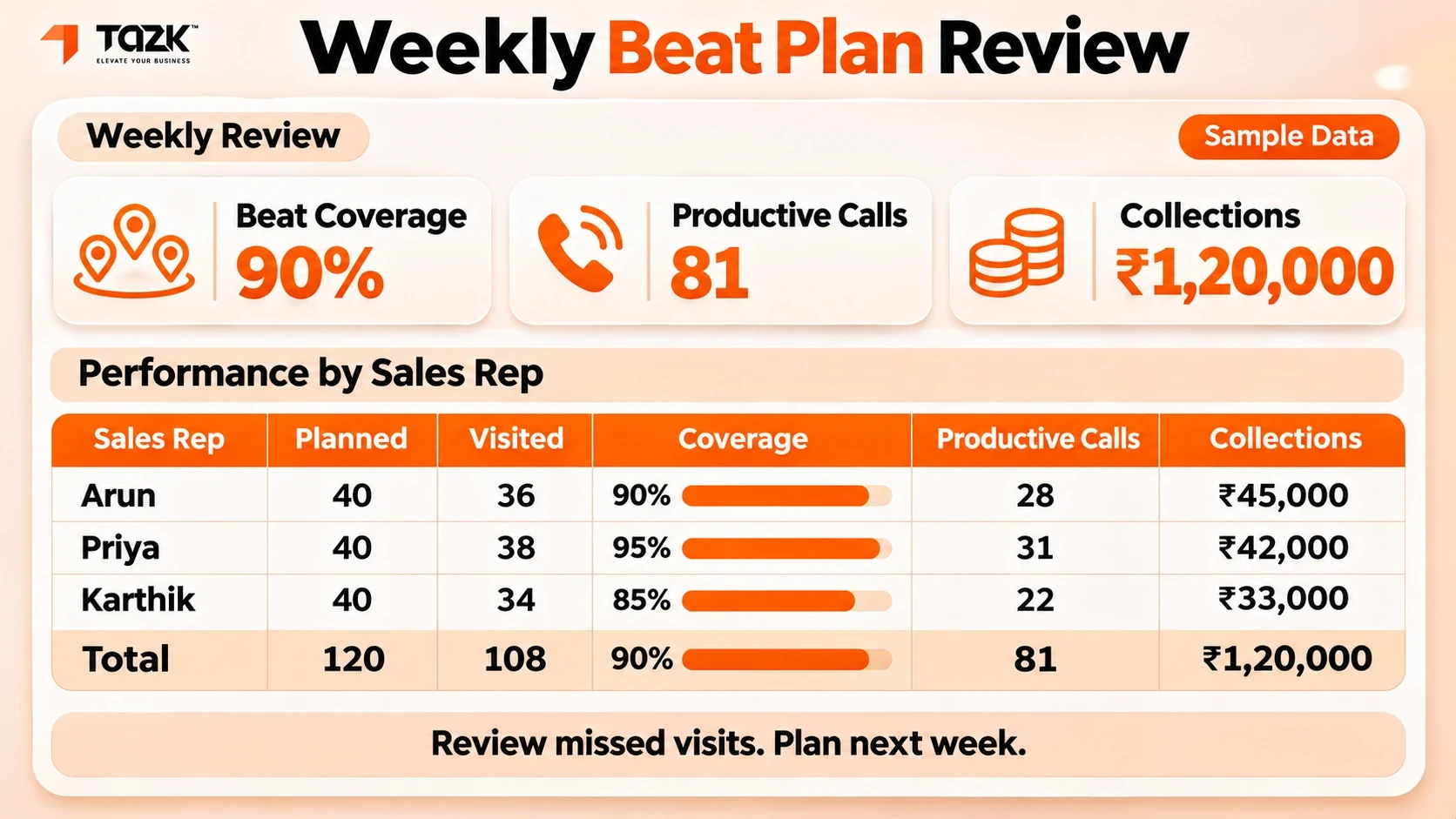
A beat plan is only useful if it improves results. Track these numbers every week in a short weekly review with your area sales manager
| Metric | What it means | How to read it |
|---|---|---|
| Beat coverage | Visits done ÷ visits planned | Low coverage means the beat is too long or the rep is skipping outlets. |
| Productive calls | Visits that ended with an order | A low share means visits are happening but not selling. |
| Lines per call | Number of different products in each order | Shows if reps are selling the full range, not just one item. |
| Average order value | Total order value ÷ productive calls | Helps you spot outlets that can buy more. |
| Collections vs due | Money collected ÷ money due on the beat | Shows if reps are following up on payments. |
| New outlets added | New shops that placed a first order | Shows if the territory is growing. |
How to run the weekly review (15 minutes per rep):
- Look at coverage first. Were the planned outlets visited?
- Look at productive calls. Which outlets were visited but did not order? Why?
- Look at collections. Which overdue amounts are still open?
- Decide one change for next week, such as moving two outlets to a different beat.
If your numbers are low in the same areas again and again, you may have a leak in the plan itself. We explain the common causes in our article on where field sales beat plans leak revenue.
Can GPS check-ins prove the visits happened?
Yes, mostly. A GPS check-in records where the rep's phone was and at what time. When the check-in matches the outlet's saved location, you have good proof that the rep was there.
GPS check-ins help you:
- Confirm the visit: The rep checks in at the outlet, not from a tea shop two kilometres away.
- See the route: Managers can see the order of visits and spot long gaps.
- Measure time at the outlet: A 40-second visit at an A outlet is a warning sign.
- Settle disputes: If a shop says "nobody came this week", you can check.
But GPS is not perfect. Signals can drift indoors or in crowded markets. Phones can be switched off. So use GPS as one part of the picture, together with orders booked and money collected. A visit with a check-in and an order is much stronger proof than a check-in alone.
Tazk's field sales app records GPS-verified visits and route history, so managers can see the day's coverage. To learn how location checks also stop fake attendance, read our post on GPS-verified attendance for field teams .
A word on trust: Tell your team why you use GPS. Explain that it protects honest reps from false complaints too. Teams accept tracking better when they understand it and when it only runs during working hours
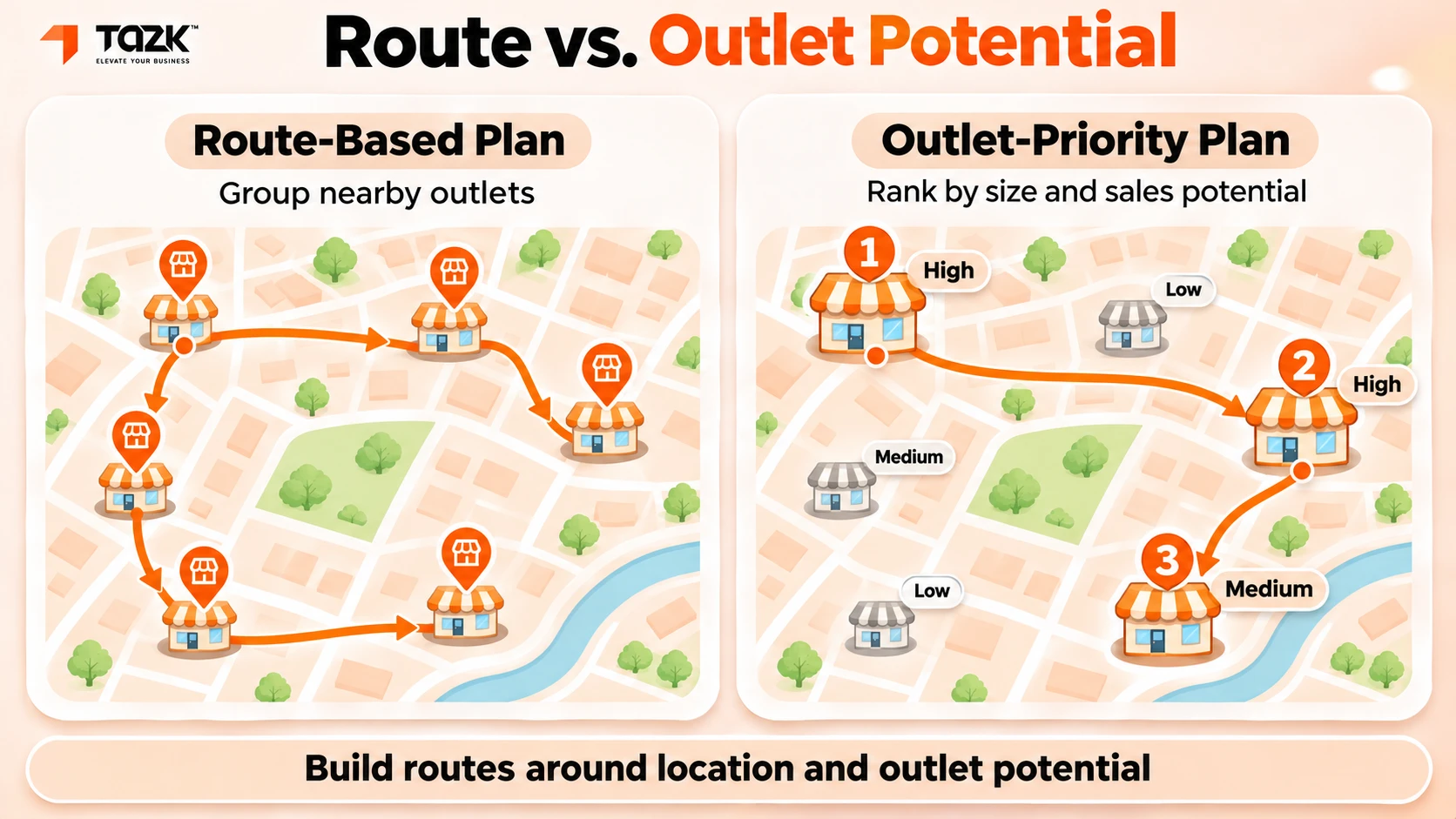
Should I plan beats by route, outlet size or sales potential?
The best beat plans use all three, in this order:
- Start with sales potential. Decide which outlets matter most (your A, B and C classes). This sets how often each outlet is visited.
- Then use outlet size and type. A large supermarket needs a longer visit than a small kirana shop. A chemist may need a different day than a hardware store. This sets how long each visit takes.
- Finish with the route. Group outlets by area and sequence them so travel time is low. This sets which day each outlet is visited.
| Approach | Good for | Risk if used alone |
|---|---|---|
| Route only | Dense city areas, saving fuel | Big buyers may get the same attention as tiny ones. |
| Outlet size only | Key accounts | Reps may criss-cross the city and waste hours. |
| Sales potential only | Growing new markets | Hard to follow on the ground without a route. |
Example: A pharma distributor might put all chemists near two hospitals on Monday because they are close together and they are A outlets. Smaller chemists in the suburbs go on a fortnightly Friday beat.
Five common beat plan mistakes
- Too many outlets in one beat. If a rep can never finish the beat, coverage falls and the plan loses respect.
- Never changing the plan. Markets change. Review beats every quarter.
- No task at each stop. "Visit" is not a task. "Book order and collect ₹8,500 due" is a task.
- Ignoring collections. A beat that books orders but never collects money creates bad debt.
- No weekly review. Without a short check-in, small problems become big ones.
What should you do next?
Start small. Pick one rep and one week. Build six beats, run them, and review the numbers on Saturday. Fix what did not work, then roll it out to the rest of the team.
When you are ready to move from a spreadsheet to a phone, Tazk can help your team plan visits, check in with GPS, book orders and collect payments from one app
Book a demo: see beat plans, visit check-ins and collections on mobile. Book a demo
Want to track your field sales end-to-end?
Tazk Sales manages orders, collections, beat plans, and team performance — from quotation to delivery.
14-day free trial. No credit card required. Go live in hours.