GST e-Invoice Is Now Mandatory for ₹5 Crore+ Businesses: The Complete Checklist Every Indian SMB Needs Before It's Too Late
8 min | By Lokesh A
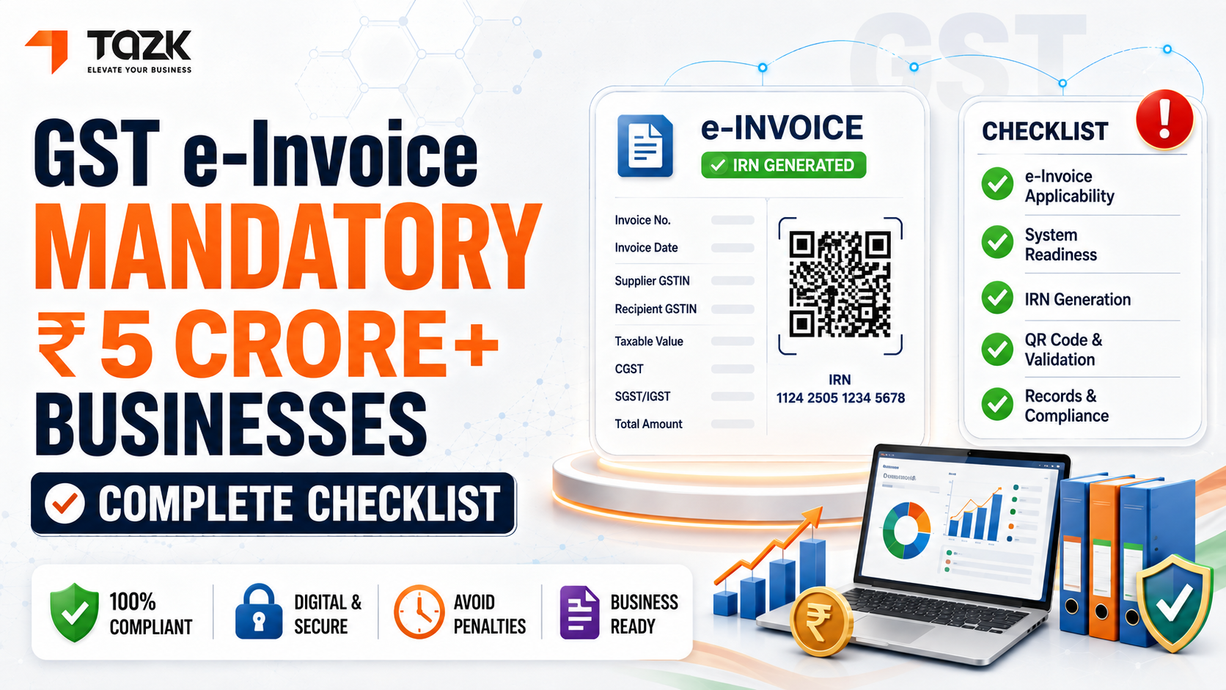
Table Of Contents
Social Media


GST e-Invoice Is Now Mandatory for ₹5 Crore+ Businesses: The Complete Checklist Every Indian SMB Needs Before It's Too Late
If your business has crossed ₹5 crore in aggregate annual turnover in any financial year since 2017–18, GST e-invoicing is not optional — it is a legal requirement. Tally Solutions' 2026 e-invoicing guide is unambiguous: 'An invoice issued without a valid Invoice Reference Number (IRN) is considered legally invalid under GST law. Your buyer cannot claim Input Tax Credit (ITC) on that invoice.' The 2026 compliance environment is stricter than ever: a mandatory 30-day reporting window now applies to ₹10 crore+ businesses, and two-factor authentication on IRP access is now fully enforced.
According to Accountune's FY 2026-27 e-invoice compliance update, the ₹5 crore threshold is widely expected to fall further in coming years — making preparation now the right move even for businesses approaching (but not yet at) the threshold. This guide is your complete checklist. Whether you are newly above ₹5 crore or want to audit your existing setup, these eight steps cover everything your finance and operations teams need.
Step 1: Confirm Whether You Are Required to Generate e-Invoices
The test is based on Aggregate Annual Turnover (AATO), calculated at the PAN level — across all GSTINs under one PAN. Digital Dreams Infotech's 2026 SME guide flags the most commonly missed detail: 'It's cumulative, not current-year.' If your AATO crossed ₹5 crore in any financial year from 2017–18 onwards, e-invoicing is mandatory — even if your current year turnover is lower. Once you cross the threshold, you cannot drop back out.
AATO includes taxable supplies, exempt supplies, export turnover, and inter-state supplies — and excludes the GST amount itself. Specific categories are exempt regardless of turnover: banks, NBFCs, insurers, Goods Transport Agencies (GTAs), and multiplex cinemas. Service businesses are not exempt as a category.
Step 2: Understand What e-Invoicing Actually Means
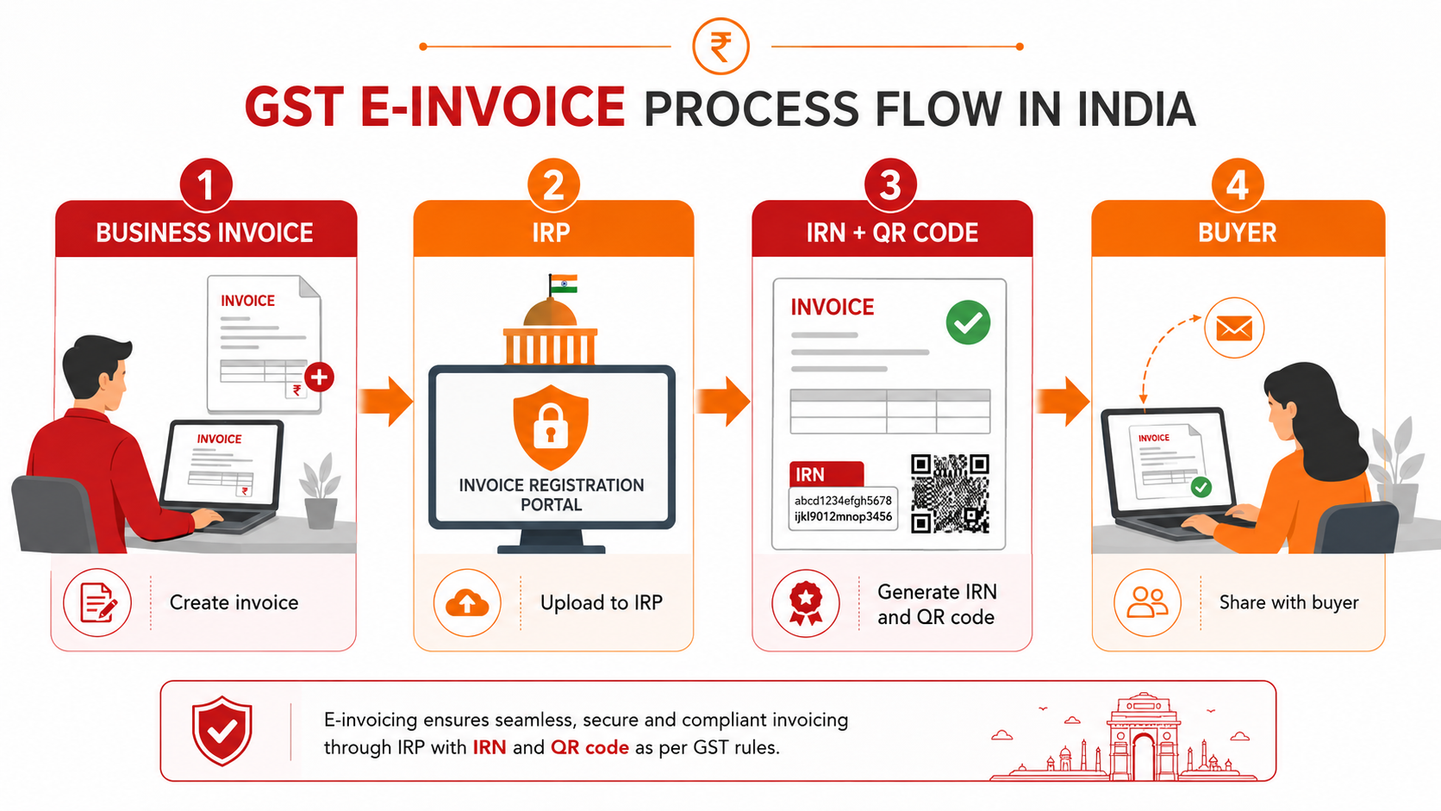
The most common misconception is that e-invoicing means creating invoices on the GST portal. It does not. Your invoice is generated in your existing billing system — exactly as before. The change is a validation step: before the invoice is finalised and shared with your buyer, it is submitted to the Invoice Registration Portal (IRP) in a structured JSON format, authenticated in real time, and returned with an IRN (a unique 64-character hash) and a digitally signed QR code.
Once the IRN is generated, that invoice data is auto-populated in your GSTR-1 under Table 4A (B2B supplies) — reducing the manual data entry burden for returns. E-invoicing covers B2B invoices, export invoices, and supplies to SEZ units. It does not currently apply to B2C retail invoices for most businesses. Credit notes and debit notes against qualifying B2B invoices also need IRNs.
The Complete 8-Step e-Invoice Compliance Checklist
✅ Step 3: Register on the IRP
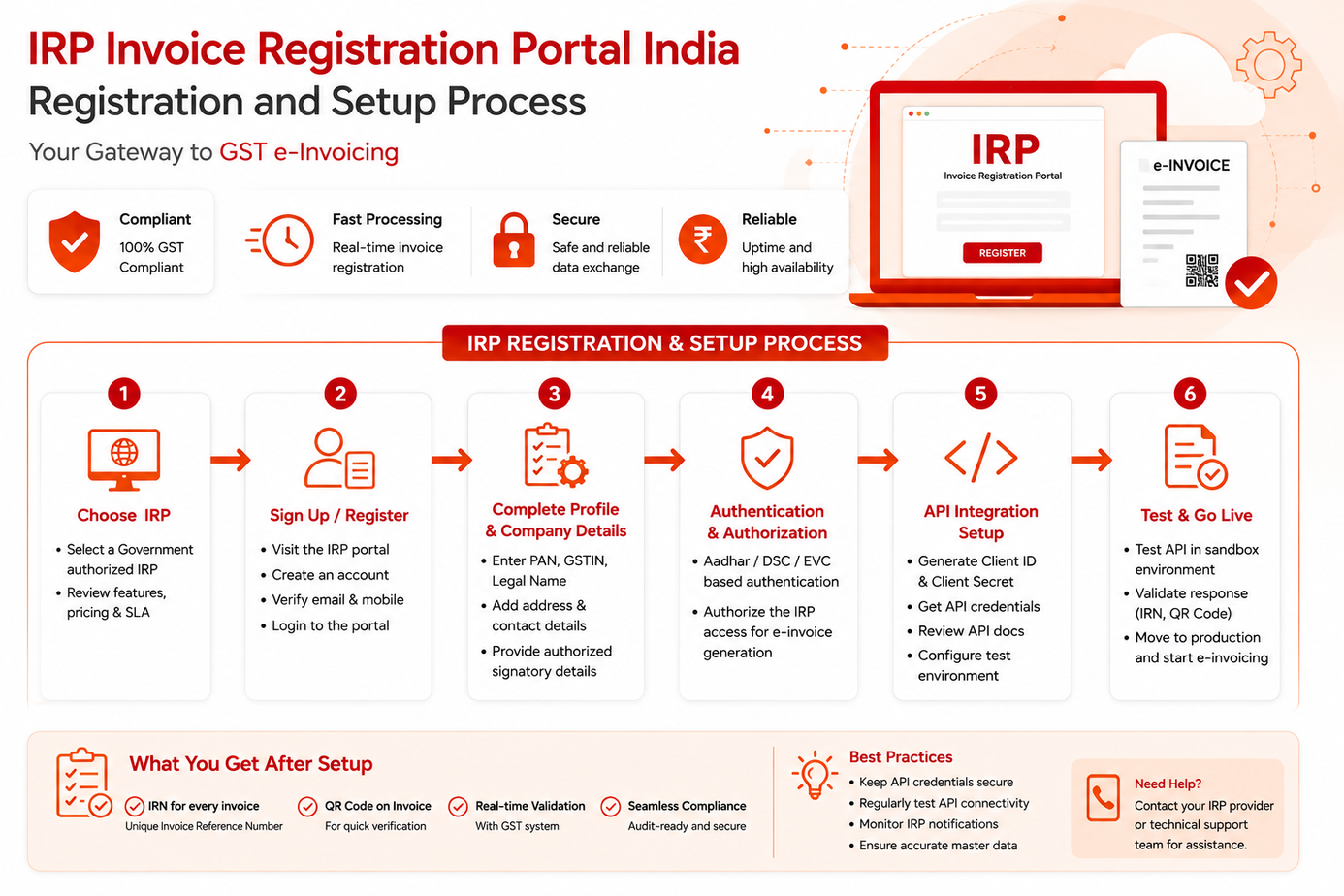
Multiple IRPs are authorised: GSTN (einvoice1.gst.gov.in), NIC, Cygnet, ClearTax, IRIS Business, EY, and others. Register your GSTIN on your chosen IRP and complete mandatory 2FA setup. Obtain API credentials if integrating directly, or choose a GST Suvidha Provider (GSP) to handle IRP communication on your behalf.
✅ Step 4: Configure Your Billing Software for the e-Invoice Schema
Your billing software must generate the e-invoice JSON payload in GSTN's schema, including all mandatory fields: supplier and recipient GSTIN, invoice number and date, line item details (HSN/SAC codes, quantities, GST rates), and supply type codes. Tazk's GST billing module has direct IRP integration built in — IRN generation is triggered automatically with every qualifying B2B invoice, with no manual steps or portal logins required.
✅ Step 5: Test in the Sandbox Environment
GSTN provides a sandbox environment (sandbox.einvoice1.gst.gov.in) for testing without affecting live data. Use it to validate your JSON schema, test error handling for common rejection scenarios (invalid GSTIN, missing mandatory fields, wrong HSN codes), and confirm that IRNs are returned correctly. Systech ERP's 2026 compliance guide recommends testing at least 50 representative invoice scenarios — including edge cases — before going live.
✅ Step 6: Go Live With Auto-IRN Generation
Enable auto-IRN generation in your live environment. Every qualifying B2B invoice must be submitted to the IRP at creation — before sharing with the buyer. Configure your software to print or display the IRN and QR code on every invoice. Build queued retry logic for IRP unavailability, so invoices are not issued without IRNs during portal outages.
✅ Steps 7 & 8: Cover Credit/Debit Notes and Verify GSTR-1 Auto-Population
A common compliance gap: businesses configure e-invoicing for sales invoices but forget that credit notes and debit notes against qualifying B2B transactions also require IRNs. Configure and test these separately. Then verify GSTR-1 auto-population: log into the GST portal and confirm that e-invoice data flows correctly into Table 4A without duplicates from manual entry.
₹10 Crore+ Businesses: The Additional 30-Day Reporting Window
If your AATO is ₹10 crore or above, a critical additional constraint applies from April 1, 2025: you must report every invoice to the IRP within 30 days of the invoice date. The IRP will reject any attempt to generate an IRN for an invoice older than 30 days — there is no manual override. Configure alerts in your billing system to flag any B2B invoice approaching the 30-day window. Accountune's June 2026 analysis notes this rule 'leaves far less room for manual error than it did even two years ago.'
Common e-Invoice Mistakes That Create ITC Problems for Your Buyers
An invoice shared without a valid IRN means your buyer cannot claim ITC on the GST paid — a direct financial cost that strains the business relationship. The most common errors: incorrect or inactive GSTIN for the buyer, failing to include IRN and QR code on the invoice shared with the buyer, not covering credit notes in the e-invoice workflow, issuing export invoices without IRNs, and not updating to the latest e-invoice JSON schema version when GSTN releases updates.
How Tazk Handles GST e-Invoicing Automatically
Tazk's GST billing and ERP module integrates directly with IRPs. When a B2B invoice is created in Tazk, IRN generation is triggered automatically — the IRN and QR code are embedded on the invoice PDF before it is shared with the buyer. Credit notes and debit notes flow through the same integrated workflow. GSTR-1 auto-population is verified against your Tazk data at every return filing cycle. For businesses approaching the ₹5 crore threshold, Tazk's ERP provides advance notification so your team can configure e-invoicing before the mandate applies — rather than scrambling after the fact.
See how Tazk generates IRN + QR codes automatically with every B2B sale — no manual steps, no portal login. Book a free 20-minute demo with our GST compliance team.