Distributor Credit Control: How Indian FMCG & Pharma Distributors Are Stopping Bad Debt Before It Happens
12 min read | By Lokesh
Table Of Contents
Social Media


A number that should worry every distributor
Here's a simple fact that surprises a lot of people: most FMCG distributors in India earn a gross margin of only 3 to 8 percent. For dairy and perishables, it's a little higher, around 8 to 15 percent. But hidden costs eat into that — spoilage, billing mistakes, and unpaid bills. After you subtract those, many distributors are left with a real, net profit of just 1 to 2 percent (source: Spirestock, FMCG Distributor Margin & Profit Guide India 2026).
Now think about what that means. Say one retailer owes you ₹2 lakhs and never pays. On a business earning 2% net margin, you would need to sell roughly ₹1 crore worth of goods just to make up for that one bad debt
This is why distributors don't lose money because they sell too little. They lose money because they don't get paid on time or at all. This article explains why that happens, and exactly how to stop it, using tools and habits any distributor can put in place.
What Is Distributor Credit Control?
Let's keep this simple.
Credit control just means deciding, in advance, how much a retailer or sub-dealer is allowed to owe you before they pay — and then actually sticking to that limit.
Think of it like this: if a friend borrows small amounts of money and always pays you back, you'll probably lend more next time. If a friend keeps "forgetting" to pay you back, at some point, you stop lending no matter how nicely they ask.
A distribution business works the same way, except the "friend" is a shop, and the "lending" is goods you deliver today, trusting you'll be paid in a week, two weeks, or a month.
The problem is, without a clear system, most distributors don't actually track this properly. They know a shop "usually pays okay." But they don't have a real number — an actual credit limit. And without that number, nothing stops a salesman from delivering more stock to a shop that already owes too much.
Why FMCG and Pharma Distribution Runs on Credit
You might wonder why not just ask for cash on delivery every time? The honest answer is: because the entire trade is built on credit, at every level.
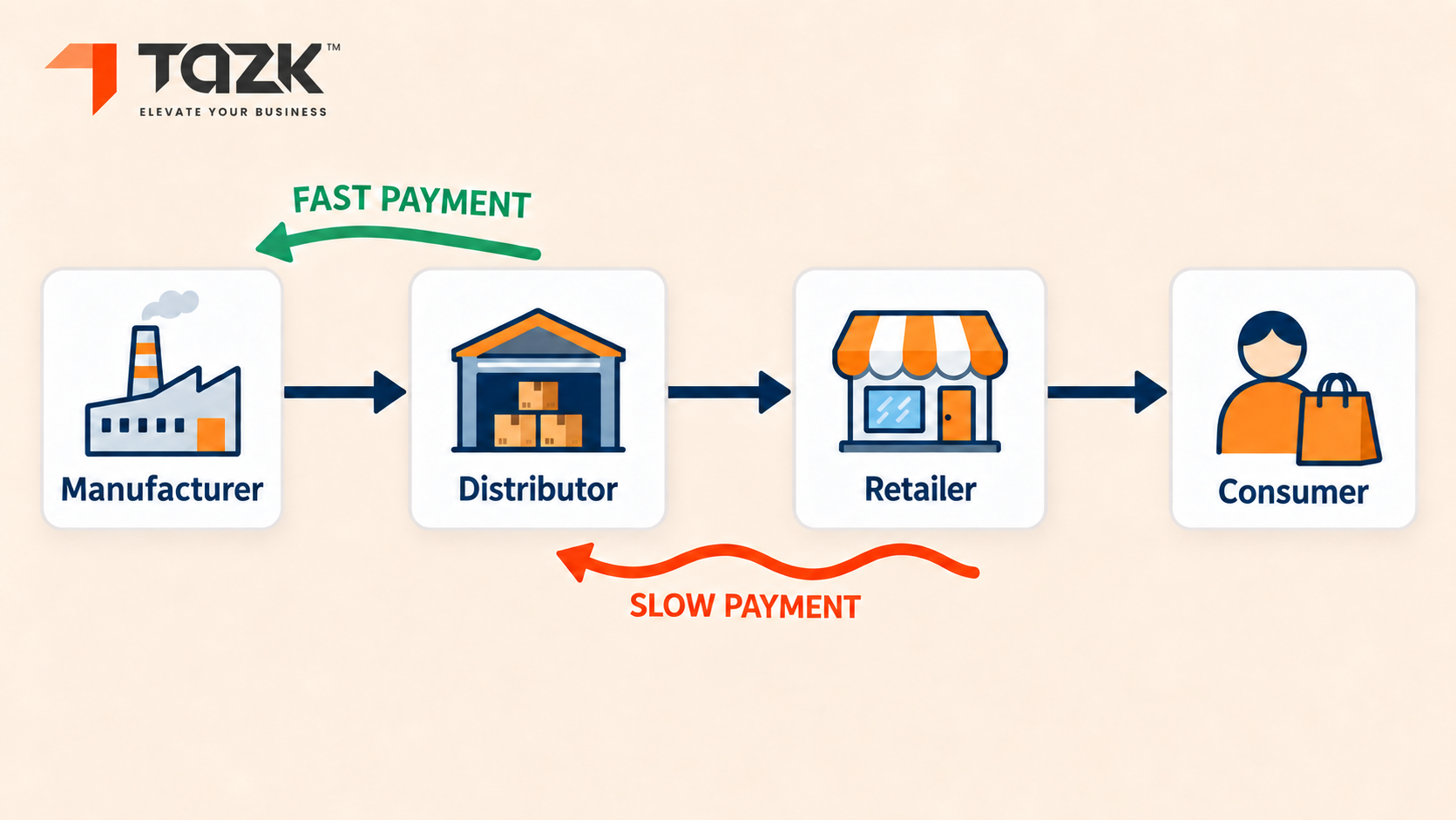
A manufacturer usually expects the distributor to pay fast — sometimes even in advance. But that same distributor has to give retailers time to pay too. Standard practice is 15 to 21 days of credit. Large retail chains often get 30 to 60 days. And in a brand-new state, where trust is still building, it can stretch past 45 days (source: Kirana Club, The Complete Guide to FMCG Distribution in India; Credlix, FMCG Distributor Financing).
Pharma distribution often works similarly, sometimes with even longer cycles, since medical stores and hospitals frequently negotiate extended payment terms.
This means the distributor is squeezed in the middle paying the manufacturer fast, while waiting weeks (or months) to be paid by the shop. If that waiting period stretches out, or worse, never ends, the distributor's own cash gets stuck and stuck cash can't buy new stock, pay staff, or grow the business.
Let's put a real number on this. Say you're doing ₹1 crore a month in sales in a new state. You give 30-day credit. And 15% of your money is tied up in scheme investments. That adds up to ₹30 to 40 lakhs of your own money locked up at any given time, in that one state (source: Kirana Club). Now multiply that across five states. That's a serious drain on the business.
The Real Cost of Bad Debt (With the Numbers)
Let's make this concrete with numbers that are easy to compare.
Large FMCG companies — the ones actually manufacturing the products — collect payment incredibly fast. Nestlé India collects in about 4 to 6 days. Britannia is close behind at 5 to 9 days. Hindustan Unilever sits around 13 days, and ITC around 11 days (source: TradeJini, Debtor Days: Formula, Benchmarks).
Notice something important here: these giant companies have the negotiating power to get paid fast — but that speed comes partly from pushing longer credit terms down onto their own distributors. The distributor, much smaller and with far less negotiating power, ends up carrying most of the actual waiting time in the system.
Industry benchmarks for distribution businesses generally suggest:
- Days Sales Outstanding (DSO) — how long it typically takes to collect payment should be in the 40 to 50 day range, not open-ended.
- Bad debt — money you never collect at all should stay under 0.5% of total sales.
- At least 90% of what customers owe you should be "current," meaning less than 30 days overdue, not sitting in the 60 or 90-day-plus bucket (source: Bizowie, Credit Management Best Practices).
Here's a smaller, more relatable example. Say your monthly sales are ₹20 lakhs. If you tighten your average collection time from 35 days down to 20 days, you free up roughly ₹10 lakhs of working capital. Left tied up, that same money would cost you an estimated ₹10,000 to ₹12,000 a month, in lost opportunity or borrowing costs (source: Spirestock, FMCG Distributor Margin Guide).
That's real money, sitting in someone else's shop, doing nothing for your business.
The Mistakes That Quietly Drain Distributor Margins
Mistake 1: Treating every retailer the same way. A shop that has bought from you for five years and always pays on time is not the same risk as a brand-new shop you met last month. Giving both the same credit terms is how bad debt sneaks in.
Mistake 2: No hard stop when a credit limit is reached. If your salesman can keep delivering stock to a shop that already owes you money, with no system stopping him, you don't really have a credit limit you have a suggestion.
Mistake 3: Not tracking "ageing" how old each unpaid bill really is. A bill that's 5 days overdue and a bill that's 75 days overdue are very different problems. Many distributors only look at the total amount owed, not how long it's been owed, which hides the real danger.
Mistake 4: Collections are disconnected from the sales team. The salesperson visiting the shop every week is often the person best placed to collect payment, or at least flag a problem early. But if collection tracking isn't part of their daily route, that opportunity is wasted.
Mistake 5: Relying on memory and paper registers. When credit limits, dues, and payment history live in a notebook or a salesperson's head, the moment that person is on leave, sick, or leaves the company, that knowledge disappears with them.
How Credit Limits Should Actually Work
Here's a practical, easy-to-follow approach.
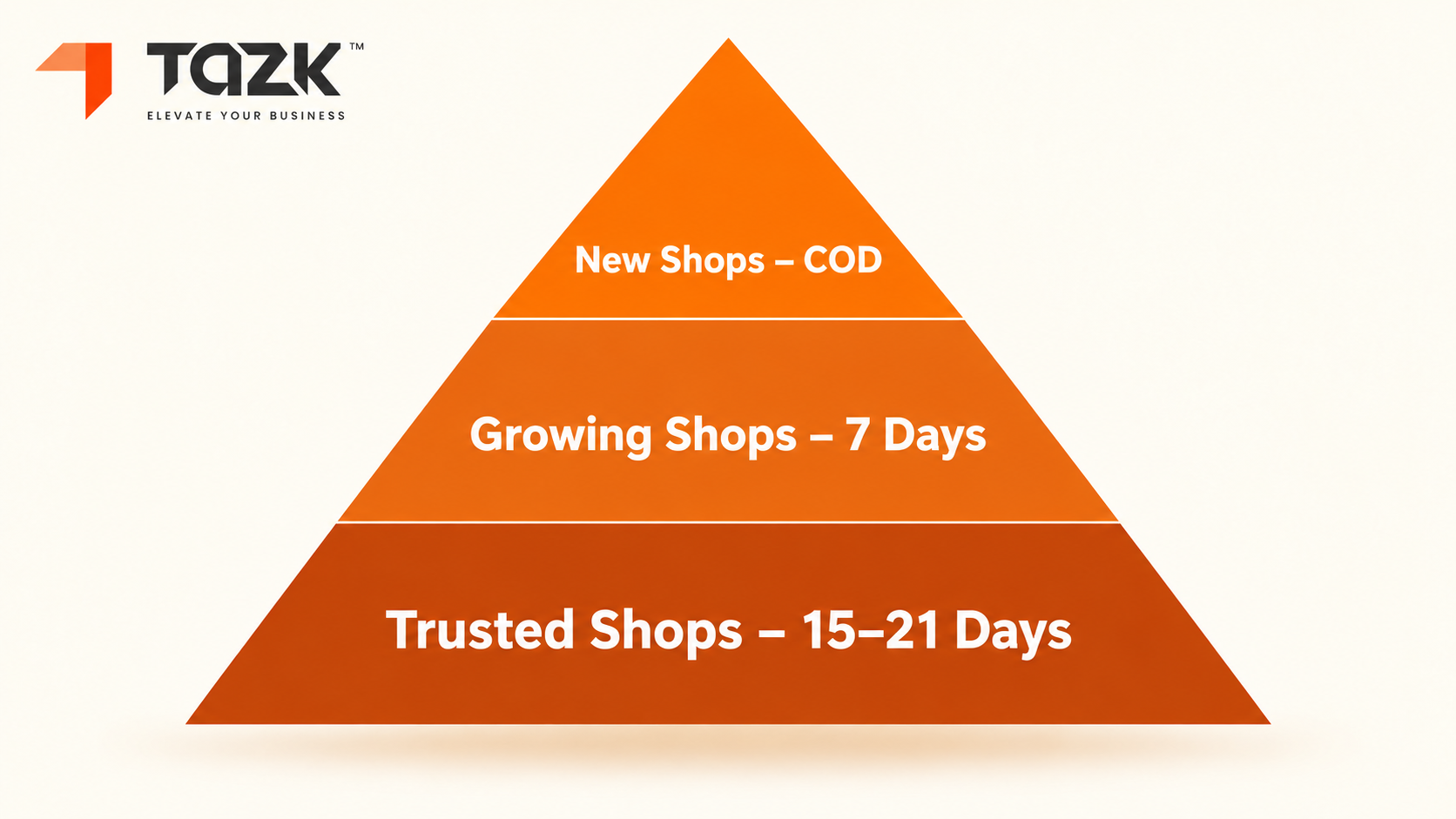
Step 1: Put every retailer into a risk group. A simple three-tier system works well for most distributors:
- New or unknown shops: Cash on delivery, or a very small trial credit limit.
- Medium, proven shops: Around 7 days of credit.
- Your best, high-volume, long-standing shops: 15 to 21 days, only after they've earned it with a track record.
Step 2: Set a real number, not a feeling. Every shop should have an actual maximum rupee amount they're allowed to owe you at any time — based on their order size and payment history, not a guess.
Step 3: Make the limit hard to bypass. Once a shop hits its credit limit, new orders should be flagged or blocked automatically. They should stay blocked until the shop pays down what it owes. Don't leave this to a salesperson's judgment in the middle of a busy day
Step 4: Review ageing weekly, not monthly. Waiting until month-end to notice a bill is two months overdue is far too late to do anything useful about it.
Step 5: Make collection part of the daily sales route, not a separate task. Many distributors already have field teams visiting shops daily on a fixed route — often called a "beat plan." Collecting overdue payments should be built into that same visit. It shouldn't be a separate, awkward phone call later.
Beat Plans and Collections — Connecting the Field to the Ledger
A "beat plan" is simply a planned, repeating route your salesperson follows to visit shops for example, the same 20 shops every Monday, Wednesday, and Friday.
The mistake most distributors make is keeping the beat plan and the accounts ledger in two completely separate places. The salesperson knows who to visit. The accountant knows who owes money. They rarely talk to each other in real time.
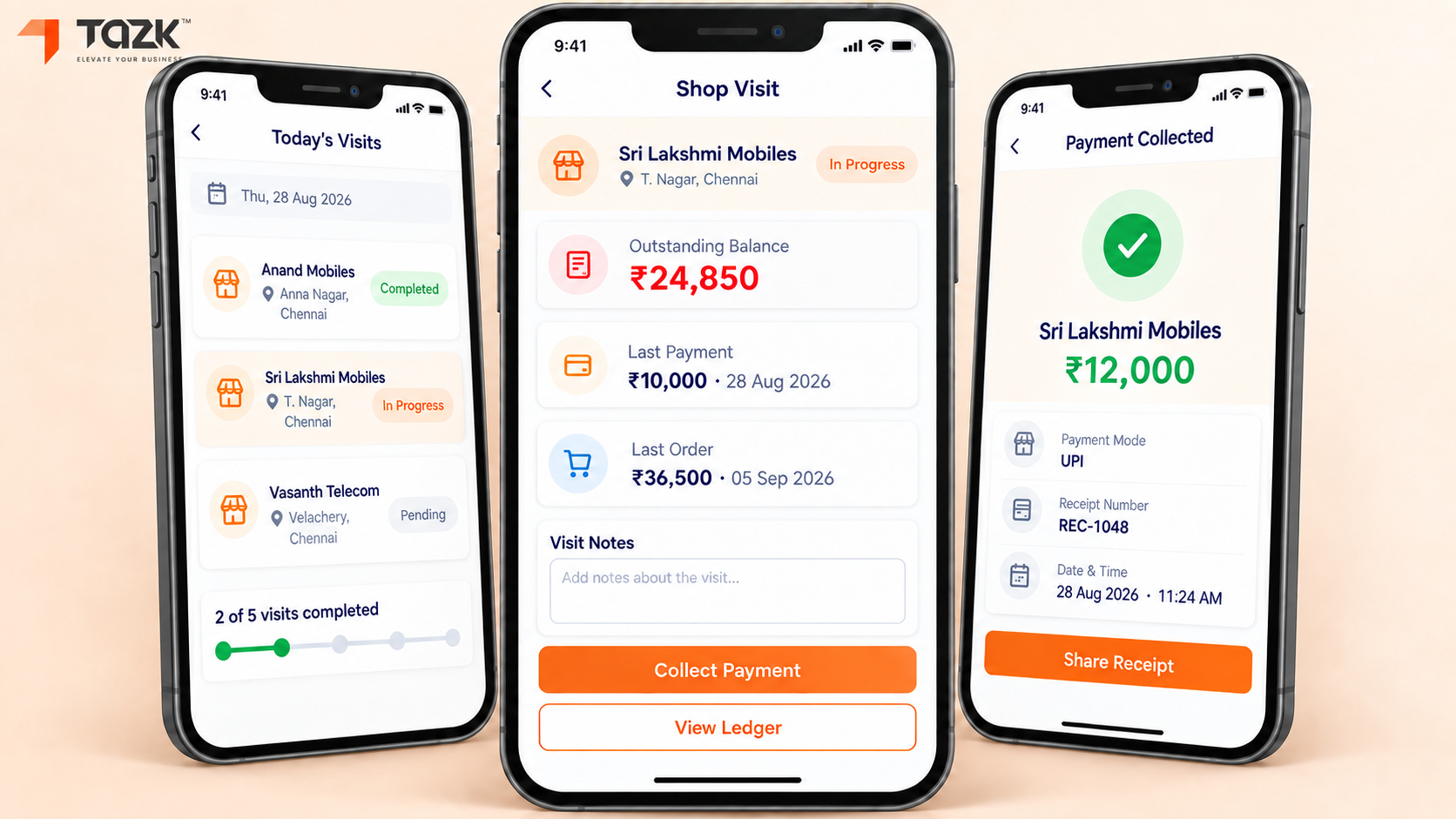
When these two things are connected, something simple but powerful happens. The salesperson visiting a shop can see, right on their phone, exactly how much that shop currently owes — and for how long. This shows up before they even walk in. They can collect payment on the spot and log it instantly. The accounts team then sees it update immediately, with no end-of-day paperwork pile-up.
For a deeper look at how much revenue leaks out of an unstructured field sales operation including missed collections see our guide on field sales beat plan revenue leaks in India.
What Good Credit Control Looks Like With the Right Software
This is exactly the gap Tazk's Sales module is built to close for Indian distributors:
- Distributor grade credit control, with real credit limits per shop that automatically block or flag new orders once a limit is reached.
- Beat plan linked collection tracking, so your field team sees outstanding dues for every shop on their route, and can log payments the moment they're collected.
- Automatic ageing reports, so you can see, at a glance, which bills are 5 days overdue versus 75 days overdue instead of one big, misleading total.
- A single ledger that both your salespeople and your accounts team see in real time, so nobody is working from outdated information.
If you're managing leads and enquiries alongside your distribution sales, our CRM and lead management module works from the same login, so growth and collections don't live in separate systems.
A Realistic Example
Picture a mid sized pharma distributor covering three districts in Tamil Nadu, supplying medical stores and small hospitals.
Before setting up proper credit control, their outstanding dues had crept up to nearly 20% of their monthly sales value spread across dozens of small medical stores, some of them 60, 90, even 120 days overdue, with no clear system tracking which ones were the real problem.
After introducing tiered credit limits and connecting collections to their daily beat plan, two things changed quickly. First, the salespeople stopped delivering new stock to the worst offenders by default the system flagged them automatically. Second, because ageing was visible weekly instead of buried in a monthly report, the distributor could have a firm, early conversation with a slow-paying store at 20 days overdue, instead of an awkward, much harder conversation at 90 days overdue.
Within a few months, their overdue balance as a share of sales dropped significantly. This wasn't because they sold less. It was because they stopped quietly funding other people's cash flow problems with their own working capital.
What's Changing Next
A few shifts worth watching, because they will keep changing how distributor credit control works:
Digital payments are shrinking the "trust gap." As UPI and digital payment adoption keeps growing across Indian retail, the old habit of "I'll settle up next time you visit" is slowly being replaced by same-visit digital payment — which only helps if your system can log and reconcile it instantly.
GST e-invoicing is creating a cleaner paper trail. E-invoicing thresholds keep being reviewed and adjusted. As a result, more transactions leave a clear digital record. This makes accurate ageing and credit tracking easier — but only for distributors whose systems are actually built to use that data.
Credit decisions are becoming more data-driven, not gut-based. Instead of relying purely on a salesperson's opinion of a shop, more distributors are starting to use payment history data itself to automatically suggest safer credit limits — reducing both bad debt and the awkward job of saying no to a long-time customer.
In a business where net margins are often just 1 to 2 percent, credit control isn't a back office formality it's one of the few levers a distributor fully controls. Set clear limits, track ageing honestly, connect collections to the daily sales route, and bad debt stops being something that happens to you, and becomes something you catch early, every time. See how Tazk's distributor credit limits and collection tracking work on mobile. Book a live demo today.