From WhatsApp Chaos to Closed Deals: How Indian SMBs Are Using CRM to Stop Losing Leads and Win More Business
9 min read | By Lokesh
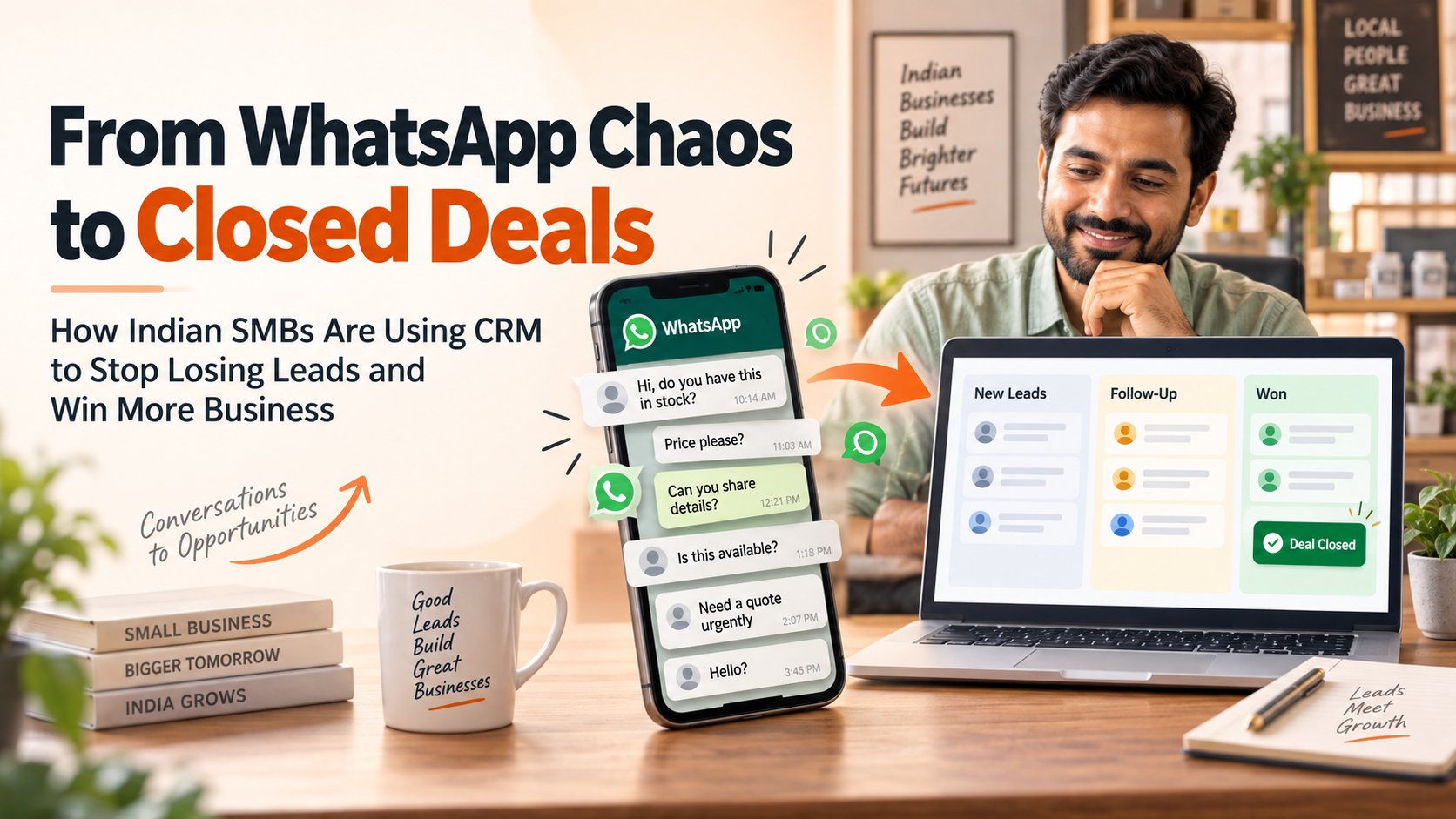
Table Of Contents
Social Media




A customer messages your business WhatsApp number at 11:14 am asking about pricing. The salesperson who usually replies is on a call with someone else. By 1:47 pm, when the reply finally goes out, the prospect has already heard back from two competitors and mentally moved on. Nobody did anything wrong exactly the rep was busy, the message got buried under a dozen other chats, and there was no system flagging that this particular lead had gone quiet for two and a half hours. This is not a hypothetical. It is the default operating condition for the majority of Indian SMBs running sales entirely through personal or shared WhatsApp numbers.
This guide breaks down exactly what that chaos costs in lost revenue, why WhatsApp itself is not the problem, and what a properly structured CRM changes with the real before and after numbers Indian sales teams report after making the switch.
The Real Cost of Running Sales on WhatsApp Alone
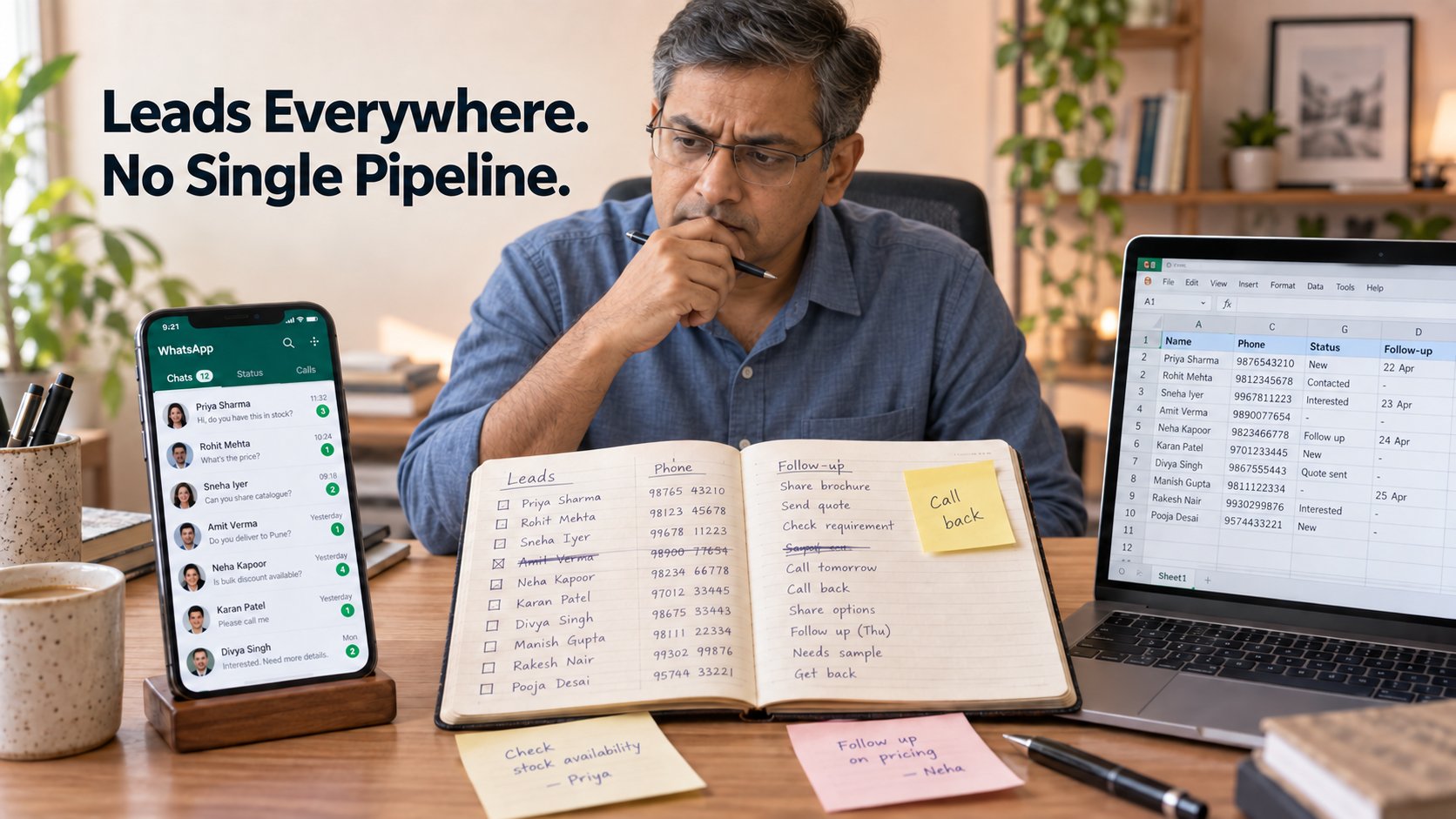
The typical Indian SMB does not have one lead channel it has four to six running simultaneously: IndiaMART, WhatsApp, Meta ads (Facebook and Instagram), Google, JustDial, and the business's own website, all generating enquiries at once. A spreadsheet or a WhatsApp chat list was never designed to watch six inboxes simultaneously, enforce lead ownership, track elapsed time since first contact, or automatically chase a follow up. Every day a business runs on this manual process is a day of quiet, invisible leakage that the monthly sales report cannot even show, because a lead that was never logged does not appear as a loss it simply never existed in anyone's numbers.
The scale of this leakage is well documented and consistent across independent reviews of the Indian SMB market: the average Indian small business loses 60–70% of its leads to poor or inconsistent follow-up, not to bad products or uncompetitive pricing. The mechanism is almost always the same a manual system that worked fine at 5–10 leads a week becomes structurally incapable of tracking ownership, status, and next action the moment volume crosses roughly 50–75 active leads per salesperson per month.
Why Response Speed Is the Single Biggest Lever You're Not Pulling
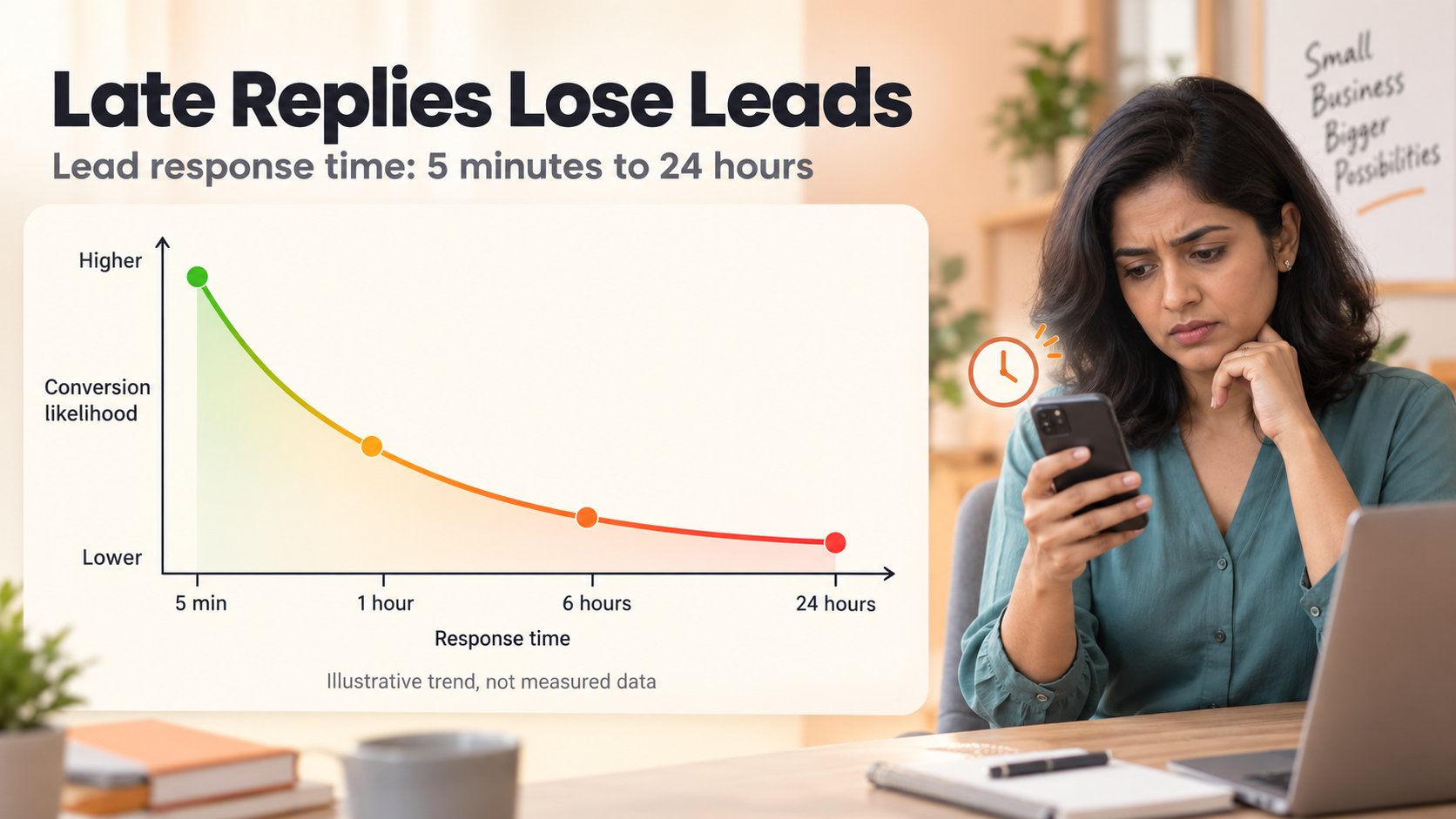
Response time is not a minor operational detail it is close to the single largest controllable factor in lead conversion, and the research behind this is old enough to be settled science rather than a vendor claim. A Harvard Business Review audit of 2,241 U.S. firms found that companies contacting a lead within the first hour were nearly seven times more likely to qualify it than those that waited even 60 minutes, and firms that waited 24 hours or longer were roughly sixty times less likely to qualify the same lead compared to responding within that first hour.
For a WhatsApp first Indian sales operation, this research translates into a specific, painfully common failure pattern. Three warning signals show up consistently before the actual lead loss becomes visible in the numbers: reply overlap, where two team members share one WhatsApp number and both respond to the same lead with different answers within the same hour response delay, where a lead messages while the assigned rep is on another call and the reply lands two hours later, by which point the prospect has already heard from competitors; and follow up amnesia, where a rep genuinely intends to circle back after a demo but the reminder never makes it onto any list, and the deal quietly goes cold. Most Indian SMBs without a structured system are experiencing at least two of these three signals right now without a way to measure it.
WhatsApp Isn't the Problem — the Absence of Structure Is
It would be easy to conclude that the fix is abandoning WhatsApp for a more "proper" sales channel. That conclusion misreads the Indian market entirely. India has over 500 million active WhatsApp users, and for the overwhelming majority of Indian consumers and business buyers, WhatsApp is not an alternative channel — it is the default, expected way to communicate with a business before making a purchase decision. The problem was never the channel. It is that WhatsApp conversations, by default, live on a single device with no ownership rules, no shared visibility, and no automated follow-up — which is precisely the gap a CRM built around WhatsApp as a first-class channel is designed to close.
What a Properly Structured CRM Actually Changes
A CRM built for how Indian SMBs actually sell needs to do five specific things, and the difference between a CRM that gets adopted and one that gets abandoned within a month almost always comes down to whether these five are genuinely native to the product or bolted on as an afterthought.
- Automatic multi-channel capture: every enquiry from WhatsApp, IndiaMART, JustDial, Google Ads, Facebook, and your website lands in one unified pipeline the moment it arrives, with zero manual re-entry required from any team member.
- Instant ownership assignment: the moment a lead is captured, it is automatically assigned to a specific salesperson, eliminating the reply-overlap problem where two reps unknowingly respond to the same enquiry.
- Native WhatsApp conversation management: messages, follow-up templates, product catalogues, and payment links are sent and logged directly against the lead record — from a shared inbox, not a single person's personal phone.
- Automated follow-up nudges: a rep is reminded before a lead goes cold, rather than relying on memory or a note that was never written down.
- Pipeline visibility for the founder or sales head: a real-time view of which leads are open, which are stalled, which source is converting best, and which salesperson has the highest close rate — without asking anyone for a status update.
The Documented Before-and-After
Indian businesses that move from unstructured WhatsApp selling to a properly integrated WhatsApp CRM report a consistent pattern: response times dropping from hours to under five minutes, and conversion rates climbing from a baseline of roughly 1–2% to 7–8% once ownership rules and automated follow-up are in place. This is not a marginal improvement — a jump from 1–2% to 7–8% conversion on the same lead volume represents a three-to-five-fold increase in closed deals without spending an additional rupee on lead generation. The gain does not come from generating better leads. It comes from stopping the ones you already paid for from silently disappearing.
How Tazk's CRM Is Built WhatsApp-First for Indian Sales Teams
Tazk's Sales CRM is designed around the reality that WhatsApp is the primary channel for most Indian SMB sales conversations, not a secondary integration added on top of an email-first tool built for a different market. Leads from WhatsApp, IndiaMART, JustDial, and your website flow into one pipeline automatically. Every conversation is visible to the sales head without needing to check a rep's personal phone. Follow-up reminders fire automatically based on the lead's stage and time since last contact — not on a rep remembering to check a to-do list. And because Tazk's CRM sits on the same platform as billing, inventory, and payroll, a closed deal flows straight into invoicing without a second system or a re-typed order.
For founders and sales heads specifically, the pipeline dashboard answers the three questions that matter most on any given day: which leads need attention right now, which channel is actually converting, and which team member's numbers deserve a conversation — all without a single status-update meeting.
Looking Ahead: Where WhatsApp Sales Technology Is Heading
The next phase of WhatsApp-based selling in India is shifting from structured tracking toward AI-assisted qualification and response. Early stage AI lead scoring flagging which of today's fifty WhatsApp enquiries are most likely to convert based on message content, response pattern, and historical deal data is moving from an enterprise feature into something mid market Indian CRM platforms can offer natively. Automated first-response drafting, where an AI generated reply is suggested to the rep for approval within seconds of a message arriving rather than requiring the rep to type from scratch, is following a similar path and will materially compress the response-time gap that currently separates the best-performing sales teams from the rest.
As WhatsApp's own Business Platform continues to expand catalogue, payment, and automation capabilities directly within the app, the businesses that will benefit fastest are the ones that already have clean, structured lead data feeding into a proper CRM — because every new WhatsApp Business API capability becomes immediately usable the moment it launches, rather than requiring months of retrofitting a system that was never built to receive it.
Try Tazk CRM
WhatsApp-first, built for Indian sales teams, up and running in a day.