Best Lead Management & CRM Software for Growing Businesses in Bengaluru (2026)
12 min read | By Lokesh A

Table Of Contents
Social Media




The lead you never lost — you just forgot about it
Here's a story that plays out across Bengaluru every single day.
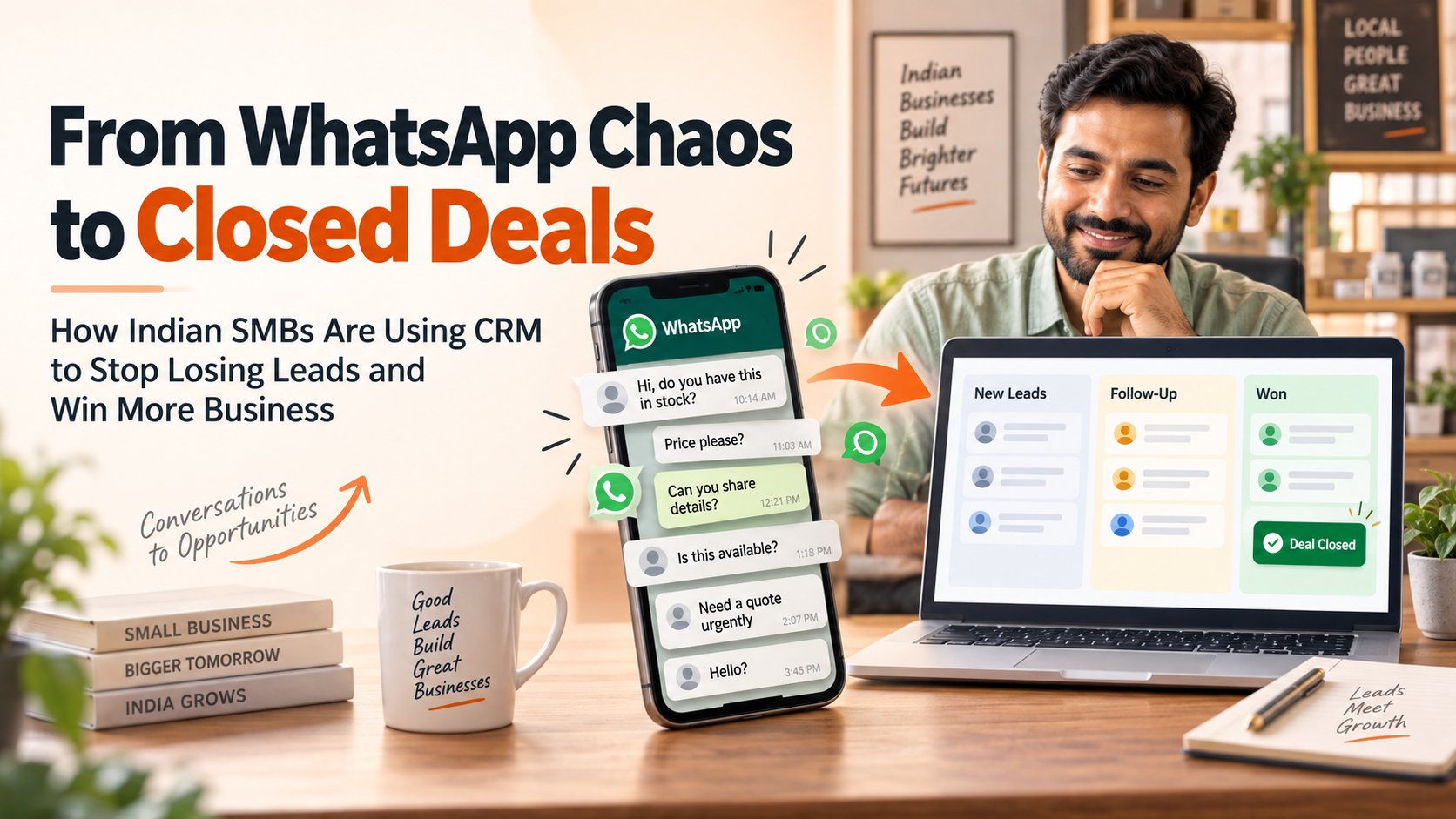
A potential customer messages your business on WhatsApp. Someone on your team replies quickly, answers a few questions, and says they'll follow up in two days. Then the week gets busy. A bigger client calls. A new hire needs training. The follow-up never happens.
The customer didn't choose a competitor because your product was worse. They chose a competitor because your team simply never got back to them. In a city as crowded with fast-moving businesses as Bengaluru, this single, quiet mistake happens constantly — and it's almost always invisible until you actually measure it.
This article walks through why this happens so often here specifically, and what a lead management setup that actually catches this looks like.
Why Bengaluru Businesses Feel This Pain More Than Most
Bengaluru isn't just another Indian city with startups. It's genuinely the country's dominant hub for them.
The city is home to more than 28,000 active startups and roughly 45 unicorns — more than any other Indian city by a wide margin (source: Upforge, India Startup Ecosystem 2026). Karnataka alone hosts around 300 venture capital firms, and Bengaluru headquartered startups have raised close to $79 billion in funding since 2010 (source : Startup Genome, Bengaluru-Karnataka Ecosystem).
What does this actually mean for a growing business trying to close deals here? It means your prospective customer almost certainly has three other companies competing for their attention at the exact same time. In a market this dense, the business that follows up fastest and most reliably usually wins — not necessarily the one with the best product.

Why WhatsApp Is Where Most Leads Actually Get Lost
Let's be specific about the exact failure point, because it's rarely the CRM itself — it's the gap between where conversations happen and where they get tracked.
WhatsApp is enormous in India — over 500 million active users, with message open rates around 98% (source: SpringEdge, Top WhatsApp Business API Providers in India). For most Bengaluru businesses, this means a huge share of real customer conversations happen there, not in email or a form on a website.
The problem is what happens next. If those WhatsApp chats live only on someone's personal phone, there's no shared record of who was contacted, what was promised, or when a follow-up is due. One employee going on leave, changing roles, or simply having a busy week can mean a promising lead just disappears. Nobody did anything wrong on purpose. There was just never a system tracking it in the first place.
This is exactly why more Bengaluru businesses are integrating WhatsApp directly into their CRM, rather than treating it as a separate, informal channel. When a WhatsApp conversation automatically becomes a tracked lead, with a visible owner and a follow-up date, this specific failure mode — a good conversation that quietly goes nowhere — mostly disappears.
What "Good" Lead Management Actually Looks Like
Here's a practical breakdown, not a marketing checklist.
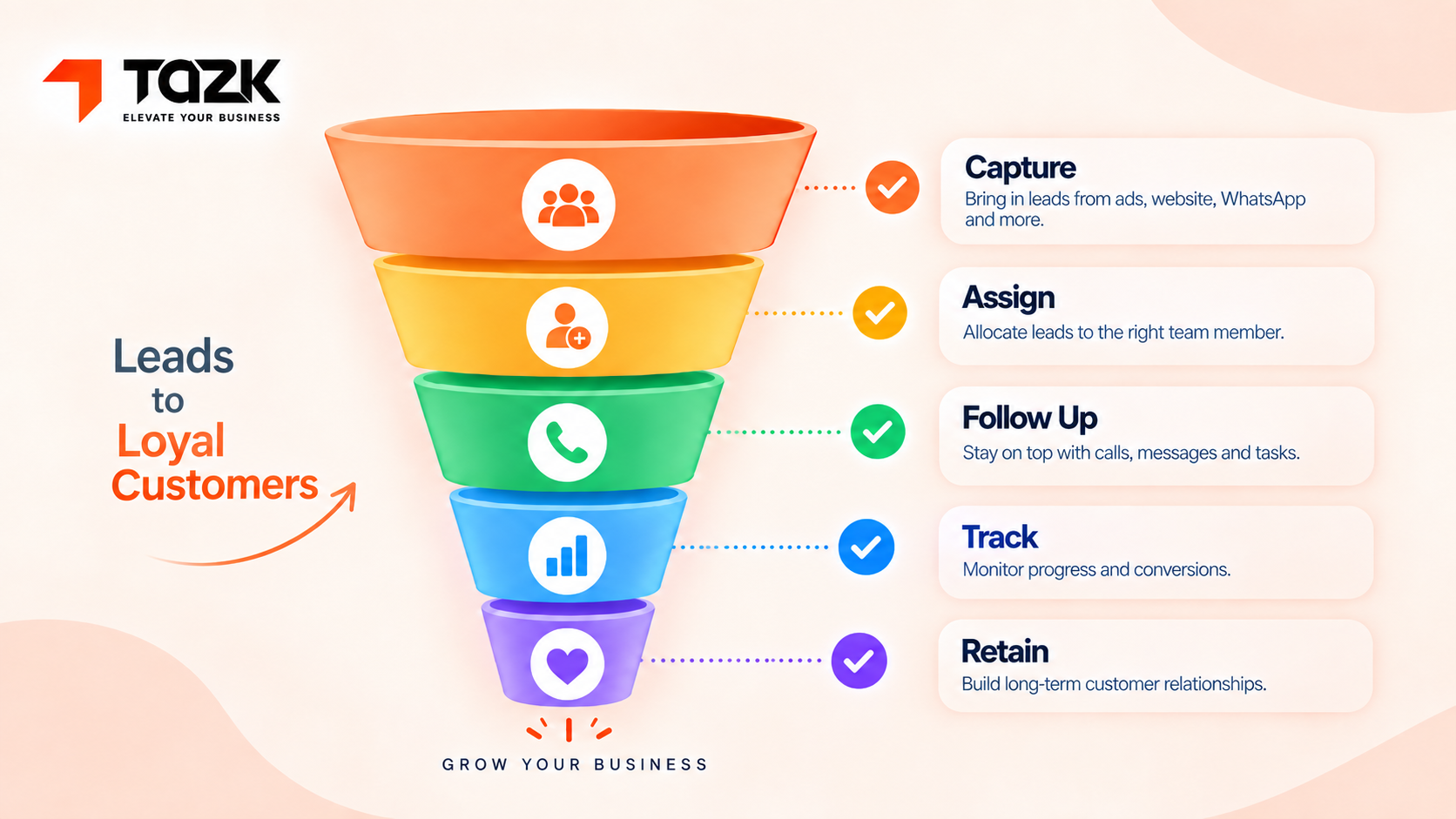
1. Every enquiry gets captured automatically, regardless of channel. Whether a lead comes from WhatsApp, a phone call, a website form, or a walk-in, it should land in one shared system — not scattered across three team members' personal notes.
2. Every lead has a clear, visible owner. Ambiguity kills follow-through. If it's not clear whose job it is to respond, the honest answer is usually that nobody does.
3. Follow-ups are scheduled automatically, not remembered manually. A good system reminds a salesperson to follow up in two days — it doesn't rely on that person's memory during a genuinely busy week.
4. Managers can see the whole pipeline, not just individual conversations. A founder or sales lead should be able to glance at a dashboard and see exactly how many leads are sitting untouched for more than 48 hours, without asking each team member individually.
5. Nothing depends on one person's phone. If a salesperson leaves the company, their leads and conversation history should stay with the business — not disappear along with their personal WhatsApp account.
The Event and Meetup Problem Bengaluru Businesses Don't Talk About Enough
Bengaluru runs on tech meetups, conferences, and networking events almost every week — and this creates a specific lead management problem most businesses never fix properly.
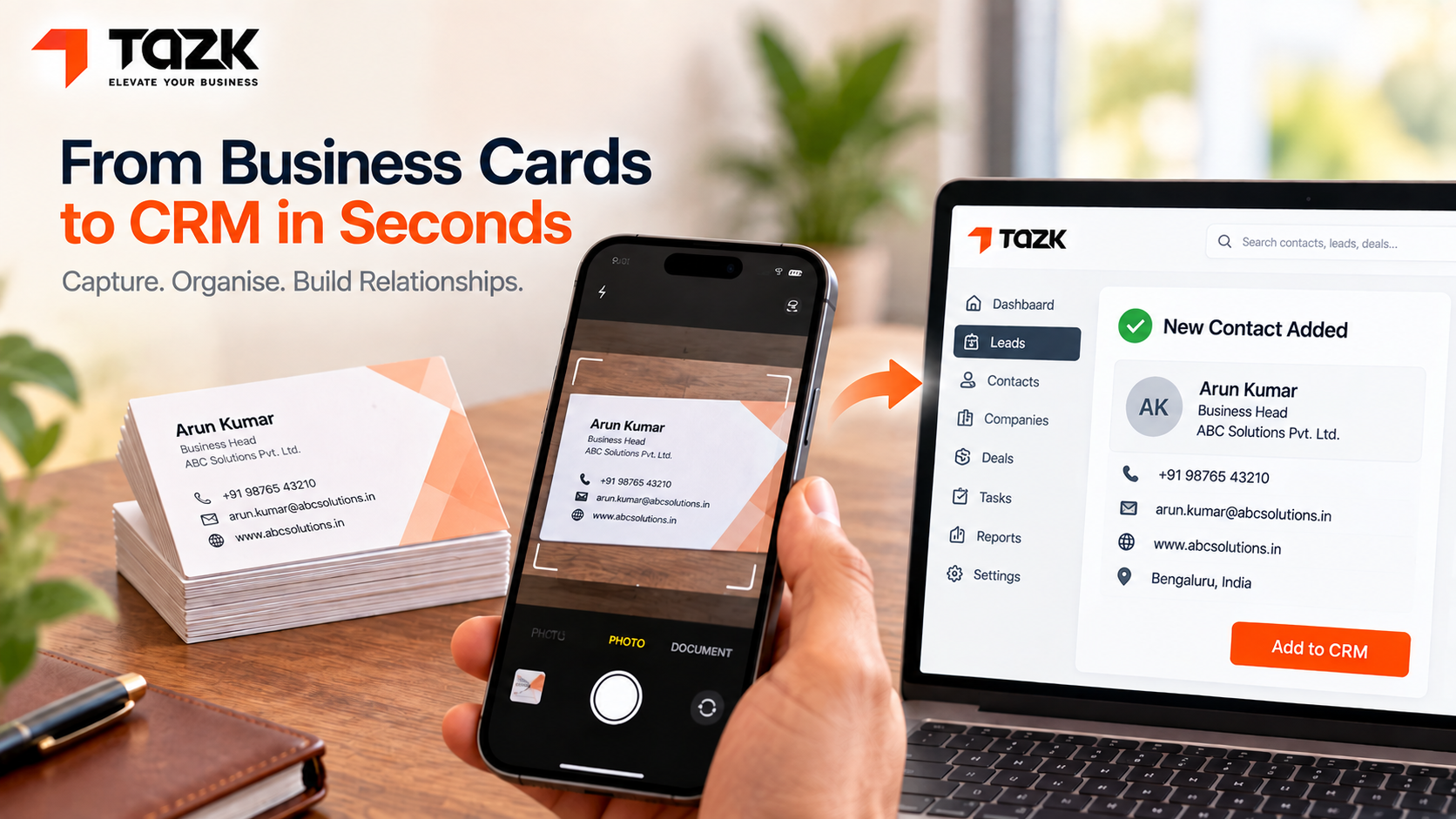
Someone from your team collects a stack of business cards at a conference, or a list of names from an event sign-up sheet. Then that list sits in a phone camera roll, a notebook, or someone's inbox for days before anyone acts on it. By the time a follow-up message goes out, the prospect barely remembers the conversation, and the enthusiasm from the actual meeting has completely faded.
This is a slightly different failure from the WhatsApp problem, but it comes from the same root cause: there's no single system that captures a lead the moment it happens and starts the follow-up clock immediately. Whether the enthusiasm-killing delay is three days after an event or three days after a WhatsApp message, the outcome for the prospect feels the same — like they weren't a priority.
The fix is also the same: capture the lead into a tracked system as close to the moment of contact as possible, ideally the same day, while the conversation is still fresh for both sides.
Common Mistakes Bengaluru Founders Make With Lead Management
Mistake 1: Treating a spreadsheet as "good enough" past ten leads a week. Spreadsheets don't send reminders, don't flag stalled leads, and quietly become outdated the moment two people are updating them at once.
Mistake 2: Splitting leads across too many disconnected tools. WhatsApp for chats, a spreadsheet for tracking, and a separate invoicing tool for closed deals means no one ever sees the full picture in one place.
Mistake 3: Measuring only closed deals, not response time. The businesses that consistently outperform competitors usually aren't closing a higher percentage of leads — they're responding faster, which naturally leads to more of those leads staying warm long enough to close.
Mistake 4: Assuming a generic global CRM will feel natural for an India-first, WhatsApp-heavy sales process. Many popular CRMs were built assuming email-first sales conversations. Retrofitting WhatsApp into them often feels bolted-on rather than native — a separate integration to configure, rather than the primary way leads naturally arrive.
Mistake 5: Not reviewing lead data until something goes visibly wrong. Many founders only look closely at their lead pipeline after noticing a slow month. By then, weeks of small, invisible follow-up gaps have already accumulated. A brief weekly glance at stalled leads catches the same problems far earlier, when they're still easy to fix.
How Tazk Approaches This
Tazk's CRM and lead management module is built specifically around the pattern described above:
- WhatsApp-first lead capture, so conversations become tracked leads automatically, not something a salesperson has to manually copy over later.
- Automatic lead assignment and follow-up reminders, removing the dependency on any one person's memory.
- A live pipeline view for founders and managers, showing exactly where leads are stalling before they go cold.
- One shared system, so a lead's full history stays with the business even if the salesperson who first spoke to them moves on.
If you're also managing field sales alongside inbound leads, our Sales module works from the same login, so a lead that converts into an ongoing account doesn't require switching systems.
A Realistic Example
Picture a B2B SaaS startup in Koramangala with a small sales team of four, most of their inbound enquiries arriving through WhatsApp after LinkedIn posts and word-of-mouth referrals.
Before setting up proper lead tracking, the founder had a rough sense that "some leads probably fall through," but no real visibility into how many, or why. A quiet audit of old WhatsApp chats revealed something uncomfortable. Nearly a third of enquiries from the previous quarter had gone unanswered for more than five days. Nobody had been specifically responsible for noticing.
After moving WhatsApp conversations into a shared, trackable system, the fix wasn't about working harder — the same four people handled the same volume of leads. The difference was visibility: stalled conversations showed up on a dashboard within 48 hours instead of being discovered, if ever, months later during a slow quarter.
What's Changing Next
Karnataka's own startup policy is actively pushing more company formation, not less. The state's 2025–2030 startup policy aims to support 25,000 new startups, including a deliberate push into cities beyond Bengaluru itself (source: Deccan Herald, Karnataka govt aims to create 25,000 startups in 5 years). More new businesses competing for the same customer attention makes fast, reliable lead follow-up an even bigger competitive factor going forward, not a smaller one.
WhatsApp Business API adoption keeps deepening, not slowing. As more Bengaluru businesses move from the basic WhatsApp app to proper API-based tools, expect WhatsApp-native CRM integration to become an expected baseline feature, not a differentiator.
Response-time expectations keep tightening. More businesses are adopting automated, instant-acknowledgement systems. Customers increasingly expect a fast reply as the norm. A slow manual response looks worse by comparison every year, even if it hasn't actually gotten slower in absolute terms.
In a city with this many businesses competing for the same customers, the fastest, most reliable follow-up usually wins — not the flashiest pitch. Get every enquiry captured, owned, and followed up automatically, and the leads that used to quietly disappear start turning into the deals they always could have been.
Try Tazk CRM free — capture, assign and follow up leads from one dashboard. Start a free trial or book a demo today. Visit tazk.in to see all connected business modules.
Related reading on the Tazk blog
- How to Choose a Lead Management System in Chennai
- CRM Lead Management in Chennai: Capture, Assign, and Close With Ownership
- Lead Tracking Software in Chennai: Pipeline Stages, Reports, and Daily Tracking
- Lead Follow Up Software in Chennai | Guide
External sources referenced in this article
- Upforge — India Startup Ecosystem 2026: Complete State of the Nation Report
- Startup Genome — Bengaluru-Karnataka Ecosystem
- SpringEdge — Top WhatsApp Business API Providers in India (2026)
- Deccan Herald — Karnataka govt aims to create 25,000 startups in 5 years