AI Leadership Team: Closing the Strategy-Execution Gap
9 min | By Tazk Team
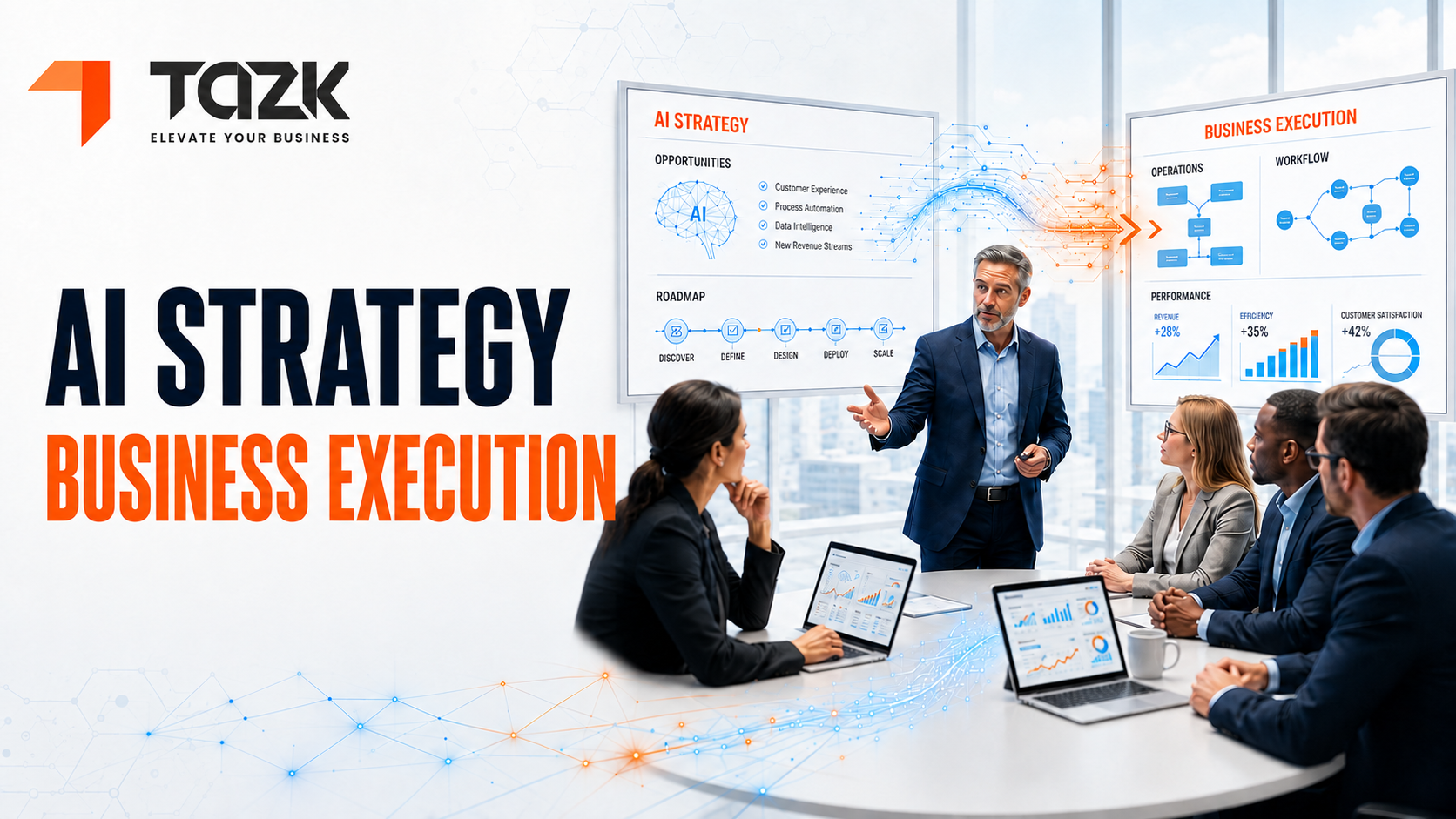
Table Of Contents
Social Media




How Can an AI Leadership Team Close the Gap Between AI Strategy and Business Execution?
Introduction
Most companies have an AI strategy on paper. Far fewer have artificial intelligence in business actually running inside daily operations. The gap between a well-written roadmap and real-world results is where most initiatives quietly stall.
This blog looks at why that gap exists and how an AI leadership team can close it - through disciplined AI implementation, strong AI governance, a realistic AI adoption strategy, and a mindset built for lasting AI transformation.
Why the Strategy-Execution Gap Exists
Boardrooms are full of AI ambition. Execution floors are full of AI friction. A few recurring reasons explain the disconnect:
- Strategy is written in isolation. Leadership teams design AI roadmaps without close input from the teams who will actually use the tools, so the plan looks great in a slide deck but does not map to real workflows.
- No clear owner for AI implementation. When accountability is spread across IT, data science, and business units without a single point of coordination, projects lose momentum after the pilot phase.
- Governance is treated as a compliance afterthought. Without early AI governance structures - covering data quality, model risk, and ethical use - pilots either get stuck in legal review or scale without proper controls, creating risk down the line.
- Adoption is assumed, not designed. Leaders often expect employees to embrace new tools simply because they exist, ignoring the training, incentives, and change management a real AI adoption strategy requires.

What an Effective AI Leadership Team Looks Like
Closing the gap starts with who is in the room. A capable AI leadership team typically blends four distinct roles, each accountable for a different part of the journey from idea to operating capability.
A business sponsor who owns the outcome, not just the technology. This person is measured on the business metric the initiative is meant to move, which keeps the conversation anchored to value rather than novelty.
A technical lead who understands the practical constraints of AI implementation - data readiness, integration effort, and model limitations. Their job is to keep the roadmap honest about what can actually be built with the data and systems the company has today.
A governance lead who builds and enforces AI governance policies before scale, not after an incident. This covers data access rules, model monitoring, and the audit trail that regulators and customers will eventually ask for.
Change management owners embedded in the business units, responsible for AI adoption strategy at the ground level. They are the ones who translate a corporate initiative into a change in how a specific team works on a Monday morning.
This cross-functional structure prevents the classic failure mode: a brilliant pilot that never becomes an enterprise capability because no one owned the path from experiment to production.
Turning Strategy into Execution: A Practical Framework
1. Start with Business Outcomes, Not Use Cases
Before selecting a model or a vendor, define the business metric that must move - cost per transaction, cycle time, customer retention. Artificial intelligence in business only creates value when it is tied to a measurable outcome leadership already cares about.
2. Build Governance into the Roadmap From Day One
AI governance should not be a gate at the end of a project; it should be a set of guardrails baked into the roadmap from the start - data access rules, model monitoring, human-in-the-loop checkpoints, and audit trails.
3. Sequence AI Implementation in Stages
Rather than attempting an enterprise-wide rollout, mature teams sequence AI implementation in three stages:
- Pilot - prove technical feasibility on a narrow, well-scoped problem.
- Scale - extend the solution across teams once data pipelines and governance controls are proven.
- Embed - integrate the capability into standard operating procedures so it survives leadership or vendor changes.
4. Design the AI Adoption Strategy Around People, Not Just Tools
An AI adoption strategy succeeds or fails based on trust. Employees need to understand what the tool does, what it does not do, and how their role changes. Training, transparent communication about job impact, and visible wins from early adopters all drive adoption far more reliably than a mandate from leadership.
5. Measure Progress as a Transformation, Not a Project
AI transformation is not a single initiative with a start and end date - it is an ongoing capability shift. Leadership teams that treat it this way build in recurring reviews of ROI, governance effectiveness, and adoption rates, adjusting the roadmap quarterly instead of locking it in annually.
Common Warning Signs the Gap Is Widening
- Pilots that never make it past a proof of concept
- Multiple teams building similar AI tools independently, with no shared governance
- Employees quietly avoiding AI tools because they do not trust the output
- Leadership discussing AI in strategic terms while frontline teams have no visibility into the roadmap
Recognizing these signs early gives an AI leadership team the chance to course-correct before the strategy loses credibility internally. Teams that want a starting point often begin with a single, well-scoped workflow - see how Tazk Agentic AI is designed to sit inside existing business operations rather than beside them.
Conclusion
Closing the gap between AI strategy and business execution is not about having a bigger budget or a flashier roadmap - it is about disciplined ownership. When an AI leadership team pairs a clear AI adoption strategy with strong AI governance, sequences AI implementation deliberately, and treats AI transformation as an ongoing capability rather than a project, artificial intelligence in business stops being a slide in a strategy deck and starts becoming a measurable part of how the company operates.
Frequently Asked Questions (FAQ)
Ready to move AI from strategy to execution?
Tazk Agentic AI works inside your existing business operations — automating decisions and workflows across POS, payroll, leads, and projects.
Free plan available. No credit card required. Go live in hours.