You've Already Paid for the Equipment — Now Stop Losing Track of It. A Practical Asset Management Guide for Indian Businesses
9 min read | By Lokesh

Table Of Contents
Social Media




Laptops issued to employees who left the company eighteen months ago. An air-conditioning unit that was scrapped last year but is still being insured and depreciated every quarter. A generator that moved from the Chennai warehouse to the Coimbatore site with no paperwork, and now shows up as "missing" whenever anyone actually looks for it. Most Indian SMBs are carrying some version of all three right now, and most have no systematic way of knowing it because the equipment was bought once, and nobody has looked at it since.
This guide covers exactly what that untracked equipment is costing you, why the problem gets worse rather than better as a business grows, and how a QR based asset tagging system fixes it typically within a week, not a quarter.

What a "Ghost Asset" Actually Is and Why It's More Common Than You Think
A ghost asset is any item still sitting on your books and still being depreciated and insured that no longer physically exists, has been scrapped, or cannot be located during a genuine physical check. This is not a rare accounting footnote. Industry verification data from Indian manufacturing and IT sector audits places ghost assets at 15% to 25% of the total recorded asset base in organisations that have never conducted a proper physical reconciliation. For a mid-sized business carrying ₹80 lakh in recorded fixed assets, that range represents ₹12–20 lakh in equipment the business is actively paying insurance and depreciation on that may not exist, may be broken beyond use, or may simply be sitting somewhere nobody has looked.
Ghost assets rarely originate from a single dramatic failure. They accumulate from years of incomplete disposal records an item is scrapped or sold but the disposal entry is never passed in the books, equipment moves between branches or departments without documentation, or a device is replaced under an AMC contract and the old unit's record is never updated to reflect it. None of these are dramatic events individually. Collectively, over a few years, they produce a fixed asset register that has stopped reflecting reality.
The Real Financial Cost of Not Tracking Your Equipment
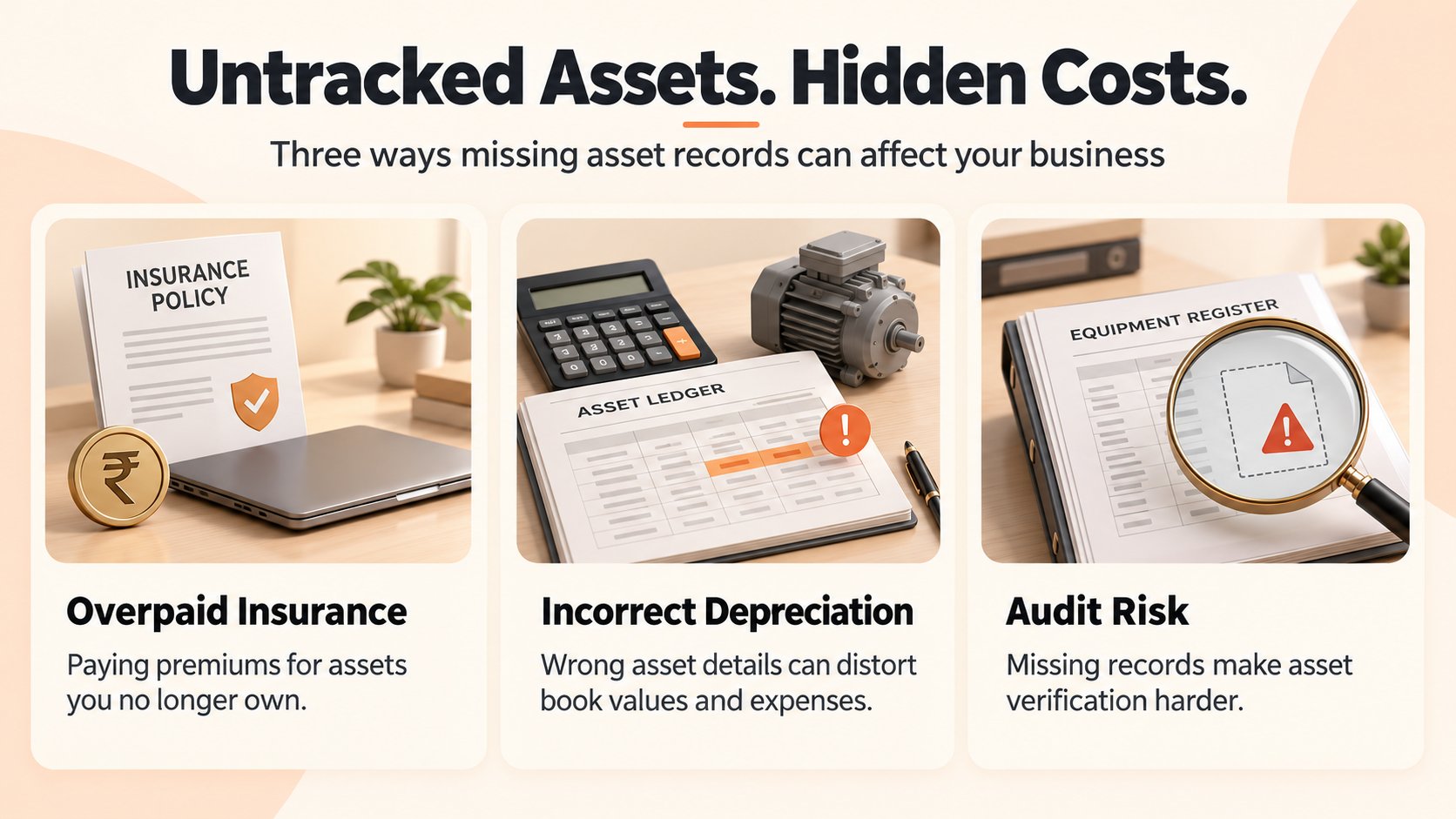
The cost of poor asset tracking shows up in three specific, measurable places, none of which appear as a single obvious line item on any financial statement — which is exactly why the problem persists undetected for years.
- Overpaid insurance and taxes: premiums and property taxes continue being paid on equipment that has been scrapped, sold, or lost, for as long as it remains on the books unnoticed.
- Inaccurate depreciation and profit reporting: a profit and loss statement reflecting depreciation charges against non-performing or non-existent assets is, by definition, misstating the business's actual financial position.
- Audit risk and qualified opinions: discrepancies discovered during a statutory audit between the fixed asset register and the physical asset count can result in a qualified audit opinion — a red flag that damages credibility with investors, lenders, and regulators alike.
CARO 2020: Why This Is Now an Explicit Audit Requirement, Not Just Good Practice
For companies subject to statutory audit in India, this is no longer a discretionary internal control question. Under CARO 2020 (Companies Auditor's Report Order), auditors are specifically required to report whether a company maintains proper records of Property, Plant and Equipment, and whether physical verification of those assets has been conducted at reasonable intervals. If discrepancies are found between the fixed asset register and the assets actually present, they must be explicitly disclosed in the audit report. A business that has never conducted a systematic physical verification against its books walks into its next statutory audit carrying real, disclosable risk regardless of how well-run the rest of its operations may be.
The three most common depreciation errors examiners encounter during verification are worth checking against your own records specifically depreciation continuing to be charged on ghost assets that no longer exist, incorrect useful life categories applied at the point an asset was first capitalised, and fully depreciated assets still in active daily use with no register note reflecting that reality. Each of these is, on its own, an audit observation waiting to surface at the least convenient moment.
Why Spreadsheet-Based Asset Tracking Breaks Down as You Grow
An Excel-based fixed asset register is genuinely acceptable for a very small operation with a handful of assets and a founder who personally remembers where everything is. It becomes structurally unreliable well before most businesses notice, because the failure mode is invisible until a physical count exposes it. Depreciation calculated manually invites transcription errors that compound every year. There is no record of which branch or department currently holds a given asset once it has moved more than once. And without a physical tag on the item itself, there is no way to link what's on the floor to what's in the spreadsheet — meaning the register and reality can drift apart for years without anyone noticing, until an audit, an insurance claim, or a simple misplaced laptop forces the question.
What Proper Asset Management Actually Requires
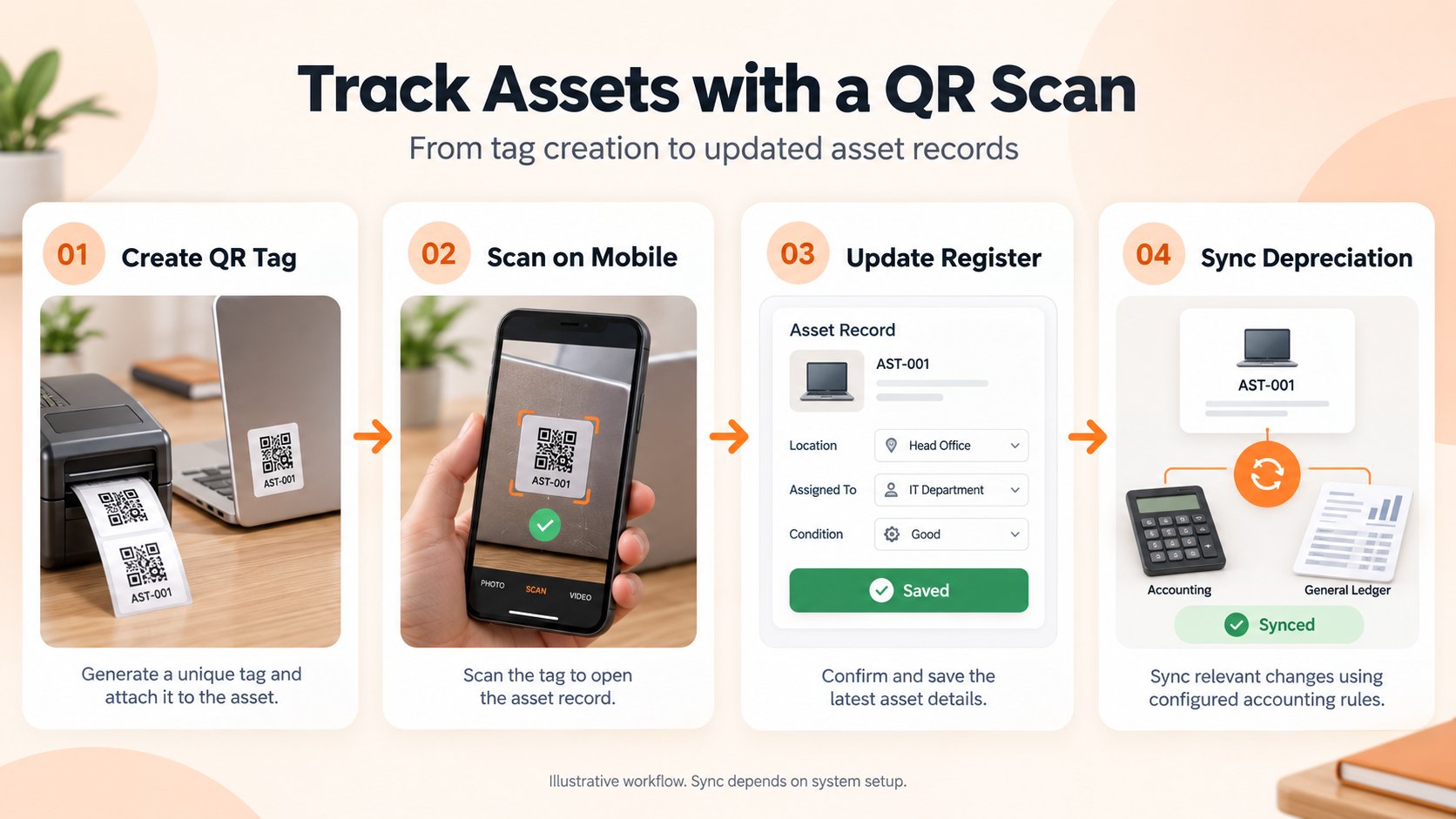
A functioning asset management system rests on four specific components working together, not a single spreadsheet update once a year. QR code, barcode, or RFID tagging gives every asset a unique physical identity linked to its digital record effectively an identity card for the equipment itself. QR codes have become the practical standard for most mid-market Indian businesses specifically because they are durable, hold more information than a barcode, and can be scanned with any mobile phone camera rather than requiring dedicated scanning hardware.
Beyond tagging, a complete system needs full lifecycle tracking — purchase, deployment, transfer, repair, and disposal — recorded as it happens rather than reconstructed later from memory. It needs automated depreciation that updates the moment an asset's status changes, rather than a manual recalculation exercise once a year. It needs structured AMC (Annual Maintenance Contract) tracking, so warranty and service coverage per asset is visible at a glance rather than buried in a folder of paper contracts. And it needs a straightforward mobile-scan workflow for periodic physical verification — CARO 2020 compliance in practice, not just in principle
How Tazk's Asset Management Module Solves This From One Screen
Tazk's asset management module generates a unique QR code for every registered asset, printable directly for physical tagging. Once tagged, any team member with the Tazk mobile app can scan an asset to instantly view its full history — purchase date, cost, current location, custodian, AMC status, and depreciation to date — without opening a spreadsheet or calling the accounts team.
Depreciation runs automatically against each asset's configured useful life and method, updating in real time as assets are transferred, repaired, or retired — so your fixed asset register reflects the current book value at any moment, not the value as of the last manual recalculation. AMC contracts are tracked per asset with renewal alerts, so a service contract never lapses unnoticed and you always know which equipment is still under warranty before authorising a repair spend. And because physical verification is a scan-based mobile workflow rather than a clipboard exercise, a periodic audit that once took weeks of manual cross-checking can be completed in days — with every discrepancy between the register and the floor flagged automatically rather than discovered by accident.
Looking Ahead: Where Asset Tracking Is Heading
QR-based tagging remains the practical standard for most Indian SMBs today because it requires no specialised hardware beyond a smartphone camera. RFID, which allows bulk scanning without direct line of sight and does not require each item to be individually located and pointed at, is becoming commercially viable for larger asset counts and high-value categories as tag and reader costs continue to fall — a shift already visible in large manufacturing and warehouse environments and gradually moving down toward the mid-market.
The more significant shift over the next few years is predictive maintenance built directly on top of AMC and repair-history data that a proper asset system is already capturing. Once a business has two or three years of structured repair and service history per asset, that data becomes genuinely useful for forecasting which equipment is approaching failure before it happens — flagging a generator or AC unit for proactive servicing based on its actual maintenance pattern, rather than waiting for a breakdown to force an unplanned, more expensive repair. Businesses building clean, structured asset and AMC records today are building the exact dataset this next generation of tools will need to work.
See Tazk Assets
QR tagging, AMC tracking, depreciation, and audits from one screen.